So, in spinning out of the Blackest Night mini's DC announced a brighter future and even have a series called "Brightest Day." But, to show that this is really just meaningless lip service and it's standard business as usual, Green Arrow has become even more violent, again eschewing trick arrows and using maiming and disfiguring shots. Remember the last time he did this, the book was actually labeled "For Mature Readers Only" and it started the downward spiral that lead to the character being killed off? The whole point of his resurrection and relaunch was to turn the clock back a bit to when the character was actually a viable superhero within the rest of the superhero community. What's next? Hal Jordan going nuts and massacring the whole GL Corps? Superman getting killed and replaced by four others? Hawk going nuts and getting enough power to kill off half the JSA?
Also, as part of this supposed focus on the heroes and brighter future, we have a new Titans book starring villains. First order of business, kill off the Ryan Choi Atom! Ok, I was a bit surprised that he hadn't died already since his book was canceled. And, once Ray Palmer started making appearances again... Still, of all the "new" One Year Later titles, his was the only one that had any legs to it, lasting for 25 issues. Part of what made it work was it didn't invalidate previous continuity nor build up the current character at the expense of the previous one. Of course, it is what ultimately doomed poor Ryan as the back door was always open for the return of Ray Palmer.
Meanwhile, the writer Eric Wallace defends the killing by talking about how much he likes the Ryan Choi Atom and what a great character he is. Just as Scott Beatty and Alex Ross talk about how much they love the Phantom character which obviously translates to not actually wanting to write the character as is but changing him. Geez, with friends like these...
Stories like this and James Robinson's JLA mini and ongoing book likewise built on a bunch of corpses are what are keeping me away from the majority of the titles by Marvel and DC. Even when they say they are going to focus more on the heroes and a "brighter day", their deeds show that it's all meaningless hype. It's an attempt to lure back lapsed readers, hoping that they won't notice that the majority of the line is still the exact same morose and dreary writing that drove them away the first time. If they really wanted to focus on producing brighter, more accessible and more heroic comics, they'd just do it.
Thought the recent promo of the new relaunched Avengers title was interesting in that the conversation between Wonder Man and Steve Rogers, if you substitute "Bendis" for the word "Avengers" and it pretty much sums up my feelings.
Iron Man 2: Saw the movie last night and I really enjoyed it. Sure, it's not a Tony Stark that I remember, but it doesn't seem out of kilter with the way the character has been portrayed in the comics in the recent past. I was happy to see Happy Hogan with significant screen time and actually doing stuff. His scenes are funny but they show that he has a heroism to him even if he's not of the same caliber as Iron Man or the Black Widow. The movie did a great job at really playing up Stark's intelligence and drive, even when he's not in the suit. At times it's unclear just how much of his personality as a egotistical shallow genius is really that or a show. There's one point after he really makes a complete jerk of himself that it's implied that he engineered the whole debacle so that Rhodey would steal the suit and become his replacement.
Only a few things bothered me in the movie. One, the armored threat. It seems to be the tact of the movies to make the hero and villains too much of the same cloth. He fought an armored villain the first movie, it would have been nice to see a different kind of threat. The Hulk movies went the same route, where the villains were just reflections of the hero.
I thought Hammer was too lightweight of a bad-guy as well. If not for Sam Rockwell's performance, he would have been a complete joke. I never felt that Stark or his business was ever in any actual danger from Hammer as he was completely shown up by Stark in every single situation. He was never a credible or serious threat, just an annoyance. In fact, Stark's enemy was really only himself and his own shortcomings and not Hammer. This backfires a bit as it distances Stark from us. It's a role reversal of the Doctor Doom and Reed Richards relationship in the first FF movie. Stark and Doom are the arrogant and more successful men and who come out on top continuously throughout the movie, their undoing more from the worse parts of their nature. The difference being that at the end of the day, we know Stark will redeem himself, while Doom will ultimately pay the price for his arrogance.
Census: I'm temporarily working for the census and it really amazes me the resistance and anger to it that I've been seeing in the field and online. How does the line go? I like individuals, it's people I can't stand. And, it's not in the places you'd expect. I am in a rural county, lots of nice subdivisions alongside mobile home parks and farms. The people in the nice homes, the ones that benefit the MOST from the information gathered are the ones that are the most resistant, rude or won't even answer their doors. The simple fact is that government is only a small part of who makes use of that data.
Unless you live in the woods in a house that you built yourself by chopping down the trees, dug your own well, have no power and grow all your own food, you benefit from the information gathered. A recent news story talked about how whites were moving from the suburbs into the city, guess where a lot of that type of statistical information comes from? When businesses look to locate, it's based on demographics gotten from the local governments. Your roads, emergency services as well as local services such as power, water, trash pickup, schools... all based on statistics gathered from the census and which drive the value of your property. The building you are living in exists because some builder made a decision based on local demographics, largely built from census info.
Ironically, by not filling out the census, it causes the government to spend MORE of taxpayers' money in trying to get that info, the going door-t0-door is the most expensive part. And, it only guarantees that someone is going to come to your front door, and keep coming to pester you. If you seriously have something to hide or don't want to be bothered, the smart thing to do was to actually mail it in and the government won't come snooping around your door trying to get or verify the information.
Thursday, May 13, 2010
Brightest Day?


Sunday, April 25, 2010
JSA: Unstick in time?
I'm a stickler for context. When dealing with established characters and stories, I'm all about context. It's the context that makes them matter. It's why I don't like it when DC or Marvel touts the latest character revival or ongoing and then pull a bait and switch, either by creating a totally new character making use of the name or powers and treating them as if they are the same or just radically altering the originals past the point of recognizability. It's a big reason why I don't like DC's take on the pulp heroes or the Red Circle heroes after all their talk about bringing them into continuity. So, it may come as a bit of surprise and seem hypocritical that I propose the following: take the JSA out of WWII. Or, rather, take WWII out of the JSA.
This would solve so many problems that are inherent with the JSA and modern continuity. Plus, it's not as hypocritical as it seems. In the 1940s, the owners of National and All-American didn't think the readers wanted to read about the War, so for the most part the stories didn't center or involve the War. Incidentally, this tactic is about the exact opposite taken at every other comic company at the time. What this means is that unlike Captain America and the Shield, the War plays little part in the original history of the JSA. In fact, it doesn't really play a major part in their history until Roy Thomas' excellent All-Star Squadron.
Where the context of the JSA matters is that they are the older heroes compared to the JLA. They don't need WWII for that. If the current heroic age is about ten years long, then the JSA should be permanently be around 15 - 20 years before that, about the same relationship they shared when the JLA and JSA first met. Just as the main DCU is in an eternal now, the JSA's prime should then be in an eternal now minus a decade or two. Since the original JSA stories didn't center around WWII, this means that very little apart from Roy Thomas' All-Star Squadron books need to be thrown out. They still fought their big villains Brainwave, Icicle, Vandal Savage, Per Degaton, Solomon Grundy, Psycho Pirate, etc. It solves a host of other problems.
- Wildcat's secret identity is that of a celebrity and most of his solo stories center around that but don't address why no one is surprised that he looks half his age. Now, as Ted Grant, he'd be expecting to look middle-aged.
- Likewise, the JSA's spouses now don't need to look several decades older than their husbands.
- Infiniti Inc. As the eternal now progresses, the Infinitors stay the relatively same age as the original Teen Titans meaning that the JSA had to have children later and later in life. This allows them to have had their children in their mid- to late-thirties as opposed to well into their senior citizen years.
- Wonder Woman can be made into a member of the JSA again. She served with them, possibly Steve Trevor died. Regardless, she retires to Paradise Island and raises/trains Donna Troy and Fury. Returns to help the JLA no older than before.
- A little time manipulation/time travel and we only have to have ONE Black Canary again.
- Don't need as many "legacy" heroes as the originals are hardly senior citizens. Johnny Thunder, Dr. Mid-nite, Dr. Fate, Sandman, Starman and the Atom can return to active duty without a problem (after un-killing them)
- Green Arrow & Speedy served with the Seven Soldiers... wait, what does that have to do with the JSA? Well, along with the JSA, I'd unhook the Seven Soldiers of Victory (and almost every character that made up the GA DC) as well. They'd still get thrown through time and rescued by the JLA & JSA. But, by making Green Arrow being only from a few years and not several decades earlier, it doesn't make him quite the man out of time with a complicated back-story while the rescue sets him up as still being the same age as the JLA and leaves the JSA as the team with the most experience.
In the end, I think this one retcon would allow the undoing and uncomplicating a host of other retcons from over the years. It would allow the original JSA be the JSA again as you don't need countless explanations and legacy heroes to make up the team (though it does mean undoing some senseless deaths along the way). And, they'd still serve as the previous generation's team of heroes and inspiration to the modern heroes which is the important context they provide.
Green Hornet Year One #2: This continues the separate paths that opened the eyes of Kato and Britt Reid to the injustices of the world while also depicting the events that lead them to have the persona of Green Hornet be of a rival gangster. There's a lot of wonderful layering of the story as we see the idealism of justice of young Britt being challenged by the face of real violence and brutality just as Kato sees the difference between the honor of the ideals of martial skills and the way of the samurai against the backdrop of the horrors and modern warfare. There's real meat to this story, providing in depth characterization and motivations of all of the characters.
Doc Savage #1: The Doc story wasn't all bad. Most of the bad notes were dictated by the First Wave "bible" ie Renny being the ugly one, the total mix-match of science and technology (Monk is talking about quantum physics, but Doc flies a blimp from Africa?). None of the aides look quite right, Ham looks too vintage in manner of dress as opposed to best dressed, Long Tom has brown hair and looks fairly normal, and the torn shirt seems to be treated as Doc's uniform as he never bothers to change to a fresh shirt. The plot and storytelling seem fairly solid though, a very pulpish threat and beginning and introduces the individual characters quite well. If DC had lead with this instead of a mini-series whose second issue hasn't come out yet. How is a mini-series late by issue 2? Throw out everything dictated by the First Wave bible, and you'd have a solid Doc Savage adventure story that doesn't really contradict much of the Doc canon.
The Avenger was worse than I even thought it would be based on reading prior reviews. Other than the character names, the story and art completely miss the boat on the character. It has less in common with the source material than the FF and X-Men movies did with the comics. Honestly, it takes deliberate work to depart that far from the source material without just creating a whole new character by the same name. It left such a sour taste in my mouth, that when The Spirit relaunch from the First Wave imprint showed up in my bag, I returned it and told the store owner no more First Wave books. Instead of being a built in buyer, they made me decide to actively avoid the whole line.
Leonard McCoy: Frontier Doctor #1: John Byrne's work on the Star Trek and Angel related projects play to his strengths as a storyteller. His best stories tended to be the more science fiction and horror ones, even when doing superheroes such as the Fantastic Four and Alpha Flight. His art has changed, grown far more organic in its depictions. He has a wider range of body types and faces, but his figure work has also become a bit looser and less iconic looking. With his books for Angel, he explores the genre of horror that did so well with the overlooked Blood of the Demon. With the first issue of "Frontier Doctor" we get those exploration sci-fi stories that he did with the FF so well. The first issue is a stand-alone that takes place some time in between the original series and the first motion picture. It's a slightly older McCoy (and Kirk) doing medical work in the vast reaches of space. The story has a feel of one that could easily take place in the original series, provided they had the budget and ability to do the fx. The only discordant note of the whole thing is when the nature of using computer technologies to produce the inks and colors shows its hand ie, you see the computer enhanced backdrops in some scenes that throws you out of the narrative due to their obviousness.
Other natter:
Probably the funniest thing coming out of the new Rawhide Kid mini is that in an interview, Zimmerman references Blaze of Glory and then talks about how the new mini is an homage to The Magnificent Seven indicating he doesn't realize that whole point of Blaze of Glory was to rip off that classic Western. Can count on Zimmerman trying to write Rawhide Kid as being more stereotypical gay than Jack of Will & Grace not being nearly as humorous.
Monday, April 12, 2010
JSA, Lorne, Black Terror & More

Angel Special: Lorne: Actor Andrew Hallett, who played the other-dimensional demon and karaoke bar owner Lorne from the television series Angel, died 2 years ago from congestive heart failure at the age of 32. John Byrne wrote, drew and inked this special book that serves as a tribute to the actor and his beloved character with proceeds going to charity. In addition to the comic story are photos of Hallett in and out of the make-up as well as a tribute by Hallett's friend and co-star Mark Lutz. Lutz' character, the Groosalugg likewise figures prominently in this tale.
Byrne tells a story that fits in well with the tone and continuity of the television series while also including things that wouldn't translate as well to live action on the small screen (and budget) such as a large flying dragon, huge monsters and ancient nigh omnipotent beings as designed by Byrne. It's a story of fate and sacrifice that while Lorne faces a personal crisis, a threat arises that he alone is specially suited for. In the days of epics that span dozens of issues and hundreds of pages, it's a tight little tale and a fitting tribute.
Byrne has a knack for drawing supernatural and horror stories, and he has found a good synthesis with his Angel projects that allow him to draw the fantastic alongside the every day. The opening scene of Fred walking down the street and getting attacked by vampires is beautiful stuff. If there's a weakness, it's in the likenesses. Angel and Lorne look reasonably close to their screen counterparts, but Fred and Groo look a bit more generic than specifically as Amy Acker and Mark Lutz. Astro City: The Dark Age Book Four #3: I'd love to John Byrne do a special issue or two of Busiek's Astro City, tackling some of the strange and yet identifiably iconic characters created in the comic. Especially given Byrne's talent at distinctive architecture. Not a slam against Brett Anderson at all, as he does a fantastic job. Most artists excel either at the everyday and mundane stuff but couldn't really pull off a cosmic Kirby sky-god or then switch gears and have vampires and giant bugs and have it all look like it belongs existing side by side.
The story continues as the Williams brothers continue their denigration into what they hate as they pursue the man responsible for the death of their parents. Such as their disdain for heroes in general and the Silver Agent in particular because of the innocent bystanders caught in middle of the battles like them and their parents. Yet, when they are given the choice to help the victims or pursue their foe, they chose the latter. "Another line crossed."
As this tale has possibly drawn out a little too long, the constant influx of new characters and designs of heroes and villains grabs my interest. In this case it's the deadly Pale Horseman who goes after and executes all criminals no matter how petty their crimes, reflecting the time of the grim and gritty comics and the darker and more violent heroes. Black Terror #9: Probably the best issue of the series so far. One, it's a story that is self-contained, done in one. Two, it is finally moving a bit of telling stories whose plots are dictated by events of Project Superpowers (such as his rescuing Tim in the mini, and the setting free and avenging of the American Crusader that kicked off the ongoing). Lastly, it's a real story with believable motivations and logical extrapolation of character. Such as seeing Mystico looking like a mummy as opposed to a man in a suit. At least here it acknowledges it's not the way he normally looked and gives a logical reason for it in the same book. It's not the way I would have handled the character, but it's a logical take. Just as the character's darkening which is all too prevalent in the Superpowers books is handled completely in this one book as it's about both his fall and redemption.
I disagree with the set-up, that an innocent bystander is killed when the Black Terror tackles a bank robbery and a bullet ricochet's off his chest. It's introducing something that would happen in the real world, but it doesn't really follow through with it. It's such an occurrence that sparked Marvel's Civil War (admittedly on a bigger scale), that superheroes act without oversight and controls. As the story isn't about the role of the vigilante and the problems of vigilantism vs legally appointed cops, that set-up needs to be tweaked so that the Black Terror is not even indirectly responsible for the girl's death other than in his own mind and sense of responsibility. That he apparently easily dismisses the concern and sees himself as the hero makes him seem even more dangerous as an individual NOT more heroic.
Another disagreement stems from the the whole pirate motif. This story at least starts off by seeing that the Terror's other path was one of a healer of sorts, one that helped cure people's ills and showing him what the path not taken could have been. But, it ends reinforcing that his costume & character do not reflect his medical background but the pirate connotations.
This goes hand in hand with something I raised in the Torch mini-series by Marvel. Part of the problem is that nine issues in, and we still have a character who hasn't taken one step at setting up a life outside of being the Black Terror. He takes a taxi but we haven't seen any indication that he does anything that would earn him any money. Where does he live? What does he do on his down time? The scene of him seeing what life could have been is about the closest we've gotten to really seeing the man behind the mask since he became the Black Terror, that he might have other dreams and desires. We need to see Benton have a life outside of the Black Terror because it gives his role and actions context and ramifications. It adds a personal dimension and personal sacrifice to being the hero.
Dragon Age #1: I got this for two reasons. The first being that I would like to see a good fantasy comic. It's interesting that everything comics do so well, yet I've not seen a really good "Lord of the Rings" type fantasy. The second, and main reason, was that Orson Scott Card's name is attached as co-writer.
Card has written a few comics, but he's known mostly for his science fiction (and some horror and fantasy as well). I've taken a writing class under him and enjoy his reviews and commentary printed in The Rhinoceros Times. This makes an interesting counterpoint to the comic as he comes across as being pretty definitive of what he likes and dislikes, especially in fantasy. He's not a fan of much fantasy that seeks to follow the Tolkien model (not to say that he dislikes Tolkien, just that most that follow it are not very original or thought out).
Yet, this is a very, very bad comic. There's a decent story in the core concept: a man and a woman find themselves in a Romeo-Juliet relationship ie they are in love but are of factions that are mortal enemies, in this case Templar Knights and Magi. When word gets out that she's pregnant, the Templars order her death. It's a mission he is willing to carry out as he mistakenly thinks she has been with someone else. And, by the issue's end, he's killed her and presumably their daughter is the main character in the following issues.
The storytelling is what kills it. First the manga influenced artwork does a miserable job at telling the story and getting across the action of key scenes. Such as when the would be Templar sees his girlfriend being comforted by a friend and mistakes it for something more intimate, he is unrecognizable. He could be any other character. A lot of stuff goes unexplained that don't make sense but play important roles in the way the world works. As this is something Card frequently harps upon, it's hard to believe that his name could be attached that makes such fundamental errors. We don't know exactly why the two factions hate each other though it seems to be religious based. We know the Magi and Templars hate each other, but we don't know how their world works. We don't know who is actually in control, that makes the laws, that the people follow. We don't know what gives the Templars their authority to hunt and kill Mages nor do we know exactly what offenses lead to a death sentence. Nor do we know why the two "towers" that train the Templars and Magi would exist so close together, in the very same town it appears, if they hate each other to the point of willfully killing each other. We don't see these characters or the two factions in context of the world they inhabit, so the conflict comes across as being baseless and ludicrous.
Dragon Age is first a video game; some of those details may be found there. But, the story gives only an extremely shallow feel of the basic concepts. Card knows better. He knows that most Fantasy stories are partially a milieu story ie one of world-building and exploration.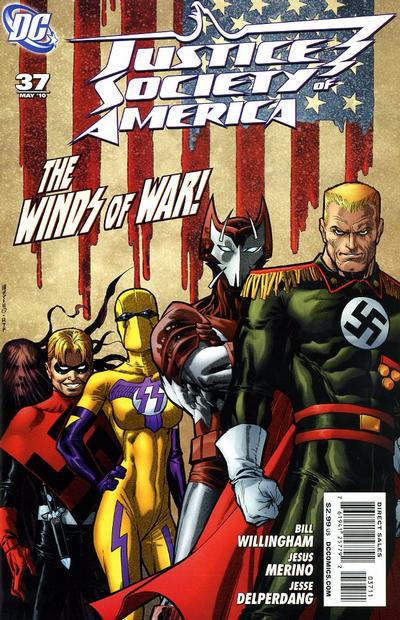 Justice Society of America #37: Twenty years in the future, Mr. Terrific relates the battle of the JSA against the Fourth Reich and how just when victory seemed to be in their grasp, they lost it all. What is unrevealed is exactly how that led to the fall of ALL superheroes, especially as the majority of the villains don't come across as that big of threats. We see Lightning and Mr. America enter the battle but it's Lightning is the one who we see take down an impressive foe with ease. The story then transitions to what the older, depowered and captured heroes are up to and hints at their big plan to set the world aright.
The story comes across as a good old-fashioned piece of fun and fluff. I couldn't help but think of the classic "Days of Future-Past" that told a similar story of older heroes facing extermination try to undo the events in their past/our present that set the world on that particularly dark course. So far, this story doesn't threaten to usurp that one in classic status as that story so easily gave so many iconic yet tragic and bittersweet moments and scenes such as the final charge against the Sentinels. But, the story succeeds in entertaining and providing some good superhero throw-downs with twists along the way even while the reader knows the pre-ordained conclusions. Of course part of that is probably due to the fact it's a title that doesn't require reading a host of other books to understand what's going on, there's not rampant death just to increase body counts or make the books seem more serious and edgy ala Robinson's Cry for Justice and Justice League.
Mr. America's place on this team continues to be a bit of an enigma as he doesn't add one iota of presence. Of the young guns, he should be the one that comes across more strongly and with a certain amount of experience and world-view. He has had formal training and presumably faced some very bad guys as part of the FBI, he already was a professional crime-fighter. He dresses the part of Captain America, but he remains a complete cypher and rank rookie. A bit of that is because it has the same shortcomings listed in the Black Terror book ie there's no real sense of who these characters are outside of the team. A little of that is forgiven in a team book as the focus of characters has to rotate through the larger cast. When you have a book like the traditional JLA, the job is made easier as many characters have their own books and there can be more focus on the secondary characters in terms of subplots and characterizations. Heck, it's part of the reasoning behind having B and C listers joining the teams to begin with. It allows for character growth and subplots without worrying about the events in the solo books.
Kid Karneval is taken out with one punch after a lot of build-up. The rest of the Reich is identified as if they had been seen before this storyline but most of them are just place-holders, we aren't told anything about them (especially as half are based on characters from MLJ and thus have no prior context or continuity to the DCU). In fact, the Fourth Reich is the weakest part of the story. As a group, they aren't threatening, their powers and abilities are not defined. Nor do we see an actual face to this new Reich, who is behind it all. On one side, the story is Mr. Terrific's story, we see it through his eyes. He personalizes the superhero side. We don't really have his opposite number though. We don't know who the villain is that set all of this up, that put together this team (or, how other than being a psychopath, the Kid fits in with the group ideologically). It needs a Red Skull/Zemo/Baron Strucker to stand on the opposite end and serve as the focal point, to be the villain whose plans and desires are the motivating forces for the story, to embody the opposite side. Especially since this is NOT really a story about the evils of Nazism. The villains are Nazis, but that's short-hand here for them wanting to conquer the world, it's not about heroes fighting Nazis per-se. It could be any world conquering type with some super-powered joes at his disposal. Thus the importance of providing the story with a character that embodies what the conflict is about, especially this far in to the story.
Project Superpowers Chapter Two #8: To bring down the mad god Zeus, the heroes that have been at odd purposes combine forces, those that serve the President and through him the Supremacy and those that have set themselves up as bringing down that group and restoring America to the people through creating seeming anarchy. The plan doesn't seem to go very well as characters with their false allegiances are found out or on the cusp of being found out.
There's some great scenes artwise. Salazar's art is steadily improving in quality and clarity in storytelling. I don't know if Ross and Krueger are deliberately aiming for meta-textual commentary, but the revelation by the Green Lama that the heroes of the urn have achieved a near mythic status and possibly may not be able to die could easily be taken as a commentary on the status of the heroes of the 1940s. Due to their public domain status several of them have popped up at various companies and in different incarnations, especially in the last couple of years. Of course other meta-textual concerns pop up across the book such as the pairing of the heroes of Big Shot comics together. It's not a bad idea per se, but no story-logic is given. They have a task to accomplish, some vision to construct a mysterious object that will help defeat Zeus. Which makes a little sense with Marvelo who is a magic hero and Skyman who is a technological/inventive genius. But, the inclusion of the Face doesn't really follow. Likewise we have Lady Satan, the Woman in Red and Masquerade nee Miss Masque are grouped solely because they are women and the use of the color red.1 Or the joining of all the Ace heroes into one group. It's a little cutesy nod to the characters' histories but without providing real story context.
________________________________________
1 Of course, there is a history of the use of the color of red and women in literature and culture. First, it signaled women of a loose sexual nature. By the thirties, there was a pulp called the Scarlet Adventuress signaling by that time the pairing didn't necessarily mean of a sexual nature, but women who didn't conform to the traditionally gender defined standards, mores and roles.

|
