Green Hornet Remastered: There are really only two things to recommend for these books. One, the wonderful covers by Joe Rubinstein that capture the Green Hornet in the middle of a dangerous situation. However, the Hornet is rendered with a simple domino mask and not the gangster style mask that covered the lower half of his face that he wears inside the comic. It also shows off just how minor of a character Kato was at the time, barely appearing in the majority of the stories. There's no doubt that the hero and star of the book is the Green Hornet. Otherwise, these stories are painfully dull and the artwork is either heavily damaged during the remastering stage or/and is really on the low end, even for GA standards. And, this is coming from someone that is generally a fan of the comics from this time. Stick to the radio shows and serials to get exciting adventures of the Green Hornet of this time.
Green Hornet: Year One #7: Not sure how long this comic is going to last and continue being called "Year One." The last issue brought together all of the various threads and backstory of how Kato and Britt Reid would find themselves coming together to fight crime as masked men and how it would result in them being thought of as rival mobsters. This issue picks up on that status quo and continues the story, but it no longer has that feeling of an extended origin tale of neophyte characters. The only change in creative staff seems to be the colorist, the new one going for more traditional color palettes. It's still a good comic, full of atmosphere and mood and feels like an honest attempt at being faithful and true to the source material while being readable by modern audiences. It feels authentic and should have DC kicking themselves for not doing something similar with the Crimson Avenger.
Hellboy: The Sleeping and the Dead #1 of 2: Written by Mike Mignola and painted by Scott Hampton, this is a beautiful little comic. Like most of Mignola's writing, it is basic and bare in the plotting and storytelling, going for creepiness, mood and the visceral experience. Hampton's artwork with Dave Stewart's colors elevate it into something that's darkly beautiful and romantic, like an old Southern mansion falling into disrepair.
Justice Society #45 and 46: If there was a book that screamed it was the right time to stop getting regular monthlies, this title is it. When the day comes that the Justice Society is so bad that I want to stop getting it as a mercy killing, then the comic companies really have passed me by. This comic isn't merely bad but just plain stupid.
It was bad enough suffering looking at pictures of the Captain America movie and reading posts by fans about how faithful and accurate it is, but then I open up #45 and see The Flash and Green Lantern on some secret mission, dressed in military versions of their costumes, complete with grenades and various packets and straps. Words fail me in just how wrong minded this is. Then, the whole mission is a black-ops one, sent to destroy a secret weapon which turns out to be a baby. Why would you send two (and only two) JSA members on a mission like this?
Then, we have the writer telling us that Drachen (the name of the Nazi project) means "Scythe", the name of the super powered terrorist. Of course, Drachen doesn't mean that at all. It means Dragon, kite and even a vixen or harpy.
We're also asked to believe that a politician from the 1950s still holds office some sixty years later. Impossible? No. But, highly improbable and like everything else in the book, it shows the hand of the writer demanding things to be so for the sake of the story he's writing with little logical extrapolation.
We also have over the course of two issues, three instances by different characters using the term "gallows humor". When a unique phrase gets used that often in so little space and by different characters, it sticks out. Again, it shows the writer behind the scenes as it becomes obvious that the dialogue by different characters are coming from one mind.
We get an appearance by Superman and Blue Devil which is fine. But, there are a whole lot of JSA'ers and hanger-ons that would be better served. Then again, interviews have indicated that Blue Devil is going to be a member for some bizarre reason. Because, there aren't enough JSA and Golden-age related characters that could be used or team members we haven't seen.
Obsidian gets all violent and dark. Again.
Dr. Mid-nite finally gets called in for a consultation on Alan Scott's condition. He claims it's taking too much energy to just keep the Starheart in check for him to heal despite his being an energy being he only sustains physical injury because he thinks of himself as human. Thus, if he's conscious and able to think at all, then his body should become normal without actually having to "heal". And, if it takes that level of concentration, then what the heck is he doing fighting crime when a slip in concentration could cost lives or letting loose the Starheart? What happens when he falls asleep? And, where does he get the power then to build himself a godawful new costume AND GROW HAIR as we've seen in previews?
In both issues and one coming up, Dr. Mid-nite is said to have "ultra-SONIC lenses". What the heck are those and what do they do? Make his eyes able to hear? Allows him to SEE sounds that people cannot hear? Apparently this comes from the Matt Wagner mini that introduced the character, as I've never read it. Just seeing in the dark and outside of the normal vision range just not good enough I guess. It's something best left forgotten unless we are actually going to see him use said "ultrasonic lenses". Otherwise, it just comes off as sounding stupid when thrown out with nothing to back it up or explain it as in these issues.
I'm not a fan of Kolins artwork, generally the opposite. To give credit where it's due, other than the military styled Flash and Green Lantern (and GL's upcoming new "costume"), the artwork has been good and easily the best thing regarding the book. But, I miss the days of the real JSA when it wasn't a team of legacies, but the original heroes.
Project Superpowers: X-mas Carol: This book is merely "meh". It gives us an origin and background of the villain known as the Clown and updates him for the modern age with powers of his own by him taking over the body of a clone of his foe, the hero Magno. It started off strong with a flashback sequence of the Clown before he became the masked villain with his girlfriend, giving him some sympathetic background juxtaposed against scenes with a mother and son Christmas shopping in the modern day as well as the American Spirit propheting that someone was about to make the ultimate sacrifice for their country. But these scenes ultimately go nowhere, serving as little teases to completely different type of tale, one of impending tragedy and sadness. Part of this is because the book is constrained by the fact that it is to follow the construction of Dicken's A Christmas Carol so we have the Clown visited by the ghost of a past associate and then heroic ghosts of the Superpowers line: The Fighting Yank, the Ghost and American Spirit. Each tries to capture the Ghost and relating events from the past, present and a possible future. But, it only has a few pages to devote to each hero. It then ends on ambiguous ground as we are not sure if the Clown has undergone any kind of spiritual transformation in relation to his physical one or not. We aren't sure if we are to take anything from this tale, if there's anything to take. It might be a foreshadowing of upcoming plots, that the Clown may betray the Supremacy and thus avert the disaster that the American Spirit shows him. Or the Clown may bring about that very future. There's nothing in the ending to really grab hold of, to see a reason as to why to read this story. We understand a little more about the background of the Clown but it's all upset by the non-descript ending, it cannot be applied to the future. It becomes a tale that's unfinished all the way around, imparting little knowledge, truth or emotion.
Spider-Girl #2: Tying the JSA of a book being not merely bad but incredibly dumb. Part of it is the simple fact that it's merely the second issue and yet managed to go so wrong so quickly in so many different directions. Part of last issue's biggest disconnect was the idea that a father would let his teen-age daughter with no powers go out and fight crime. This was a big source of conflict between Mayday and her parents in the DeFalco series, resulting in her just doing it anyway, and she had powers. Arana doesn't have anything other than good training. This is compounded by that Sue Richards, adult and mother, also supports and aids her in these actions. Well, we don't have to worry about that because the writer decided to go for that standard cliche and kill off the girl's father. And, then spend the whole issue of the character dealing with it. I could see this being done somewhere down the road, it's a big cliche but it does up-end the status quo and gives a change-of-pace story. BUT IN THE SECOND ISSUE? And, it's not a villain she can take on, but the Red Hulk. So we have a story where the character is not only sad and depressed for the whole issue but completely ineffectual. Again, this might be fine later, but it hardly makes me want to read more about this character. She comes across useless, her book is depressing, and now two issues in, there's no status quo or regular supporting cast and relationships to draw me back to.
This issue at least shows that the line she swings by is some grappling line although where she keeps it and the mechanisms that control it is a complete mystery. I guess it's in the same place where she manages to find coins to buy newspapers to fling in the Red Hulk's face.
More bad writing: there's zero introduction of just who or what the Red Hulk is. My brother's first question was, "why is the Hulk red?" I could answer a little of it as I keep up with some of the general goings on in the Marvel U, but there is zero in the story to tell us anything about the character, that it's not even the real Hulk just in different Christmas colors. Remember, every issue is someone's first exposure to the characters. Why should I, reading a Spider-man family book, be expected to know what's going on in the Hulk books?
The book tops the JSA with writing characters with the same voice with this bit of dialogue.
Johnny Storm: Did he seem...crazy to you? He's never talked like that before. Let's find him and find out.
Reed Richards: It was...strange. Let's find him and find out."
In the same panel, we have the world's smartest man and leader of the FF simply repeating verbatim what a high school graduate just said, proposing the same action as if it was his idea. My guess for the future death in the FF, Johnny kills Reed for constantly undercutting him like this. Or Reed is already dead and they are hiding it from the world by using a robot.
We are lead to believe her father was this respected journalist and the go-to press-guy for the celebrity heroes the Fantastic Four, yet his funeral is practically empty, the FF don't even show up. His daughter wears plain clothes but not black and her friends wear nice colorful clothes. Instead of a powerful scene, all I can think is "this is supposed to be a funeral?" Bad, bad storytelling.
Thunderstrike #2: At least this title has a teenager acting like a teenager, albeit a surly petulant one, and parents acting and reacting in ways that seem like real human beings and parents would. And, with DeFalco and Frenz at the helm, there's lots of superhero action. If we cannot have the real Spider-Girl or even the real Thunderstrike, this fills the gap nicely.
Victorian Undead: Sherlock Holmes vs. Dracula #3 of 5: The story shifts a bit from how I remember the Dracula story going as Mina has died and one of Lucy's suitors has become a betrayer, thus we are no longer following Stoker's script even discounting Holmes' involvement. It sets things up as the conclusion no longer being pre-ordained. Despite that, it's a fun book, pitting the world's greatest sleuth against one of its biggest villains.
Warlord of Mars #3: A switch-up in artists. The new guy draws Carter as being a little too muscle bound for my taste and doesn't have quite the same texture to his pencils but he does a great job at drawing an alien city. In this day and age, I don't think it's too much to ask that an artist be able to draw faces differently, so that the only way to tell the green-skinned martians apart is whether they have both tusks or not. The series seems intent on having them all drawn as four-armed Hulks as opposed to the more lanky, almost skeletal proportions they are generally shown as. These are small complaints though as overall the book has looked very good and it's going to be hard for anyone to really top what Gil Kane and John Buscema could do with sci-fi/fantasy sword fighters.
Tuesday, January 18, 2011
Hornets, Spiders, and Vampires, oh my.


Wednesday, October 06, 2010
Todays Comics Looking to the Past
 Since I probably won't be getting any new comics this week and I've not talked about comics in a little while, here's my chance to plug away.
Captain America: The Patriot: Two issues have come out and I'm conflicted on the book. General consensus on the web seems to be as well. Most seem to praise the artwork over the writing (I guess because Kesel is not Brubaker) whereas I'm a bit the other way around. Kesel does seem to be writing Brubaker-lite, but I think he does an admirable job at writing the history of a man whose history is generally known. He succeeds in doing so without actually changing known facts and keeping the focus and point of view on Jeff Mace and his view of things. The art is passable in most places and is in keeping in toning down the gosh-wow factor of superheroes and their costumes that passes for good superhero art these days as half the artists seem embarrassed at drawing superheroes.
The second issue is where it really begins to falter. The problem is that while it is telling a good character-centric story and makes Jeff Mace seem like a decent and likable lunkhead, it and the art never get across why the characters are cool characters. The highlight of the whole issue is when he gets fed up with Namor's snarkiness and attitude and punches him. There you see his passion. Otherwise, as soon as Mace puts on the Captain America costume he becomes a second-rate hero in his own book. Every story of the fill-in Captain Americas center around why they were bad Captain Americas. As this is his chance to shine, it would be nice that the focus went the other way, why he was such a good choice for Captain America. Maybe the best choice for the time period. There are little bits where he shines such as the afore-mentioned conflict with Namor, but otherwise it is more about his shortcomings.
Other little things that bug me, Kesel seems to forget that the Bucky he's writing is not the original Bucky, at least in the way he writes him. Bucky comes off as a better fighter and hero and constantly berating Patriot-Cap, even though Patriot would have been a superhero for much longer. And, this Bucky has only been Bucky for just a couple of months longer than Jeff has been Cap, so it seems especially strange for Bucky to constantly be talking and acting as if he has so much more experience.
Kesel also uses the term "blue ticketed" to explain the discharge of a friend of the Patriot's and his subsequent suicide and why Jeff cannot appear as Captain America at the guy's funeral. It is also used to explain why Jeff would never become the Patriot again as his appearance and impassioned speech at his friend's funeral in the guise of the Patriot would make that identity a pariah. However, what Kesel doesn't do is explain what "blue ticketed" actually meant. He gives us the effect, but the closest he gets to the cause is the Whizzer asking if his buddy had a girlfriend. A Blue Ticket discharge was a way to get undesirables ie blacks and homosexuals out of the service without it actually being a formal dishonorable discharge and such a discharge haunted the men back in civilian life. Sure, we don't want clunky exposition, but it could have been handled a little better.
One of the pleasures was seeing the focus on Miss Patriot in this series. Appearing only once in the Golden-Age, here and her identity as a fellow co-reporter of Jeff Mace's she plays a central role. From the start of the second issue, we get the hints of bad things to come, that is if you know the history of Captain America and Bucky. After WWII, there was an explosion of good-girl art and characters. Most of them were jungle queens, but Timely/Atlas/Marvel explored shapely female heroines along the lines of Sun Girl and Golden Girl. Thinking that Captain America might do better with an adult female sidekick, Bucky is shot by a lady criminal called Lady Lavender and Cap recruits the help of Golden Girl who is Betty Ross, a long recurring character and possible romantic interest in the Golden-age Captain America tales.
That's a lot of threads being tied together in this one comic. We see Mary/Miss Patriot several times with a mention of her Lavender perfume each time. One discussion even centers around Jeff accusing her of hoping that Bucky is shot so that she could become his partner. Then you factor in that Jeff is generally oblivious of her romantic feelings for him and that he pretty much ruins her career as Miss Patriot when he destroys the Patriot's reputation. Mary's path is obviously becoming a sad tragic one. And, when Bucky is shot at the end of the issue with the smell of lavender in the air, Cap will get a future female partner but it will not be Mary. What we don't really get is the feeling that Mary has gone over the edge. We see her as being sad, but we don't actually see the bitterness. You feel sorry for her but don't see that final step or sign that she has gone over the edge, it's a huge gap in the portrayal of her characterization. It might be Kesel just trying to be coy for just a little too long, or a sign that she's not really the villainess (after all other women probably wear the same perfume). Either way, it's obviously going to be a story that doesn't end well for Jeff or Mary.
DC Universe Legacies #5: I had sworn off this book, didn't get issue four because the writing had so many holes and internal discrepancies in it that it was a chore to read to try to figure out exactly what the point of it was. However, issue five shows this book's perspective of Crisis on Infinite Earth's and with it, the wonderful George Perez doing what he does best: drawing scores of superheroes on model in big battle scenes. Not only that, we get an appearance by one of my favorite wonky silver-age characters Ultra, the Multi-Alien, who was left out of the original mega-mini. Couple that with a great little back-up with art by Walt Simonson teaming up Space Ranger, Adam Strange, Captain Comet and Tommy Tomorrow. Other than Adam Strange, the others don't have much to do, but it's great seeing them again looking the way they should.
And, as I usually come down hard on colorists, this is a book where the colorist gets it. His skin tones are natural and subtle, no obvious banding to the point that under most lighting conditions, people's skin appears only to have two tones, you generally don't have bright highlights on skin. No blurring of speed lines and edges of super-speed characters, no obvious texture fills, etc. In general, no special effect that actually draws attention to itself, the coloring instead serves to help the art to tell the story, something important in artwork that's dense like Perez.
While the writing still makes as little sense as ever (we have references to Judomaster as a modern day hero and Captain Atom in a costume he didn't actually wear in the DCU other than as part of government cover-up suggesting a career that was longer than it was), it's at least a book that looks good.
JSA #43: It read like a setup issue by a writer who is not the regular writer of either principle character of the story or title with a plot that has similarities to the upcoming story arc by the new regular writer, the JSA take over the running of a town. Just as Robinson's JLA/JSA arc featured heavily Obsidian going bad/being taken control of immediately after a series culminating with Obsidian stating that would never happen again. Serious, what is the editor doing on this book?
I think part of this was to actually give some kind of reason that Robinson's storyline mattered. Because, otherwise, it's no big deal that Obsidian and Jade cannot be in proximity because other than their days as part of Infiniti Inc, they rarely are featured together, each following different paths and teams. And, she's been dead. So, he needed this bit of durm und strang to make it seem like what just happened was this really big deal. However, just how much time has passed between issues? For everything that Alan Scott has done on the moon it would have to be close to a year at least, that he's been able to master talking to different races in their speech patterns, broker truce treaties with various worlds and realms AND research with Fate Obsidian and Jade's condition and the various futures.
Project Superpowers: Chapter Two #12: The final issue of the second series, the big Claw battle seems almost like an afterthought. In many ways it's a retread of the previous battle with Zeus, the heroes fighting a giant god-like being that they don't have the power to kill. The Claw battle has a bit more of a philosophical/moral dilemma in that his body is made up of innocents and thus to defeat him means killing or condemning thousands of people who don't deserve to die, drawing parallels to dropping the Atomic bomb to end the war with Japan. It's an anti-climactic ending though. Part of that was rendering the heroes ostensibly immortal and another that the Claw is such an ill-defined threat. And, you have the heroes apparently readily accepting Dynamic Man and Power Nelson into the folds despite their traitorous crimes.
In Chapter One and the Death Defying Devil minis, the Claw was a terrorist organization and an almost demonic entity that possessed others. It was a storytelling device that could have been used to fuel quite a few different type of stories or a long series in and of itself ala the mostly excellent JSA vs Kobra mini. But, much of that is dropped in making him a more physical threat. He goes from some kind of long plan insidious goals to one of more direct physical confrontation and easily handled. The actual terror of what he is and what he does doesn't really come across as it has been too far into the background of the storyline that focused more on Zeus and the identity of DDD. What could have been a heart and gut wrenching tale is ho-hum. After all, the Claw only absorbed one person we could even possibly care about.
The drawing AND the coloring improve. In a book like this, cannot really separate the two, but for the most part, the two do merge to make single whole. Although, the style has its shortcomings such as a page that has a 15 panel grid of single heroes in battle. The panels are too small, the detail needed too tight for such over done coloring. Time Masters: Vanishing Point: The mini suffers from not having any clear direction or plot. We know the over-arcing plot, that the small group of heroes are traveling through time to rescue Batman. But, as his return is the focus of another book, that's obviously not the point of this one. So, instead, we have a battle alongside heroes of other times against other ill-defined threats. Meanwhile some classic mastermind villains are exploring the remains of Booster's headquarters, Vanishing Point, for some clues and power to reshape time. Despite these villains each being scientific masterminds, they are give little to do. The Ultra-Humanite is used mainly to being a short-tempered foil and for his brute strength. Jurgens does little to really explain or characterize many of the characters, some of whom who haven't appeared in comics for decades.
With the second issue, I noticed the art looked off. It looked a bit like Jurgens but it seemed to be more of all of his shortcomings and not his strengths, that bodies looked stiff and disproportionate, reminding me of bad Jim Starlin in places. I looked at the credits and saw that Jurgens was only the layout artist and with two different finishers, explaining the inconsistencies. With issue three, we still just have Jurgens on layouts but at least only one guy doing the finished art. However, it still looks like "bad Jurgens" art. One of the big problems is that with both issues, the art is trying hard to have all the principle characters with their bodies facing the reader. Heroes are constantly fighting threats behind them and looking over their shoulders, having conversations while not facing each other, and so on. One panel has Booster and Starfire talking about being surrounded. Not only are they hardly surrounded, but half of their foes are not even looking at them. It looks more like a group of people just milling around than any kind of threat. The one good news is that either the coloring is not as bad with the computerized effects or it just distracts you from it.
And, why is the Black Beetle almost completely red?
The only reason to get this book is the chance to see Bronze-age characters like Claw and the original Starfire, Despero and Per Degaton in their original looks. For that, I'm a sucker.
Peter Cannon, Whereforth Art Thou?
The story goes that shortly after DC canceled his series and he made a couple of appearances in Justice League Task Force, the rights to Peter Cannon, Thunderbolt returned to his creator Peter Morisi, shortly before he died. As such, he was the only character that was part of a Justice League book to not appear in the JLA/Avengers mini. Of course, there was some justification that that the heroes that appeared in Task Force were never actual JL members and so didn't require an appearance, but he is still the sole notable exception. Even Hourman from the same story was in there.
However, we have Thunderbolt appearing in TWO different DC books this past month. One, alongside the other Charlton heroes in DCUniverse: Legacies #5 which admittedly has other problems in the same panel: the WWII Judomaster and Captain Atom appearing in his red, blue and silver outfit when he wasn't really on the scene at this time, in this costume, both being government fabrications. Meanwhile in Justice League: Generation Lost, we have a retelling of the scene in Kingdom Come where the Charlton heroes alongside Magog track down the Parasite who uses his powers to split open Captain Atom and setting off an atomic explosion and is pretty much the kick-off event of that mini. In the comic, Thunderbolt is identified by name and is show in the more GA Daredevil influenced costume.
Makes you wonder what is going on. Do we have two blatant examples of editors just not doing their jobs and allowing the exact same copyright infringement? Is the original story about the character's rights reverting to Morisi just a comicbook legend? Did DC buy the character back? Of the three, I'd say the latter is the most unlikely. Why buy the rights back and debut him back into the DCU in what are largely throwaway scenes where the character does absolutely nothing? Either of the other two are the most likely though it's strange to see him appear in two completely different books out of the blue. But, no love for the Son of Vulcan (I like the name, design and concept of the character, his actual comic though was beyond bad).
Black Terror Canceled. Been seeing references that the Black Terror book has been canceled. A shame but not surprising. The book never gelled, the plotlines and the stories never actually developed the character other than to add kewl pirate motif elements. What could have been a decent book about a super-powered Batman type character fighting super-criminals and bizarre mysteries never became anything more than a book about a perpetually angry and gruff hero. No supporting cast or characterization was developed over just following up plot threads left over from the Superpowers book itself. A shame as I believe Dynamite was right in focusing on him as a character to launch a single character title. He has one of the more iconic costumes, names and storytelling potential. If only they had approached it as they were telling a single character comic and not a "comic universe" comic and actually looked at the source material that made him such an enduring character and concept to begin with and not just the revisionist ill-tempered Black Terror of Superpowers.
The Return of the Originals: On the subject of pulps, I have started my own blog reviewing various pulp novels and characters. So far, two entries. One, a Secret Agent "X" novel and two, the Doc Savage rift Thunder Jim Wade and his final novel. This blog started off as a pulp and comic review site, but it's difficult to do both subjects justice in one place. Plus, the overlap may not be all that great as many fans and readers of pulps don't translate to being fans of modern comics, as we will see below.
Moonstone is getting ready to launch what they call the "Return of the Originals", ie seeing many of the original pulp heroes into their line of comicbooks. They've already been using Domino Lady although the first issue failed to me in any way other than just being badly done and the Spider has been appearing in some illustrated prose "comics". They have also published a couple of really good books, one being radio scripts of Doc Savage written by Lester Dent and an Avenger anthology of short-stories by modern writers, most of whom get the character far better than anyone at DC does (it could have used an editor overseeing the original stories as many centered around introducing various characters from Richard Benson's past).
This website has a host of interviews with people involved in reprinting and writing modern pulp stories and comics as well as many of the people behind Moonstone's upcoming foray (you'll have to scroll down to get to them).
One of the standard questions they ask is how the interviewee feels about DC's take on Doc and the Avenger and modern revisions/reimaginings of the characters. It's almost funny at the spin that each writer gives as they are all doing pretty much the same thing to different degrees. I give Hopkins a break with the Golden Amazon because she did have a couple of different irreconcilable back-stories. Sort of like the Alec Baldwin Shadow movie which tries to combine both the radio Shadow and the pulp Shadow into one character. The creators behind the Green Ghost and the Phantom Detective both talk about using as much of the original published history as possible. But, both decide to give them powers. While the writer of the Moon Man changes the gender of his chief assistant for no good reason (there's already a capable love interest in the original stories). The Ghost gets his new powers through a new mask and the Phantom Detective gains abilities through using performance enhancing (and mind altering drugs). What's really funny about this is the Phantom Detective writer brings out all sorts of psycho-babble to justify it, that he feels he's being made obsolete due to the explosion of costumed heroes with real powers. This is sorta true meta-fictionally. The pulp heroes did give way to the costumed comicbook heroes. In fact, the Phantom Detective was also in the comics as his publisher was one of the big companies at the time. HOWEVER, Moonstone does not have that superhero-universe. There are no true super-powered heroes bursting on the scene unless this writer creates them. Plus, it's a flawed argument in that the presence of superheroes does not make police, soldiers, firemen and detectives superfluous. It's a writer that truly does not get the character or subject matter.
Likewise, the interview concerning the Black Bat goes along the same lines. The character debuted the same time as Batman with a similar look. More importantly though, his origin was pretty much lifted for both Dr. Mid-nite and Two-Face, at a trial he has a vial of acid thrown at his face which scars him (and leaves him blind). After a secret experimental surgery, he discovers he can see in the day and night and with a small gang of aides, he fights crime. He's not above killing criminals especially the ringleaders beyond the touch of the Law, but he doesn't set out to kill them. Of course in the one online preview, we see him killing drug dealers execution style and driven by voices in his head. Yet, this complete revision of the character isn't seen as being the same as Azzarello's handling of Doc Savage? Maybe it's because they talk about how much they love the characters vs his professed disdain of the source material. What's sad is that this was not their approach to the Phantom. They wrote the character as he was classically but with modern threats and credibility. The character stayed in keeping with the way he was portrayed in the strips. You could go from their comic to the newspaper to old reprints and still see character as being completely recognizable, that you're obviously reading about the same character. But, their interviews are along Ross' and Dynamite's promos and talking about their Phantom comic. "Here's how much I love the character, so I'm going to change all this stuff about him."
Secret Agent "X" is about the only one we know that's going to be appearing that they haven't talked about. "X" has a lot of potential, especially as his past is a complete mystery so there's plenty that could be developed. However, based on what we've seen so far, I expect a lot to be changed concerning what the character already is.
A little interesting tidbit, the principle characters we know are being used, this is not their first time in the comics. As noted, the Phantom Detective appeared in the Golden-age comics, mostly intact. Secret Agent "X", Black Bat, and Captain Future all had their first stories pretty much straight-forwardly adapted though they all became Phantom Fed "X", the Mask, and Major Mars (the Captain Future id was used by a "standard" superhero). The Moon Man also made it into comics but with a name and costume change to that of the Raven. The Ghost got re-imagined in comics as superhero magician with true magic powers, dumping much of his pulp influences.
The comic store I frequent actually has several pulp fans, about five I think. Plus, he just got one more whose tastes seem to mirror mine own in modern comics only he gets even fewer than I do. However, he's only getting one issue each of these books and it's not going on the shelf. As the longest customer apart from the owner, more than likely I'll get first refusal. But, it doesn't speak well when the books don't even seem designed to appeal to those who should be their most core basic audience. Especially considering that pulp reprints are fairly popular these days and very pricey. If we're willing to spend $12-$16 for a forty year old reprint, we might be very willing to buy a comic for a fraction of that price if it at least played fair with us instead of pulling a bait and switch.
Saturday, July 10, 2010
Aquaman's Gloves and some comics

Notice a couple of things off in the picture to the right? Hint #1: there's two things not quite right. Hint #2: Both concern the gloves, though you may have to blow the image up to see the second one.
Give up? Well, the first thing is, Aquaman's gloves aren't like Captain America's gauntlets, loose fitting with a split. At times they have been drawn as flaring at the end, but traditionally, they are form fitting with a fin that flares out at the side (see image below for how they were drawn, sometimes subtly but still obviously not the gloves above as you can see the musculature of his forearm underneath the glove). The finned gloves makes sense as a design element in terms of an aquatic superhero and the fins on the forearm then reflect the fins on his calves, so it's good basic design. Here, we have more standard superhero gloves that not only don't reflect his character-theme, they now obviously look odd and out of place on an aquatic character. The second design flaw became obvious once I focused on the fact they were the wrong type of gloves: the seam and the split. Over the course of the comic the artist is unable to decide whether the split is on the top or the bottom of the gloves as he draws them both ways depending on the scene while Finch draws the seam on the side on a few of the covers. The correct placement of course is on the side so that the split and the seam line up. The place for a split in clothing is along the seam and seams on gloves are along the sides. Ironically, the whole reason for an artist to go through the effort of rendering seams on superhero costumes is to make them somehow seem more realistic, more like real clothing. However, the effect here is that it makes the gloves more unrealistic! If he had left the seam off, I probably wouldn't have even noticed that the splits changed positions depending on the panel, or I'd have simply chalked it up to artistic license. But, with the seam, I couldn't help but think, "gloves wouldn't be made that way, the split would be on the side along the seam where the material meets." The artist made me aware of the placement of the split by his use of a realistic detail in an unrealistic manner which then lead me to noticing the split constantly changing whether it was the top or the palm side of the gloves!
Doc Savage: Man of Bronze:Went into the comic store the other week and found something I wasn't expecting. DC reprinted Marvel's Doc Savage color series! Marvel produced two distinctive Doc Savage books. One was a large b/w magazine with art mostly by John Buscema. These were all new stories and had Doc running around in a t-shirt (though the covers mimicked Bama's paperback look with the torn shirt). The other was a color series that adapted several of the pulp novels with art mostly by Ross Andru and some great covers by Steranko and Kane. Here Doc wore simply an open vest over his bare chest! In addition to this series, Doc would crossover and appear with the Thing in Marvel Two-in-One (one of my all-time favorite comics) and with Spider-man in a Marvel Team-Up annual (not nearly as good). Marvel would also reprint the first couple of issues of their color mag when they were publishing the b/w mag a few years later, no doubt to coincide with the Ron Ely movie. So, on the cover Doc was re-drawn as sporting the t-shirt look from the magazine!
Because Marvel no longer has the rights to Doc, when they were reprinting Marvel Two-in-One in their Essentials format, there is an issue missing. Likewise, this trade sadly is unable to include the cross-overs with the Thing and Spider-man.
The stories it adapts are "The Man of Bronze", "Death in Silver", "The Monsters", and "The Brand of the Werewolf". Like Doc the villains get a little bit super-fied for their comic appearances and there's quite a bit of heavy editing. For example, in the original pulp story "The Brand of the Werewolf" readers are first introduced to Doc's cousin Pat. However, this is the last of the pulp stories adapted in this comic series and Pat had appeared in one of the other stories, so the story is written so that Pat is merely on vacation in Canada. Likewise, a werewolf is only hinted at and never actually seen in the pulp. Here, one of the villains actually sports a werewolf costume and engages Doc. And, while I usually like Rich Buckler despite his reputation as a swiper, his artwork here is a real disappointment and fails to tell the story. One scene would imply that Doc either can make himself immaterial or is invulnerable as the werewolf slashes at Doc who is standing still. Naturally both crook and reader are understandably a bit surprised that this doesn't affect Doc at all!
Despite the flaws and clunkiness in having to compress hundreds of pages of prose in about a tenth of comicbook space, the stories are a breath of fresh air compared to how decompressed modern comics have become while page counts get shorter and shorter. There's variety of story without skimping on characterization all balanced against plenty of action and mystery. Ross Andru's art excels and I love the issue with Tom Palmer on inks.
Wonder if DC would be able to follow up and reprint the b/w series by Marvel as well? Those are great reads, capturing a lot of the spirit of Doc but as they are all new stories, without the necessarily force-fitting and clunky editing required in adapting longer works in prose form to a different medium.
Justice Society of America #40: Disappointing end to what is ultimately a mediocre and overly drawn out story. The biggest flaw is the whole issue is essentially an epilogue. After ending on a bit of a cliffhanger, we get that basically Mr. Terrific woke up and the rest is Obisidian narrating matter-of-factly how being set free changed things over the past year's worth of stories so that pretty much everything happened as before with the exception of Green Lantern getting blown up and the Fourth Reich winning. Zero dramatic tension and can be used as a text book example of the definition of "anti-climactic". Still unanswered is who was leading the Fourth Reich and where did the army come from that they had amassed to take over America and the world. For all that is shown here, the JSA seems content with taking down the few super-Nazis and not worrying about whatever mastermind had put this together and the obviously huge and powerful organization he has at his disposal.
I'm probably about the only person that thinks it would have been perfectly ok to make Obsidian straight again as the reasoning and execution behind making him gay was some of the worst to come down the pike as it purposely completely mis-read and invalidated a story that was all about him not being gay and to not make judgments about people based solely on stereotypes. And, as this retcon was by a writer that went out of his way to completely re-write another writer's entire run and character (basically saying the creator got his own character wrong) AND killing the character off, and then boasting that people hadn't solved his little mystery story because they hadn't figured out the motivation that all hinged on a massive retcon history that the writer hadn't bothered to reveal yet (whereas, almost all of the readers had figured out the who part of the mystery). To say the least, I don't feel especially beholden to honor anything he wrote in his title and an appearance by the current female Manhunter is enough to keep me from purchasing a book.
Lastly, Mr. Terrific is a little too gadget happy, that the writers are working too hard at making him seem all that uber. In talking about the Legion of Superheroes online, I wrote one of the things I think that hurts them these days is that super sci-fi tech exists as being very common every-day in the pages of superhero books set in the present day. Such as I don't mind the Avengers having the occasional space mission but when they investigate an Earth corporation mining on Mars, it completely throws me out of the book as being set in the here and now. Here is a prime example as Mr. Terrific has given his T-spheres the ability to allow his team-mates to fly. Considering some of the spheres' other abilities, he has shown himself to be able to invent things consistently on the level of Brainiac Five if not surpassing them. Look at the things they are able to do vs the Legion's flight rings which basically have only two functions. How long is it before he is able to recreate Starman's cosmic rod in ring form thus putting him on the level of the Oans?
The art on the book looks good, especially Obsidian. Ordway really knocked the ball out of the park with that one. He does a good job on Green Lantern and the Flash without making them look too old or too emaciated but iconic and powerful. Although he does overdo the wrinkles in the clothing a bit making it look like Alan sleeps in his clothes.
Project Superpowers: Chapter Two #10: Wonderful cover by Ross of Skyman, the Face and Marvello. Their role in the story just highlights there's no reason for the Face to be involved in this part of the plot. He adds absolutely nothing, his whole reason being that the three of them appeared in the same comic in the 1940s.
Justine's role as a sleeper agent of the Claw comes to light as she and scores of other followers go Voltron and start combining and merging into one huge body if the cover of next issue can be taken at literal value. We also get a possible explanation as to who or what the current Death Defying Devil is. Although in the space of two panels we got conflicting accounts. The first says that Bart Hill, the original Dare-Devil didn't enter the urn but that he put his costume in (implying that Bart knew the Fighting Yank's plans and likewise that the Yank should have known from the start that this wasn't Bart but never mentioned or hinted otherwise). The second panel claims that whatever is masquerading in the costume took it from Bart and cast him out of the urn. And, both accounts are from the same character, so which is it?
Again, a relatively all-ages friendly comic marred by over graphic ad for Ennis' The Boys.
Monday, April 12, 2010
JSA, Lorne, Black Terror & More

Angel Special: Lorne: Actor Andrew Hallett, who played the other-dimensional demon and karaoke bar owner Lorne from the television series Angel, died 2 years ago from congestive heart failure at the age of 32. John Byrne wrote, drew and inked this special book that serves as a tribute to the actor and his beloved character with proceeds going to charity. In addition to the comic story are photos of Hallett in and out of the make-up as well as a tribute by Hallett's friend and co-star Mark Lutz. Lutz' character, the Groosalugg likewise figures prominently in this tale.
Byrne tells a story that fits in well with the tone and continuity of the television series while also including things that wouldn't translate as well to live action on the small screen (and budget) such as a large flying dragon, huge monsters and ancient nigh omnipotent beings as designed by Byrne. It's a story of fate and sacrifice that while Lorne faces a personal crisis, a threat arises that he alone is specially suited for. In the days of epics that span dozens of issues and hundreds of pages, it's a tight little tale and a fitting tribute.
Byrne has a knack for drawing supernatural and horror stories, and he has found a good synthesis with his Angel projects that allow him to draw the fantastic alongside the every day. The opening scene of Fred walking down the street and getting attacked by vampires is beautiful stuff. If there's a weakness, it's in the likenesses. Angel and Lorne look reasonably close to their screen counterparts, but Fred and Groo look a bit more generic than specifically as Amy Acker and Mark Lutz. Astro City: The Dark Age Book Four #3: I'd love to John Byrne do a special issue or two of Busiek's Astro City, tackling some of the strange and yet identifiably iconic characters created in the comic. Especially given Byrne's talent at distinctive architecture. Not a slam against Brett Anderson at all, as he does a fantastic job. Most artists excel either at the everyday and mundane stuff but couldn't really pull off a cosmic Kirby sky-god or then switch gears and have vampires and giant bugs and have it all look like it belongs existing side by side.
The story continues as the Williams brothers continue their denigration into what they hate as they pursue the man responsible for the death of their parents. Such as their disdain for heroes in general and the Silver Agent in particular because of the innocent bystanders caught in middle of the battles like them and their parents. Yet, when they are given the choice to help the victims or pursue their foe, they chose the latter. "Another line crossed."
As this tale has possibly drawn out a little too long, the constant influx of new characters and designs of heroes and villains grabs my interest. In this case it's the deadly Pale Horseman who goes after and executes all criminals no matter how petty their crimes, reflecting the time of the grim and gritty comics and the darker and more violent heroes. Black Terror #9: Probably the best issue of the series so far. One, it's a story that is self-contained, done in one. Two, it is finally moving a bit of telling stories whose plots are dictated by events of Project Superpowers (such as his rescuing Tim in the mini, and the setting free and avenging of the American Crusader that kicked off the ongoing). Lastly, it's a real story with believable motivations and logical extrapolation of character. Such as seeing Mystico looking like a mummy as opposed to a man in a suit. At least here it acknowledges it's not the way he normally looked and gives a logical reason for it in the same book. It's not the way I would have handled the character, but it's a logical take. Just as the character's darkening which is all too prevalent in the Superpowers books is handled completely in this one book as it's about both his fall and redemption.
I disagree with the set-up, that an innocent bystander is killed when the Black Terror tackles a bank robbery and a bullet ricochet's off his chest. It's introducing something that would happen in the real world, but it doesn't really follow through with it. It's such an occurrence that sparked Marvel's Civil War (admittedly on a bigger scale), that superheroes act without oversight and controls. As the story isn't about the role of the vigilante and the problems of vigilantism vs legally appointed cops, that set-up needs to be tweaked so that the Black Terror is not even indirectly responsible for the girl's death other than in his own mind and sense of responsibility. That he apparently easily dismisses the concern and sees himself as the hero makes him seem even more dangerous as an individual NOT more heroic.
Another disagreement stems from the the whole pirate motif. This story at least starts off by seeing that the Terror's other path was one of a healer of sorts, one that helped cure people's ills and showing him what the path not taken could have been. But, it ends reinforcing that his costume & character do not reflect his medical background but the pirate connotations.
This goes hand in hand with something I raised in the Torch mini-series by Marvel. Part of the problem is that nine issues in, and we still have a character who hasn't taken one step at setting up a life outside of being the Black Terror. He takes a taxi but we haven't seen any indication that he does anything that would earn him any money. Where does he live? What does he do on his down time? The scene of him seeing what life could have been is about the closest we've gotten to really seeing the man behind the mask since he became the Black Terror, that he might have other dreams and desires. We need to see Benton have a life outside of the Black Terror because it gives his role and actions context and ramifications. It adds a personal dimension and personal sacrifice to being the hero.
Dragon Age #1: I got this for two reasons. The first being that I would like to see a good fantasy comic. It's interesting that everything comics do so well, yet I've not seen a really good "Lord of the Rings" type fantasy. The second, and main reason, was that Orson Scott Card's name is attached as co-writer.
Card has written a few comics, but he's known mostly for his science fiction (and some horror and fantasy as well). I've taken a writing class under him and enjoy his reviews and commentary printed in The Rhinoceros Times. This makes an interesting counterpoint to the comic as he comes across as being pretty definitive of what he likes and dislikes, especially in fantasy. He's not a fan of much fantasy that seeks to follow the Tolkien model (not to say that he dislikes Tolkien, just that most that follow it are not very original or thought out).
Yet, this is a very, very bad comic. There's a decent story in the core concept: a man and a woman find themselves in a Romeo-Juliet relationship ie they are in love but are of factions that are mortal enemies, in this case Templar Knights and Magi. When word gets out that she's pregnant, the Templars order her death. It's a mission he is willing to carry out as he mistakenly thinks she has been with someone else. And, by the issue's end, he's killed her and presumably their daughter is the main character in the following issues.
The storytelling is what kills it. First the manga influenced artwork does a miserable job at telling the story and getting across the action of key scenes. Such as when the would be Templar sees his girlfriend being comforted by a friend and mistakes it for something more intimate, he is unrecognizable. He could be any other character. A lot of stuff goes unexplained that don't make sense but play important roles in the way the world works. As this is something Card frequently harps upon, it's hard to believe that his name could be attached that makes such fundamental errors. We don't know exactly why the two factions hate each other though it seems to be religious based. We know the Magi and Templars hate each other, but we don't know how their world works. We don't know who is actually in control, that makes the laws, that the people follow. We don't know what gives the Templars their authority to hunt and kill Mages nor do we know exactly what offenses lead to a death sentence. Nor do we know why the two "towers" that train the Templars and Magi would exist so close together, in the very same town it appears, if they hate each other to the point of willfully killing each other. We don't see these characters or the two factions in context of the world they inhabit, so the conflict comes across as being baseless and ludicrous.
Dragon Age is first a video game; some of those details may be found there. But, the story gives only an extremely shallow feel of the basic concepts. Card knows better. He knows that most Fantasy stories are partially a milieu story ie one of world-building and exploration.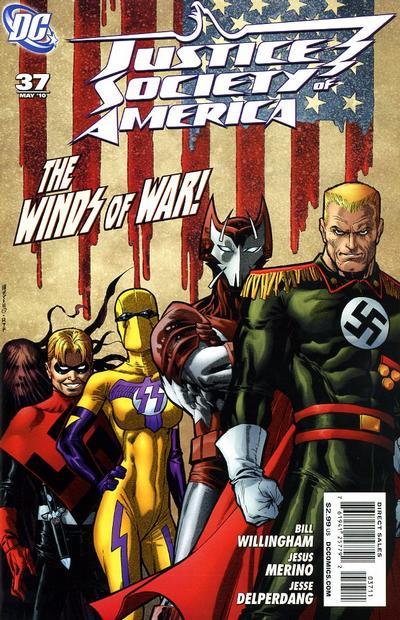 Justice Society of America #37: Twenty years in the future, Mr. Terrific relates the battle of the JSA against the Fourth Reich and how just when victory seemed to be in their grasp, they lost it all. What is unrevealed is exactly how that led to the fall of ALL superheroes, especially as the majority of the villains don't come across as that big of threats. We see Lightning and Mr. America enter the battle but it's Lightning is the one who we see take down an impressive foe with ease. The story then transitions to what the older, depowered and captured heroes are up to and hints at their big plan to set the world aright.
The story comes across as a good old-fashioned piece of fun and fluff. I couldn't help but think of the classic "Days of Future-Past" that told a similar story of older heroes facing extermination try to undo the events in their past/our present that set the world on that particularly dark course. So far, this story doesn't threaten to usurp that one in classic status as that story so easily gave so many iconic yet tragic and bittersweet moments and scenes such as the final charge against the Sentinels. But, the story succeeds in entertaining and providing some good superhero throw-downs with twists along the way even while the reader knows the pre-ordained conclusions. Of course part of that is probably due to the fact it's a title that doesn't require reading a host of other books to understand what's going on, there's not rampant death just to increase body counts or make the books seem more serious and edgy ala Robinson's Cry for Justice and Justice League.
Mr. America's place on this team continues to be a bit of an enigma as he doesn't add one iota of presence. Of the young guns, he should be the one that comes across more strongly and with a certain amount of experience and world-view. He has had formal training and presumably faced some very bad guys as part of the FBI, he already was a professional crime-fighter. He dresses the part of Captain America, but he remains a complete cypher and rank rookie. A bit of that is because it has the same shortcomings listed in the Black Terror book ie there's no real sense of who these characters are outside of the team. A little of that is forgiven in a team book as the focus of characters has to rotate through the larger cast. When you have a book like the traditional JLA, the job is made easier as many characters have their own books and there can be more focus on the secondary characters in terms of subplots and characterizations. Heck, it's part of the reasoning behind having B and C listers joining the teams to begin with. It allows for character growth and subplots without worrying about the events in the solo books.
Kid Karneval is taken out with one punch after a lot of build-up. The rest of the Reich is identified as if they had been seen before this storyline but most of them are just place-holders, we aren't told anything about them (especially as half are based on characters from MLJ and thus have no prior context or continuity to the DCU). In fact, the Fourth Reich is the weakest part of the story. As a group, they aren't threatening, their powers and abilities are not defined. Nor do we see an actual face to this new Reich, who is behind it all. On one side, the story is Mr. Terrific's story, we see it through his eyes. He personalizes the superhero side. We don't really have his opposite number though. We don't know who the villain is that set all of this up, that put together this team (or, how other than being a psychopath, the Kid fits in with the group ideologically). It needs a Red Skull/Zemo/Baron Strucker to stand on the opposite end and serve as the focal point, to be the villain whose plans and desires are the motivating forces for the story, to embody the opposite side. Especially since this is NOT really a story about the evils of Nazism. The villains are Nazis, but that's short-hand here for them wanting to conquer the world, it's not about heroes fighting Nazis per-se. It could be any world conquering type with some super-powered joes at his disposal. Thus the importance of providing the story with a character that embodies what the conflict is about, especially this far in to the story.
Project Superpowers Chapter Two #8: To bring down the mad god Zeus, the heroes that have been at odd purposes combine forces, those that serve the President and through him the Supremacy and those that have set themselves up as bringing down that group and restoring America to the people through creating seeming anarchy. The plan doesn't seem to go very well as characters with their false allegiances are found out or on the cusp of being found out.
There's some great scenes artwise. Salazar's art is steadily improving in quality and clarity in storytelling. I don't know if Ross and Krueger are deliberately aiming for meta-textual commentary, but the revelation by the Green Lama that the heroes of the urn have achieved a near mythic status and possibly may not be able to die could easily be taken as a commentary on the status of the heroes of the 1940s. Due to their public domain status several of them have popped up at various companies and in different incarnations, especially in the last couple of years. Of course other meta-textual concerns pop up across the book such as the pairing of the heroes of Big Shot comics together. It's not a bad idea per se, but no story-logic is given. They have a task to accomplish, some vision to construct a mysterious object that will help defeat Zeus. Which makes a little sense with Marvelo who is a magic hero and Skyman who is a technological/inventive genius. But, the inclusion of the Face doesn't really follow. Likewise we have Lady Satan, the Woman in Red and Masquerade nee Miss Masque are grouped solely because they are women and the use of the color red.1 Or the joining of all the Ace heroes into one group. It's a little cutesy nod to the characters' histories but without providing real story context.
________________________________________
1 Of course, there is a history of the use of the color of red and women in literature and culture. First, it signaled women of a loose sexual nature. By the thirties, there was a pulp called the Scarlet Adventuress signaling by that time the pairing didn't necessarily mean of a sexual nature, but women who didn't conform to the traditionally gender defined standards, mores and roles.
Thursday, November 19, 2009
Comic reviews and musings
 Batman/Doc Savage Special: Despite all the indications of Azzarello not really getting it, this is a decent one-shot. It involves Doc, early in his career (actually would be contemporary with the events of the first Doc pulp story, "Man of Bronze".) Avoiding some unpleasant business, he decides to investigate the actions of the Batman of Gotham City and a possible murder committed by him. Much of the story explores similar tropes of the Batman-Superman relationship or the crossover storyline several years back of Doc Savage and the Shadow in DC's last time licensing of the comic.
The cover has the wonderful feel of being Bama influenced and the interior artwork is adept at storytelling. However, the style lacks solidity, looking more like animation cels, a feel that grows as the story progresses, being very ephemeral looking by the end.
While the story is decent, it underscores the problem with the concept. As noted, the Doc-Shadow crossover did the same thing better, telling a story with a villain that suited the strengths of the characters and their style. Batman feels almost shoe-horned into the story, made to fit a role that he's not suited for.
Then, there are the end-notes about other characters appearing as part of this "First Wave". It's more of Didio's New Earth style madness. Instead of going with the purer aspects of characters, it's seen as a chance to make judgments and arbitrary changes of characters. So, instead of a chance seeing the GA Black Canary free of 40 years of retcons, we have the character being re-cast as an Asian American. The Blackhawks are now a second generation team, the original Blackhawks being mostly dead. Why? The whole idea behind this pulp-Earth was to make characters like Doc Savage and the Blackhawks work. Instead, we get a Blackhawks team that is less pulp-like and completely at home in modern DCU. Azzarello apparently doesn't think Ebony can work unless as a cliched sassy African American woman. Except that Cooke made the character work completely well in his Spirit series. Ugh. To the point that it seems that they have a better handle on the pulp characters than the others, though it still seems like they are adding and changing complexities and dynamics than working with what's there. There is quite a bit of interest to the Avenger and the original stories. Such as the efforts of the creators to make the characters more racially enlightened (one of his chief aides, Smitty was originally meant to be African American judging by the artwork and eventually he did get two African American aides that played up their intellect and society's pre-judging the characters). Despite his and his team's personal losses to crime, they DON'T actually kill criminals, he goes out of his way to not personally kill them. However, he does set things up that criminals often kill themselves through their own ruthless actions. The books also often have a fatalism about them, how the Justice, Inc crew expect this profession to kill them one day.
Likewise with Doc. While Monk will kill though Doc chooses not to, Monk always feels a bit guilty about it, usually making excuses. On the other hand, Renny has killed if he thought that was the only way and without excuse. The books don't suggest Monk and Ham as Doc's enforcers with Ham keeping lease on the pit-bull. I guess just being best friends isn't edgy enough. Lastly, Azzarello sees Renny as being an ugly man. Did he not actually read the stories? Dent gave all the characters specific physical looks and other than Ham and Doc himself, none are described as being actually good looking. But, the books are consistent in describing Monk as being incredibly homely NOT Renny. It's the creator re-casting the characters to fit his agenda than actually working with the characters.
The Black Coat: Ok, there is obvious stupidity here in the numbering. This issue is listed as being Two Issues, 1 & 2 of 4 (the next issue will be 3 & 4). Man, zero issues were bad enough of gimmicks.
Beyond that, it's a wonderful two-chapter comic, very pulpish story of a costumed hero in the days of colonial America (not too dissimilar to the Disney adaptation of Dr. Synn in "The Scarecrow of Romney Marsh") mixed with some of the occult stylings of Mignola. The publishing of Black Coat has been very sporadic, the long gaps in this little known title making you wonder if that's the last to be seen of the title, that it will just fade away like Xenozoic Tales, then, bam, a new issue comes out.
The story of this 2/4 parter begins with the death of the Black Coat and his resurrection and occult menaces that aren't flesh eating zombies as well as the menace of a traitor in his organization against the backdrop of the American Revolution. The artwork of the first half is Francesco Francovilla who has a wonderful old school illustration style, full of cross-hatching and atmosphere and making a name for himself on Dynamite's Zorro book. The second half is by Dean Kotz, a name unfamiliar to me but whose style is similar to Brett Blevins' and appropriate to the feel of this book (his cover is gorgeous by the way).
Black Terror #5 (picking up the numbering where the mini ended): The comic spins off into its own owngoing of a sorts, though the concept of Project Superpowers doesn't really lend itself to ongoings at this point in time. Hester shows himself to be a capable writer and focuses on a small story against the big picture. While most of the heroes went into the urn, the American Crusader apparently did not. When the heroes returned, they found zombie like beings in black wearing the Crusader's symbols and having a modicum of his power. The opening arc of this story goes into the background, establishing a friendship between the Black Terror and the American Crusader in the days of the War and making AC into a perfect martyr character ala Barry Allen crossed with Captain America. It's very well done, perfectly setting up the twist at the end. Especially considering that American Crusader was in many ways a very generic character, a variation of Nedor's basic template and often with art that was crude even by their standards. The most notable thing about him is metafictiona, one of the earliest patriotic heroes and the first to use atomic power as a basis for an origin, but he's generally overshadowed by the likes of the Fighting Yank, Black Terror, Doc Strange, Captain Future and even American Eagle.
The artwork is the weakest part. It's actually hard to judge the pencils as the coloring is extremely dark and completely overwhelms the artwork. To the point that if you weren't aware of the American Crusader was supposed to be a patriotic hero by his name, you really wouldn't get it from the art as it looks like he's wearing red & black and not red & blue (admittedly, on the covers of the 40s, his cowl and cape does look black with blue highlights).
JSA vs Kobra #6 of 6: After a very solid story of a team of heroes fighting a super-villain terrorist, the mini ends with whimper as it just ends without resolving anything after all of the set-up. As if the powers that be lost the resolve to go where the story was taking them, that the heroes are not allowed a clear cut win. At the end, the status quo is the same as where it was at the beginning of the book, the very definition of a bad story, the central conflict has resolved nothing. If the reader wasn't paying attention, one could expect another issue or two to go. Tacked on is that Mr. Terrific's girlfriend is cured of her ill-defined techno illness. But, other than a mention in the first issue, her plight and what it means to Mr. Terrific is not dealt with or touched on the rest of the mini, this isn't an ongoing theme of the story or a central motivation or struggle on the behalf of Mr. Terrific. So, her curing is just an afterthought, an attempt to give the story a feel of some kind of resolution, but is forced as it has nothing to do with what the story or characters have been about, her condition is a minor footnote for all that it has meant.
The sad thing is the artwork is good and there are some great panels and scenes scattered throughout. But, it's a case of when in the end, all is said and done, more is said than done.
Friday, November 06, 2009
Fred Gaurdineer
 One of the unexpected joys of working on this project about the publisher Centaur was finding in many of the text stories art by Fred Guardineer, often nice big images really showing off his attention to detail and strong illustrative sense.
Guardineer is not a name you hear very often when people talk of the golden-age greats unless it's about the golden-age magician characters. While he worked on almost every type of story for many of the companies of the day, Guardineer made a name for himself on working on magicians. He did art for Zatara at DC, Tor and Merlin at Quality, Marvelo at Columbia, and Mr. Mystic for the Spirit supplement. And, many of them tended to follow Zatara's magic casting at some point by saying words backwards.
It's a shame he doesn't garner more interest. Even with his earliest art, he had a solid command of illustrating, layout and style. Every line or lack of line is deliberate and serves to define a shape, or texture or pattern. Patterns and textures play off of each other. The pic here is of Dan Hastings, a character that hopped from one publication and company to another, specifics changing back and forth. In this case, Dan for some reason is colored as a brunette, most images have him as a blond. It has been re-colored for publication purposes and reasonably accurate, but the real star is Guardineer's linework.
Website:
Yes, my website is down. When yahoo announced it was shutting down its free sites, it had mentioned that the plus account holders would be able to transfer at that date. When I started my site, it was a plus account but apparently had not been for awhile (though I still operated with all the benefits of a plus account). What it means is I have to find a new home or start a new account with an actual domain name.
I had been thinking about changing the name anyway, the Cash Gorman moniker being a bit problematic in that it's not public domain though not like the owners are doing anything with the character right now. Although with recent events of them finally okaying the reprinting of Doc Savage, the Shadow AND the Whisperer and Avenger as well as DC using Doc and others for a pulp-Earth, it's possible that Cash Gorman might just have a small comeback. All the more reason to at least change the name of the site. With the name changed, I also wanted to update the layout and design of the site, including the beginnings of a page devoted to the Quality characters. When I chose the name for my yahoo email address, I didn't really anticipate it expanding into having an identity of its own (or having to explain where the name comes from, a few times explaining that it's not really my name.
But, I've been busy with other projects and just not been able to move on it yet. Although, I had lots of updates of information to transfer. And it means having to re-do all those links too. sigh. Sadly, this means that unless he's moved them elsewhere, some of Jess Nevins' sites are also lost as well as copperage's where the micros came from. double sigh.
Reviews
Abe Sapien: The Haunted Boy: A wonderful one shot story of Abe investigating a simple haunting. Perfect for Halloween, it's a tightly told horror story centering around human pathos and grief. It misses a few beats as the big twist hinges on the writer and artist firmly establishing visible differences between the two boys, so the a-ha moment isn't as strong as it should be. Regardless, it has more of that feel of what the Hellboy books or shows like Buffy/Angel/Supernatural were before continuity and ongoing plots became more important.
Angel vs. Frankenstein: I can understand some people not liking how Byrne's art has changed and developed. I think his figures have lost a bit of that iconic feel, that sense of epic proportions and action to the point that it's jarring when he's working on superheroes. I found this to be true first when he was working on Wonder Woman where all too normal looking everyday characters looked out of place standing next to someone like Wonder Woman or Superman. Yet, when he's working on projects like Angel (and the late Demon series), what's been gained is texture and nuance that are perfect for horror titles or books featuring all too human characters even if they are vampires, psychics and monsters. He knows when detail is important and when the action should take front-stage, a master of storytelling in each panel.
I got so caught up in reading the story, I briefly forgot that it was a book featuring Whedon-verse characters and was a bit upset that the vampires turned to dust immediately when stabbed with a stake but then remembered that's the rules this book has to operate under. The monster is beautifully rendered and characterized, his whole book summed up in a few pages. He's both tragic and horrific in his ruthless nature, a perfect anti-hero to pit against Angel when he was less than sympathetic as well.
If there's any flaw, it's the story has a lot going on for just one issue, would have loved to have seen this paced out into two issues, to really get to know some of the poor citizens that get caught in the battle between the two characters, and to wince at their sudden violent deaths. Maybe we'll see the Frankenstein monster spin off into its own series. Meanwhile, Byrne has in the works a new Angel story, one taking place in the current day.
Astro City: Astra #2: The cover alone has that great feel of a glossy magazine cover ala Omni. To the point, that I didn't at first recognize the two heads kissing. By this point, I guess Brent Anderson must find the book a joy to work on as he's still doing it. I could see some artists getting frustrated, "you want me to draw what?" He must draw the ordinary alongside the cosmic, and make the fantastic look both fantastic and everyday. Which is what the text is going for as well, as Astra is showing her boyfriend other worlds and cosmic goings on and finding that a place populated by aliens from all over with fantastic science, she fits in as being "normal" because different and strange is normal in a sense that it's not in Astro City where the two co-exist in large quantities but still segregated. It is a bittersweet tale about our culture's fascination with celebrities and celebrity news over real news, how we chew up the celebrities and spit them up and the fascination of reality shows and the voyeurism they provide. Busiek continues to provide a mature superhero books with mature storytelling without sacrificing what originally drew so many of us to superheroes to begin with. And, it's still more "all ages" accessible than most of the mainstream superhero books out there.
The Brave and the Bold #28: This has been reviewed online elsewhere and they pretty much all hit the mark in that the comic doesn't. I'll give JMS credit in that he's trying to tell stories with meaning, that are about something. However, he doesn't really know how to do it without preaching, he isn't able to pull it off through metaphor and themes. Part of that is the format of single issue stories doesn't allow him much room to explore thematic elements.
The other part is that once you get past the purty pictures and the surface story, it's just full of bits and pieces that don't make much sense. It's a team-up of the Flash and the Blackhawks in WWII. This is the second appearance for the Blackhawks in this title and nowhere are their planes in evident. Nor are their varied characters identified or explored much. There's no reason for them to be the Blackhawks vs Sgt Rock and Easy Company or even the crew of the Haunted Tank. I'm not caught up on the planes angle, the Blackhawks were more than pilots, they are one of the earliest non-powered costumed teams, providing the template for many that followed. But, their use here doesn't really give them much to do.
Next, the Flash is stranded in the past via a broken leg. We are told that. It keeps him from running at superspeed. However, what it doesn't do is apparently give him any pain, hinder him standing, walking, etc. I've sprained my ankle worse than the Flash's broken leg for all the trouble it gives him. And, why not contact the JSA to send him back to his own time? Of all characters, Barry Allen would know that Green Lantern, Johnny Thunder, Dr. Fate or the Spectre would be able to do so.
Then we have the moralizing part. The Flash sees himself as a symbol that doesn't kill, a superhero must stand for something after. Ignore that the character's last big story before Crisis on Infinite Earths and his recent rebirth was about him killing the Reverse Flash and standing trial. Now, part of the conceit of the genre of superhero fiction is we are willing to cede that heroes with guns never accidentally kill or wound innocent bystanders, that all the fisticuffs and knockouts don't result in accidentally killing or permanently injuring their opponents, etc. However, when you raise this issue as a story point, that the Flash does not want to use a gun to kill enemy soldiers, it draws attention to the incongruity and nonsense that his idea of a better non-lethal solution is a barrage of bricks thrown with super-speed! Seriously? After all, to quote the tv Flash, "it's not guns that kill people, it's these little hard things!"
And, then the Blackhawks are upset that the Flash managed to incapacitate the enemy in a few seconds instead of killing them through a protracted gunfight? Might be different if his waffling or solution took more time and actually put their lives at risk, but it was more efficient than their method AND somehow, miraculously, didn't kill anyone. It makes the Blackhawks just seem needlessly bloodthirsty.
Doom Patrol: Haven't been getting this since the first issue, but judging from pages pasted online and quick perusal at the store, I have to ask has anyone been getting this and enjoying it? Every issue seems designed to make each member of the team thoroughly unlikeable and pathetic as characters and make you long for the days when they were blown up and martyrs. Last issue, Mento and this issue the Chief. It further compounds it by making the dead "New" Doom Patrol with Celsius, Tempest et al as being the more likeable and less issue laden team. AND, they retcon Tempest's powers? The dude is dead and being referenced in a flashback, so WHY? Cannot bother to do a character in character for just a couple of panels? For $3.99 a month, why would anyone bother getting this book?
Justice Society of America #32: The book progresses along its way with little change from the previous issues. As the investigation continues into who betrayed the team, important points are brought up, important enough that it could be argued they should have been addressed earlier. Despite that, there's no real new development or progress, it almost feels like a bit of filler between the beginning and end. Sorta like how in the old movie serials, about 2/3 of the way through the storyline, you have a chapter that just kind of sums up all the pertinent details and storyline to that point. Still no clue as to who half the villains are or what they can do. Likewise, it pains me a bit that we don't really see who many of the JSA really are either. They all come across as superheroes full-time without real outside lives.
A good time to address the previews, in this book is the preview of Batman/Doc Savage. The art looks good. However, the way Batman is blasting away with guns... sure, it's a more pulpish world and Batman originally did use a gun on occasion. However, when that's Batman's first recourse, to go in with guns in each hand blasting, you don't have Batman, you have the Shadow, a character that this world is supposed to already have. Why bother with Batman at all?
Meanwhile, online is a preview of the JSA: All-Stars. Reinforces my plan on not getting it. Didn't care for the art, half the team is who I'd like to see booted anyway, AND the writing in just a few pages has two stupid moments. One, Magog seems surprised to discover his foes are cyborgs to the point that he mistakens them for robots. Of all the JSA, who's the one character that is cybernetic? Magog. Then, Power Girl gives the order for the JSA not to hold back since they aren't humans in suits but cyborgs? Maybe, she doesn't know the definition of the term, that they are still living people? Not like discovering they are undead zombies or something.
Marvels Project #3: A decent issue, following up on several threads introduced. As the story is progressing, the narrative itself is not as strong. This plagued JMS on The Twelve as well, starting off with a strong narrative voice, but the story being told was much bigger than what could be contained or told via that narrative. Thus, the Angel's narrative at times is barely oblique commentary. The scene with the Ferret seems completely incongruous, having little to nothing to do with anything else going on in the book at this point. Maybe, it'll play in later but right now it's just wondering what it was all about other than to be a minor character cameo. Epting's art is a bit of a disappointment there as well. He does a good job at setting up the office and all but his Ferret pretty much just looks like the Angel.
The Angel himself comes off as being thuggish, his method of investigating being hitting people til they talk as opposed to doing some detective work. It seems a bit contrary to the way he's been portrayed up to this point as someone extremely capable and smart. There's a couple of leaps in storytelling logic as well. The Angel seems to take the death of the Phantom Bullet very personally. He's never met the man in either identity, no reason the two even really knew of each other this early in their careers, yet he calls him "comrade". And, while I can see investigating the guy's death and his most recent cases, is there anything to indicate that he wasn't just killed while stopping a mugging or commission of some other crime, that it was an intentional murder? But, the Angel in his questioning isn't asking who killed the Phantom Bullet, who's been taking credit or talking about it, but about who would WANT to kill him, which implies that the killing was a planned and intentional act and not a spur of the moment opportunity. None of it read right, it comes off as being the easiest way to get from point A to point C, without spending the pages of actual writing it would take to do it logically.
Project Superpowers: Chapter Two #4: The storyline is moving along and a hero seemingly falls. After the big reveal of last issue, nothing concerning it is touched on other than it seems as if the Supremacy has ways to get inside information with each group. Makes you wonder how Tim "healed" his face after the rather sizable cut that left him noticeably a fake.
Project Superpowers: Meet the Bad Guys... Dagon #3: This issue is pretty much undercut by the previous one. Here, Samson is alive and well and there's a lot of talk about him suffering a crisis of faith and the villain played up as a rather personal threat, only to have Chapter Two render it all kind of moot. Again, there's the usual feel of a Casey script that seems to indicate that he thinks readers can read his mind and thus he can leave out all sorts of background, motivations and relevant information that would actually give his story any meat and help it make some kind of sense. The villain looks cool, and who thought we'd see Hydroman as a serious hero this day and age (only he's called Hydro these days). Otherwise, there's a lot of talk as if something is going on, but it's all sound and fury.
The Torch #3 of 8: Toro finally breaks out of his funk and fights back, we see a bit of Jim Hammond inside the revived Human Torch and the Thinker exits stage left. The story is still very linear and it makes you wonder just how it's going to be more than 4 issues, what are the rest of the issues going to be about? Still, an enjoyable romp.
Witchfinder #5 of 5: In the end, the book falls in the category of many of the Hellboy minis, best to be savored as a trade and read in one sitting. I found myself picking it up and really not recalling many of the details and characters and by the time I remembered, the story and the book was done. It is better than the modern BPRD books have been in having that gothic feel of dread and horror with unholy beasts, magic, mystical objects and secret brotherhoods though. A good creepy book for cold dark stormy nights.

|
