Saturday, April 30, 2022


So, I recently picked up a couple of older comics: Adventures of the Fly #30 and Fly-Man #32. Partly because it turns out that the Archie company let several a couple of years of mid 1960s comics slip through the cracks. In this case, they left off the copyright notices, a requirement at the time of publication and rendering the comics public domain upon publication. What's interesting in these issues is that issue #30 re-introduced the Comet. Issues 31 and 32 (with the change in name) introduced the third Shield and the concept of the heroes as the team the Mighty Crusaders. 

Adventures of the Fly #30 is the last issue before the superheroes went in full camp mode. Like the Jaguar comics of the time, at this point of time the comic reads much like 1950s, early 1960s Superman family comics. Just not quite as good. But, still there's some fun to them, especially if you're a kid. Or, if you're weary and need something to cleanse your palette after reading a selection of comics by Tom King, Brian Michael Bendis, and Geoff Johns.

The other interesting thing about this particular issue is that two of the three stories it contains are centered on Kim Brand aka the Fly Girl. And, in the second story, she is in the story as much as the Fly is.

The first story, Kim Brand decides to call on Tom Troy aka the Fly in his law offices. Troy has been so successful of late in putting away gangsters, that a couple are laying in wait for him and she ends up being captured by them. She knows she could change to Fly Girl and take them out easily but it would mean sacrificing her secret identity. She reasons Troy is on patrol as the Fly and could return any moment. So, she must figure a way to warn him without alerting her captors. The good part of this story is that her solution is by subverting the stereotypes of women of the time, that they would dismiss her bizarre actions as being those of a dizzy female. The only real flaw is that bad science in that as Brand she has no powers, but she blows up a balloon which is able to float away as if filled with helium. 

The second story, Fly Girl and the Fly discover a bank robbery by a short man named Limbo and his girlfriend Stella Stretchpants (really!) in progress. Only the bank tellers are helping the couple in the robbery! Turns out Limbo is a master chemist from a perfume factory who accidentally discovered a super-chemical when used in perfumes has extreme effects. One, is a super attracter that makes women fall in love with him and men overly eager to help. Soon, he has the Fly couple also helping them make their escape. The next encounter, he reveals another perfume that sets the couple against each other, more interested in fighting each other than stopping the villain. The heroes realize they have a dilemma, trying to stop the couple without coming under the influence of the super-perfumes. The story actually makes me think of the plots of the Batman television show. There's the humor and parody in the names and plot, but not at the expense of the heroes or the nature of heroes. They are capable and smart and treat the threat as serious.

The third story is the one with the Comet. This story especially reminds one of the Supergirl and Lois Lane stories. The Comet is the ruler of the alien planet Altrox. Through alien technology, he has fallen in love with Fly Girl and has foresaken his crown to do so. His rainbow pith helmet is actually a replica of his crown. He proves he is able to fly and has super strength that puts him at the equal to her. She is suspicious of his motives and comes up with several tests: an electromagnet to see if he's a robotic android (it only attracts and destroys his prized helmet), a wrestling match under the excuse that she cannot marry someone who cannot outfight her but really to give her an excuse to see if she can grab a face mask hiding some kind of ugly inhuman visage and three, and lastly, a kiss to see if there is an attraction and that she could love him but in reality to allow her to read his mind to see if he's lying about anything. The mind-reading backfires as it gives the Comet's advanced brain a head-ache. She confesses and was quite moved by the kiss. However, he wants nothing to do with suspicious women and leaves to go back home. If the first story subverted the expectations and characterization of women, this one leans into them Fly Girl does not come off as well here.

The interesting thing is the Comet. His appearance here is similar to many of the super suitors other super characters that would pop up in the Superman family comics. It reads as nothing more than a one-shot. The cover shows a purple faced alien but that's simply Fly Girl's imagination of what he might look like underneath a human mask. His costume is simply red & white. Another thing that's notable is there is no mention of the golden-age Comet. At some point, it was revealed that the original Comet didn't die, but was transported to the planet Altrox. But, here it is just re-using the name without acknowledging the older character.

Yet, it didn't end there for the Comet. He returned for the next two issues! I don't have #31 handy, but it includes the Fly couple, the Comet, the son of the golden-age Shield as the new Shield, and the Black Hood. His costume has changed colors to the more garish orange and green. I don't recall whether there is an in-story explanation for why he's back on Earth, slightly different powers, and different colored costume. The other notable thing, as seen with change in name to Fly-Man, these new stories are less straight-forward and more campy. They read like it's recycled 1960 Justice League plots but scripted by Stan Lee doped up on strong cold medication. With that is also a change in artists, from the solid if somewhat dull John Giunta to the more notably flashy and hyper art of Paul Reinman whose work fittingly has the flat cutout looks of Mike Sekowsky from his JLA days


Issue #32 opens up with the heroes fighting each other on a deserted island. Turns out, they disagree on what to call their new team. It seems like the Mighty Crusaders name was given to them by the Fly-man's old villain the Spider and the other members think that tarnishes it. However, the names the other members have are even worse. The fight is interrupted by an incoming atomic warhead. Before it reaches them, they are encased by a force-field globe that protects them from the blast. The Comet reasons the warhead was sent to kill him by enemies fearing that he might return to Altrox. Likewise, the force field was from his friends. This kind of scares the others, that just being near him makes them a target. So, they depart. However, the explosion has awoken the Atlantean tyrant Eterno from his suspended animation sleep, centuries ahead of schedule. Fearing that the heroes or descendants of them could be a threat to his future plans of conquest, he sets out to do a preemptive strike against them. 

Now, these aren't good comics, but there are some interesting bits here and there. The first threat sent against them is a powerful giant robot called Doombala whose name evokes the monster comics of Atlas. It's he and not Eterno on the cover. In a writing and art disconnect, Fly-man shrinks himself and enters the robot through it's nose and is expelled by a sneeze. At least that's what the art shows us. The writing says he is entering through the mouth and expelled by a robotic cough!

The summation of the story's plot on the GCD actually gets this wrong. It says that it was the fight against Doombala that set Eterno free when it wasn't. The readers aren't introduced to Eterno until after the fight, but that's presented as a flashback revealing Eterno is behind the menace of Doombala and was woken by the earlier atomic explosion.

Another part is the heroes in an attempt to strategize in private decide to hide out amongst others at a comic book convention! They almost don't get in since they aren't dressed as comic book characters but real superheroes. Eterno tracks them down and creates evil powered duplicates based on several of the characters of several cosplayers. A very similar story was done in the pages of the Freedom Fighters which was part of an unofficial crossover of the Freedom Fighters and The Invaders. In both cases, the villains the teams faced were called... the Crusaders. It's too bad that the cosplayers aren't in costumed identities meant to parody the Justice League, FF, or Avengers. Instead, they are using names that clearly meant to be silly, belittling the subject matter. At one point, there is a deliberate meta-fictional bit (before the term existed), where the comic fans are extolling the characters from the golden-age and companies should dust them off and bring them back like Radio Comics is doing. Radio Comics is the name Archie was publishing these under at the time and the Shield, Black Hood, and Comet were all golden-age characters back when they were MLJ. Soon, they would also bring back the Web and Steel Sterling for solo stories and some others to lesser degrees.

The ending is really bizarre but suitable for this comic. You have the Shield revealing a power that was set up earlier in the comic but this is the last time he's able to use it. Then, there's how Eterno is ultimately taken out. It's a bit out of left field and almost seems like something that might have happened in an Ant-Man comic. But, I won't spoil it for you.

As noted, the Comet is in the green and orange costume which he'd wear for the rest of his Silver-Age appearances. When he shows up in the 1980s revival, he is wearing his original red & white colors which is a definite improvement before he reverts to his golden-age powers and looks. I think I may be the only person that actually liked the red and white costume with the rainbow helmet. There's no mention of the character's previous super-strength. It is revealed that it is his helmet that allows him to fly as well as powering his gloves which fires de-atomizing rays aka disintegrating beams. He is still being presented as being the ex-ruler of Altrox.  I wonder when it was revealed that this version of the Comet was really the return of the golden-age one, that he's not simply an alien using a currently unused superhero name. Was this something Buckler came up with when doing the revival in the 1980s? It is something to keep in mind if anyone wishes to use the public domain versions of the Comet. The 1940s one is public domain, and this one is public domain. But, combining the two into a single hero might not be.

Sunday, August 20, 2017

Eclipse means Eclipso!

With the eclipse, it seemed a good time to look at one of a couple silver-age DC comics I picked up. One thing the comics showed was that if you think that the Silver-Age Doom Patrol was weird, you probably need to read more DC comics from that era. House of Secrets during this time had two features much like their competition's Strange Tales and Tales of Suspense. In this case, the two were Eclipso and Prince Ra-man. One of the things that attracted me with this comic was it promised a merging of the two features into one story pitting the hero against the star villain.

Eclipso was sort of DC's version the Hulk, playing on the Jekyll and Hyde motif: good guy scientist who turns into a menace. In Eclipso's case all it takes is an eclipse to turn scientist Bruce Gordon into the villain Eclipso. Unlike the Hulk, Eclipso got to wear a costume, had incredible intellect and was an out and out villain. Gordon spent most of his time trying, and failing, to prevent coming into eclipses and then helping to set things up that would force him to become Gordon again. In this he is aided by his girlfriend Mona and her father Professor Bennet. A strong sudden light is enough to banish Eclipso.

Prince Ra-Man is a bit tougher to explain. He has his roots in an earlier strip featuring Mark Merlin who was an occult detective. He got himself stuck in another dimension and the only way to get back to our reality was to be cast into a recently deceased body. In this new body, he has various mental powers (telekinesis, illusion casting) and a powerful artifact, the six-sided sun. Sort of like the cinema version of Doctor Strange, it has the all of the earmarks of being a mystical hero but explaining it in pseudo science fiction terms while hedging their bets by also sprinkling in Egyptian references. Upon arriving back in this reality he tells Mark's fiance Elsa that Mark is dead. But, she travels with Prince Ra-man in his crusade against crime. Prince Ra-Man may be DC's first superhero to actually sport a beard. With that, plus a white streak in his black hair and his eyes being all white and black ringed, he is looking almost more like a villain than a hero at the time.

This story starts with Bruce, Mona and Professor Bennet preparing for the next eclipse and a plan to instantly banish Eclipso. As usual Eclipso uses his intellect to outwit them and embark on his next plan of world conquest. In this instance, Eclipso emerges from Bruce Gordon as opposed to Bruce transforming into Eclipso. Eclipso's plan involves him to create Helio, a being made from sun and various chemicals. He even designed a costume for Helio. Of course, it means Eclipso has to shield himself from his own being in order to avoid getting banished. With Helio's power, they steal a space platform so that they can attack anywhere on earth from the safety of space. Eclipso is eventually defeated and returns to Gordon's body. However, Helio is still out there.

In the part two, Prince Ra-man sets out to end the ongoing threat of Helio. In their first encounter Helio almost manages to kill Ra-man and Elsa in a cave in. Helio travels to the lab complex of Buce Gordon in Solar City. He creates an artificial eclipse which transforms Bruce into Eclipso this time. When Prince Ra-man arrives, he quickly reasons that Eclipso is Gordon's other self which Professor Bennet admits. The professor tells him this transformation is only temporary but if there is a real eclipse, Eclipso will split off permanently and if Eclipso and Helio are able to get the stolen space platform into space, they will be nearly unstoppable. Ra-man grows his disc to giant size and flies it like a flying carpet after the platform where he has to battle the two villains.

GCD lists both parts of the story to be by Bob Haney while Jack Sparling did the art for the first half and Bernard Bailey on the second. It's not quite the book length battle promised on the cover, it is still a fun read of a couple of off-beat characters. The stories don't give much background on the characters and so the handling of Eclipso seems a bit inconsistent, with him emerging from Bruce in the front half and a transformed Bruce Gordon in the second. Eclipso's appearances after his run were sporadic in the 1970s. Some reprints, a battle against Batman, the Metal Men, an appearance in Crisis. It would be in the 1990s that Eclipso would get upgraded into a major villainous threat as he was portrayed as a dark villain that was able to use his black diamonds to create dark-sides of the various heroes. In one issue of his own comic he would be responsible for the deaths of various characters including the original Steel, the lady Dr. Midnight and Wildcat, Peacemaker, Mark Shaw Manhunter, the Creeper and another or two. The Creeper would get better and the Manhunter killed was retconned to have been someone else in his costume. In these stories, Eclipso doesn't display the scientific expertise and cunning that he does in these Silver-Age stories where he seems more of a Doctor Doom or Lex Luthor style villain. Prince Ra-Man would cross swords again with Eclipso a few issues later. He would eventually come clean with Elsa over his identity. Not much later he was killed in the final issue of Crisis on Infinite Earths. Since then, there have apparently been sporadic inconsistent appearances of him and/or Mark Merlin.

Monday, April 24, 2017

Pete Francisco redux

Back in February I shared the story of Revolutionary War hero Pete Francisco who loomed like a mythological hero come to life. Today on Comicbookplus.com I was reading a newly uploaded book Soldiers of Fortune. I've not read a lot of ACG and was mainly going through this for curiosity's sake. However, it has a two page story devoted to Peter Francisco. The story even mentions the Battle of Guilford Courthouse in Greensboro, NC and the commemorative monument remembering him. From Soldiers of Fortune #3, ACG, July-August, 1951, retrieved from comicbookplus.com.


Saturday, March 25, 2017

The Terror


Continuing my foray into the lobby cards I had recently obtained from an antique mall. This one is from the 1928 film The Terror. The first two things that attracted me to this one is the artwork on the front & back, plus the image of a hooded, robed menacing villain. Then, I noticed it was adapted from the work of Edgar Wallace. Wallace may be one of the more influential writers on popular culture that few have read or very much aware of.

Edgar Wallace was a popular English writer of thrillers and detective stories. His work appeared as novels and reprinted in pulps on both sides of the ocean. Many have been filmed, some several times. Wallace also worked as a scriptwriter and his most famous work was the initial draft for King Kong. He died before completion of the script and filming but his name remained attached to the project.

The story goes that when the publishers created the house name of "Robert Wallace" as writer for the Phantom Detective pulps, it was because of the association the last name would bring.

The Green Archer by Wallace is an interesting novel that has been filmed several times. Its second outing was as a movie serial starring Victor Jory. Like all adaptations, characters are changed quite a bit from the source material. Still, it is hard to miss the color and initials of the mysterious title character and not wonder about the possible influence of the comic book superhero and villain archers that would follow: the Arrow, Green Arrow, Golden Arrow, Green Knight, etc. Most rightly point to the popularity of Robin Hood, both stories and swashbuckling films as direct and indirect inspirations of the whole costumed superhero genre. But, I like to think that there is room for the Green Archer still: the secret identity behind the costume and archaic weapon, the colorful name.

In The Four Just Men, Wallace wrote one of his few series of books centering around continuing characters. In these novels, he would write of a small group of men from different backgrounds coming together as an organization of vigilantes to punish criminals beyond the reach of the law. In an early science fiction story, Wallace would pioneer the idea of a parallel Earth, one that exists on the opposite orbit around the sun.

The Terror was first written and developed as a play in 1927. It was then adapted into this film version in 1928. This is an early talking movie, reportedly, Warner Bros. second. In 1929, Wallace would write a novelization of the story. It differs markedly from this movie in various character names and occupations. I do not know how closely the novel follows the play though. The 1938 film follows the novelized story more closely and is almost universally considered the better of the films. The latter film definitely had the better cast: Alistair Sim (A Christmas Carol), Bernard Lee (M of the James Bond films), and Alfred Wotner (Sherlock Holmes in several films).

Joe Connor and "Soapy Marks"are two crooks in the employ of the mysterious super criminal known only as O'Shea whose features no one has seen. With him they rob an armored truck full of foreign gold coins. Even though the two are responsible for hiding the truck and are to meet up with O'Shea later to split the loot, they find themselves captured by the police at the rendezvous and the gold gone.

Ten  years later as they near their release, the crime is still unsolved. Each vows their own separate revenge against O'Shea and intimate they may have an idea on the man's identity. The only thing they reveal to the police is that he is only sane 22 of 24 hours a day.

The action shifts to the mansion and grounds owned by the eccentric Colonel Redmayne whose military title and money seem a bit questionable. One of his eccentricities is that he sort of runs it as an inn but by invite only. The longer term residents include a middle aged businessman, a widow with a knowledge and interest in fantastic crimes, her daughter, and the colonel's own daughter newly arrived from school. Added to the mix are a youngish drunkard ne'er-do-well who is steadily trying to worm his way into an invitation, a roaming tinkerer, and a visiting scholarly pastor. Stories circulate of mysterious organ music played in the late hours of the night, and a spectral, robed figure that wanders the grounds. Such reports tend to set the colonel on edge. And when a murder happens on their doorstep, the links of the events from ten years before and rumors of hidden treasure come to the fore.

The novelization takes advantage of being a novel and fleshing out details of the story that cannot readily be captured on film. In man ways the story is similar The Green Archer. A master criminal, a mansion with hidden passageways, a mysterious spectral figure haunting the grounds. It is also similar to another story by Wallace, The Black Abbott, where a mysterious robed figure is haunting an old abbey where there is reportedly hidden treasure and those that might know too much meet death.

Unfortunately, the novelization is unable to expand much beyond its original stage play format. So, while the characterization and motivation is expanded upon some and given more flourishes, much of the plot is sadly simple. It does not get a lot out of the gothic touches inherent in the story. The idea of the robed figure being the ghost of a monk attached to a ruined abbey and underground chapel don't get the build-up it richly deserves (as compared to the Archer being the ghost of a hanged archer with a corpse-like countenance in TGA). The cast is small because of its origins as a play and film which limits severely the choices of who "the Terror" is and there is no doubts about the Terror being the mysterious O'Shea. The cast feels even smaller once an absent detective whose specialty is O'She is brought up. There can be no doubt that one of the characters will stand revealed as the detective. Then add the two ex-cons, there are more characters in the story with second identities than there are those who are who they seem.

This gives the whole story a feeling of a distilled down plot of a Scooby-Doo episode. It brought to mind the many outlandish detective stories that P.G. Wodehouse would often allude to in his stories and would make fun of. Characters with hidden identities and motivations, apt to knock someone off just for the heck of it. Mansions always have hidden doors, passageways, and access to subterranean lairs. And, a decent mansion must come with hidden treasure and a ghost-story or two. And the mysterious criminal is always after the pretty young girl who is to be rescued by some fumbling bumbling guy who will stand revealed as being the great heroic detective all along.

The Terror at Project Guttenberg.

Tuesday, March 07, 2017

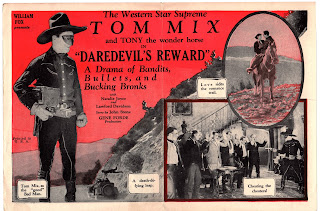
Daredevil's Reward


Continuing my sharing of some of the movie flyers that I bought several months ago. This one appealed because of the notable star as well being an early masked hero

For many, the idea of an old Western is probably one with John Wayne. My own first exposure to Tom Mix was as a character played by Bruce Willis in the move Sunset with James Garner playing Wyatt Earp. And, then as a character in the graphic novel Batman/Houdini: The Devil's Workshop.

Daredevil's Reward also aired overseas as $5,000 Reward so this managed to serve double duty. This is a silent film from 1928. A little research revealed the movie was copyrighted and renewed. At least old newspaper listed it as being successful, airing several nights to capacity crowds. Finding information on the story was a little more difficult. IMDB had nothing beyond the credits. The carried more details.

Mix plays Texas Ranger Tom Hardy who has to adopt various disguises to capture a gang of stagecoach robbers, one of which would appear to be the masked man shown here. Judging from the flyer alone, I assumed the film to be a response to the popularity of the Zorro films, but it's hard to tell from the description whether he wore the mask and black outfit regularly or even if he's called "Daredevil" as in the title. However, the film description does raise an interesting comparison. A Texas Ranger who puts on a mask to fight crime? This is 5 years before a more famous masked Texas Ranger would debut on the radio and was apparently a popular film.

Sunday, March 05, 2017

Alias Jimmy Valentine


Several months ago at a local antique store mall, I came across a bunch of these movie flyers from the early days of film making. They were from silent movies and early "talkies" and some illustrating movies that are now considered lost.

I bought several of them, basing my choice on subject matter and overall sense of design and artwork.

This first one satisfied all of my criteria. It has some interesting art along with photos of the stars. The character of Jimmy Valentine is interesting for a couple of reasons of his own merit. He also is the creation of famed short-story writer O'Henry. I don't know if I was a fan of O'Henry because he was from my hometown, and where I currently call home, Greensboro, NC or if that was just happenstance.

While O'Henry was from NC, most of his stories were written while he was a resident of New York in the early part of the 20th Century. Before M. Night Shyalaman, O'Henry specialized in the ironic and twist ending to his tales. He wrote around 600 short-stories but four are especially notable for their fame extending past the stories themselves.

Before Hallmark started making so many Christmas themed movies that they could show them without repeating 24/7 weeks before Christmas, us older folks watched many of the same Christmas specials over and over and read many of the same stories. It was fairly popular for television shows to do a Christmas episode, usually borrowing the plot from "A Christmas Carol", "It's a Wonderful Life", and, a little more infrequently, "The Gift of the Magi" (1905). Like the other two stories, it has been formally adapted in film and plays as well. No doubt many are aware of the story without having actually read it. Interestingly, almost all adaptations that I can remember seeing, most tend to ignore one of the more unique aspects of this story that separates it from other O'Henry stories (at least of the paltry 20% I have read from that prodigious 600 total). It is one of the few stories written that the 3rd person narrative has a personality. The narrator is a cynic and presents the story as a cautionary tale, the young poor couple described as being foolish and for readers to not emulate them.

"The Ransom of Red Chief" (1910) is one of several stories featuring Bill and Sam, a pair of somewhat scoundrels always pursuing a quick buck or easy path to fortune. In this story they decide to kidnap the boy of a local prominent citizen and end up getting far more than they bargained for. Like the above story, it has been filmed and adapted for stage many times. Its plot has become a standard comedy trope, showing up in movies and television shows. Most recently, the plot showed up just a couple of weeks ago in television's Grimm when a crooked cop kidnaps Renaud's daughter to force him to honor his end of a bargain and not knowing how powerful of a little witch she actually is.

"The Caballero's Way" (1907) is notable for two things. One, it introduces a specific character who becomes famous beyond the original story, in this case, the Cisco Kid. Two, it does not have the wit and humor generally found in O'Henry stories. It is a dark tale. Readers expecting the Cisco Kid of television and comics are in for a surprise as he is a clever, ruthless and murderous outlaw. In 1914 a silent version of the story was filmed and apparently a fairly faithful adaptation of the plot. In 1928, a sound film, In Old Arizona, was released with a more heroic Cisco, albeit still an outlaw. The movies would continue, he'd have various sidekicks before settling on the familiar Pancho. The characters made the transition to a 1950s television series. In 1972, he even made it into a pop song. Sing it with me, "The Cisco Kid, was a good friend of miine." In 1994, Jimmy Smits and Cheech Marin would saddle up for a tv movie featuring the characters. Moonstone Comics did a series several years ago that walked the line between the two versions of the Cisco Kid.

This brings us to "A Retrieved Reformation" (1903) which introduced the world to the safe-cracker Jimmy Valentine. Jimmy is known to be able to break into any safe or vault and is casing a small town bank with a state of the art new vault. However, he sees the bank manager's daughter and falls in love. He passes himself off with a new name and endeavors to go straight. However, a detective rolls into town and is positive he recognizes Jimmy but has no proof. That's when a young girl gets accidentally locked in the safe. Jimmy can save her but it means revealing who he is and sacrificing his chance for happiness. The story was adapted for a play which was then filmed as a movie three times. The above images are from the third film, Metro-Goldwyn-Mayer's first sound film with dialogue sequences. The story would also make it onto radio. He would achieve a different kind of fame outside his story than the Cisco Kid. His name became synonymous for skilled safe crackers and became a somewhat slang term. Reading mysteries and pulp novels, it would not be surprising to come across a sentence that read something like: "he wasn't a Jimmy Valentine, but this old safe shouldn't give him too much trouble he thought." These days, his name has drifted into the past as money is stolen more through computer hacking than safe cracking. With all of the meta-fiction out there and people dusting off old characters and concepts for new stories, I am a bit surprised that we have not seen "The Return of Jimmy Valentine" as a series of historical mysteries set in the early pre-WWI days of 20th century New York. Or, maybe we have and it has just slipped by me.


Saturday, February 25, 2017

Pulpy Motifs in Pop Lit


So, I was at the comic book store and looking over the titles and the one for Hellblazer struck me as being very familiar. It probably wouldn't have been immediately recognizable if not for the fact that I got a Fantomas paperback using the image from the original cover. From the online Hellblazer previews, the story does take place in Paris so the swipe obviously is meant to be an homage or a parody. However, Cassaday does not cite from where his cover comes from. Plus, it is an image that probably only a small percentage of  comic readers are going to be aware of the reference. You know the old saying, "if you have to explain the joke..."

Astro City #41/100: I will warn you, the issue comes with two different covers. At the store I frequent, the issues with the Astro-naut on the cover all had printing/binding issues. In two different places, several pages were duplicated in place of the proper pages. I returned mine and swapped it for the one with other cover as the issues they had left with the same cover had the same errors.

Busiek has lately been knocking it out of the park using the superheroics to explore the history of music and race relations and tensions around the turn of the 20th Century. In this issue, the lead character and his story and relationship to the colorful superheroes of Astro City are definitely meant to evoke the era of pulp heroes and the relationship and popularity of them to the rise of the comic book heroes of WWII. As usual, Busiek does a great job telling a story that is meta-fictional in its use of history and archetypes but in a way that's not mocking or parodying by focusing on creating rounded characters and character driven stories. Prior knowledge is not required for the enjoyment of the stories on their own merits.

Books:
Her Dark Curiosity by Megan Shepherd. Several years ago I heard about Megan Shepherd, a new North Carolina author whose debut book The Madman's Daughter was coming out. The book features Juliet, a 16 year old girl in late 19th Century London. Juliet is strong-willed and talented in sciences despite the limitations on her due to her gender. She finds out her exiled father is still conducting his mad experiments on a secret island, the same experiments that got him exiled. She decides to find out if it is true. The catch, her father is Dr. Moreau. That story is a compelling retelling of H.G. Wells' classic tale. The retelling does take quite a few liberties beyond simply inserting the character of Juliet. It is a re-writing of the story, using it to explore similar and different themes and constructing a powerful new story that follows some of the same plot points.

For some reason, the first book was in the local bookstore and library under regular new fiction. With the second book, it was classified as "Young Adult". I also discovered at the local library that carries the book, there is a difference between "Young Adult" and "Youth" fiction which explains why I was having trouble looking for it amongst the Harry Potters and Percy Jacksons of the latter. While the protagonist is of an older teen, the storytelling is every bit of sophisticated and even moreso than much of the fiction that finds itself on the adult shelves of genre and normal fiction.

Her Dark Curiosity picks up after the first with Juliet back in London. A professor that had once been friends with her father has taken her in. Meanwhile, she is living a double life as she is conducting research in trying to find a cure for her illness and dealing with personal fallout from the first novel. There are killings occurring across the city, gripping it in terror. Juliet discovers that there are links of the killings to her own past and the methods seem to indicate that maybe not all of her father's beast men died on the island.

Like the previous novel, the story uses a pre-existing classic to explore different themes and issues of a person trying to find her own way in a highly gender divided society. In this case, it is Robert Louis Stevenson's Strange Case of Dr. Jekyll and Mr. Hyde. Shepherd takes more liberties with the original novel and characters. But, she uses it to explore some of the same themes just recasting for a new generation. Juliet struggles with the nature of good and evil existing in the same person, from seeing the world in black and white vs shades of gray. In some people, the demarcation between good and evil are literal. But some are more successful in keeping their bestial sides hidden from view. By the novel's end, Juliet and the reader find themselves in a world where knowing who to trust is difficult and trusting the wrong person can be fatal.

The novel ends on a note setting up the third and last from the trilogy drawing inspiration from Mary Shelley's Frankenstein. Now, I know where in the library to find it.

Reanimatrix: The Horror of Lovecraft's 20th Century by Pete Rawlik. I am only a few chapters in to this book. The opening chapters are in the format of letters from a soldier in France in the days after WWI to his brother. Each chapter is a whole short story of horror and dread and are setting him up to be the proper character to return home to the town of Arkham, Mass. to handle crimes and horrors that the regular cops cannot.

As the novel is based on Lovecraft, I expect references to characters, creatures, and places from his works and those that continued the mythos. However, Rawlik is in full Wold Newtonian mode. In the first few chapters, there's references to The Great Gatsby, The Phantom of the Opera, Robert W. Chambers' "King in Yellow", Talbot Mundy's Meldrum Strange (who is related to a Hugo Strange, whether the superhero Doc Strange or Batman's villain is untold), the pulpish French master-villain Cornelius Kramm (http://www.coolfrenchcomics.com/cornelius.htm), Frankenstein, works of Clark Ashton Smith (Beasts of Averoigne, events around the fictional location of Yvones) and even Bela Lugosi's Dr. Sangre from King of the Zombies. There is also a reference to the real legend, the beast of Gevaudan that served as the basis for the movie Brotherhood of the Wolf.

On one hand, once you realize the references are there to such a degree it becomes distracting from the novel. With each character or concept introduced one wonders is it from a specific source? It's akin to all the Easter Egg in Moore and O'Neill's The League of Extraordinary Gentlemen. Yet, Rawlik so far is excellent at telling disquieting stories, building a novel from short short stories. His writing skill is strong enough to override the name-dropping. As I am still under 40 pages into the book, here's hoping that he is able to maintain the quality. At the worst, he has already directed me towards some other writers and short stories to check out.

Friday, February 10, 2017

Peter Francisco & Ann the Huntress

One of the joys of my new job in archives is coming across bits of information while conducting research. Often as I am looking to track down a bit of information or history for someone, often something I know little about, I come across completely unrelated but fascinating information. Going down rabbit holes I call it.

Most recently, I was looking for information concerning history of Greensboro, NC. After looking through several archives boxes, I was checking through some of the history books in archives. In one a photograph caught my eye of a man from the Revolutionary War. The photo was of Peter Francisco but it was the billing of "Hercules of the Revolutionary War" that further drew me in. Also called the Giant of Virginia and Hercules of Virginia, he fought valiantly at the Battle of Guilford Courthouse among other conflicts. His life story reads like one out of myth and later Americana tall tales. As a boy, he was discovered on foreign docks and spoke Portuguese. He gave his name as Pedro Francisco, that his family lived in a mansion and that he and his sister were kidnapped. She escaped but he was taken away by ship and later abandoned.

He was taken to America and grew up in Virginia. When he was old enough he apprenticed as a blacksmith. Peter grew to be somewhere between 6 foot 6 to 6 foot 8, a giant of a man, especially for those times. As a soldier, he participated and was wounded in several notable battles. In addition to stories of his prowess as a soldier, stories of his strength spread. When a wagon was stuck in mud and two mules could not pull it out, he did. Another time, he was loathe to leave a cannon to be recovered by the enemy and the horses that were to pull it had been killed. Supposedly he hefted the heavy cannon on to his shoulders and carried it. This feat was immortalized on a stamp. To add to the mythos of the man, he had a special broadsword made, commissioned for him by General Washington. The sword was six feet long, five feet of it being the blade. The mental image of this fighting giant on the battlefield with a sword longer than the height of many men is striking. Sadly, his sword was lost at some point after being donated to a historical society by his daughter.

With these stories of strength and fighting ability, it is no surprise that the moniker of Hercules would be attached to him. I cannot help to wonder if such stories around a man of historical record somehow inspired later fictional heroes of tall tales, folklore and various supermen of late 19th and early 20th Century pop culture. More can be found out about him at www.peterfrancisco.org.

Ann the Huntress

I came across this story in another book, Greensboro North Carolina: The County Seat of Guilford by Ethel Stephens Arnett, University of North Carolina Press, 1955. For a little context, Mrs. Arnett writes that in the late 1700s in order to increase agriculture harvests, legislation passed a law that each man in the region would kill a quota of crows, blackbirds and squirrels or pay a fine. Out of this grew a celebration and shooting match as the men would turn in their quotas and show off their marksmanship skills to their women. Quoting Mrs. Arnett:

At one of these meetings, about 1790-1791, "an incident occurred... of such a character that it had an influence of North Carolina... the United States, and the world," wrote Addison Coffin in his "Early Settlements of Friends in North Carolina" And this is the story he recorded:
There was a shooting match about one mile east of where Guilford College now stands, in a forest. [A large company of noted riflemen were performing wonderful feats of marksmanship]. In the midst of the exciting contest a beautiful young woman suddenly made her appearance coming up the road from the northwest. She was dressed in a neat walkng dress with ornamented Indian leggins and moccasins. She carried a small rifle highly ornamented with silvr mountings, and the usual shot pouch and belt, with hunting knife and small hatchet, a complete hunting outfit. After the excitement had somewhat subsided and shooting began again, she modestly asked permission to take a shot with the contestants; the request was granted and she stepped lightly out of the line, raised her rifle, took quick aim and fired, the ball drove the center to a hair's breadth sixty yards away. A shout of applause from the hunters made the forest ring. Again she loaded and fired, again the ball drove the center. Astonished and bewildered the old hunters gathered around her, doubting whether they were seeing a vision, or were in the presence of flesh and blood, but her bright intelligent face, respectful language, and lady-like bearing convinced them that whe was a mortal, and one of the highest types of sacred womanhood, but to the inquiry who she was, from whence she came and why thus alone among strangers, she respectfully declined to answer, but gaver her name as Ann, the huntress. Richard Dodson, a Friend, invited her to go home with him... she accepted the invitation and as they walked away her form was so graceful and her step so light and springing that the old veterans shook their heads again doubting or no all was really human.
The story could end there. It makes for a great tale from folklore or legend. But, it does not simply end there. As Paul Harvey, now for the rest of the story. According to Arnett, she stayed with the Dodson family working as huntress for the family and teacher for the children. In addition to be a crack shot and hunter, Ann was highly educated for her time and she changed the language of the region.
Everybody said "goin" "doin." She taught the children to sound ing to all words with that termination - some of the old ones had trouble retwisting their tongues to talk "politely" but before she left a half generation had grown up under her magic instructions...Her cheerful smile, bright face, and gentle ways [were] a light in every household; so much so that many began to seriously believe there was supernatural about her, but alas, the scene suddenly changed. In the winter of 1807-8 Ann disappeared as suddenly as she appeared and no trace of her was ever found. It is said that her teachings were engrafted [by emigrants from North Carolina] into the school systems of Ohio, Indiana, Illinois, Michigan, and Iowa and the language and the pronunciation is that of all the great Northwest and Pacific coast." (Arnett).
 She is not to be confused with Mad Anne Bailey, another interesting woman.

Thursday, March 31, 2016

Leadership and superheroes


Cannot believe it has been so long since I last wrote. It has been a busy year. During the summer, I processed collections, researched bios, and created some finding aides for the Betty H. Carter Women Veterans Historical Project at UNCG. An interesting project and in looking at the military careers of WACs and such, it gave me some context concerning Wonder Woman. While much grief and disdain has been given concerning her secretary status for the JSA, this was actually common and considered a bit forward thinking for the time, especially as she also accompanied the men on adventures! The other option for secretary (which was more than just taking notes) would have actually been the Flash or the Atom (one being freshly college graduated and the other with some college courses, but neither established professionally). Johnny Thunder would never have been considered a serious candidate and the others were all established professionally and probably with advanced degrees. The other thing that occurred to me that I've never seen mentioned, Wonder Woman would be considered a spy if her secret identity was ever discovered! She is a foreign national, using an assumed name and rank that is not really hers to infiltrate the US military.

In the Fall, I did an internship with the Carrboro Public Library and obtained a temporary part-time job with the Center for Creative Leadership performing copyright research for program materials. December, I graduated with my MLIS from UNCG. At the start of the year, my temporary part-time job got extended into being a temporary full-time job (ie a full-time contractor position), with me maxing out my hours probably some time in May.


What can comics like Fables and characters like Ash of "The Evil Dead", and Xena and Gabrielle teach you about leadership?


My current job as a contractor at the Center for Creative Leadership has me researching copyrights and trademarks of third party IP in our various lessons, presentations, and documents. Which has me looking up strange things from time to time (did you know the man who brought the duck-rabbit graphic to the English speaking world also helped develop the APA citation style? Or that there was such a thing as dead mice wine?). A recent search brought this website to my attention. Cummings combines reviewing comic books and pop culture with lessons on leadership and management, something that makes up a big part of my life right now.

This would be unusual enough except for another search lead me to this blog discussing heroes of various stripes including Superman (and even looks at the Superman song by the Crash Test Dummies).

Superman not a good role model for charity giving?

Grant, Adam M. Give and Take: A Revolutionary Approach to Success. New York, NY: Viking, 2013. Print.

Another search lead me to this interesting book on different factors that influence people giving to charity. It talks of a study where people were asked to give attributes for superheroes vs. attributes for Superman and how that influenced subsequent behavior. To be fair, this study would have probably been true if they used almost any specific superhero by name, not just Superman.

Consider an experiment by psychologists Leif Nelson and Michael Norton, who randomly assigned people to list either ten features of a superhero or ten features of Superman. When invited to sign up as community service volunteers, the group that listed superhero features was nearly twice as likely to volunteer as the Superman group. Three months later, Nelson and Norton invited both groups to a meeting to kick off their volunteering. The people who had written about a superhero were four times more likely to show up than the people who had written about Superman. Thinking about a suphero three months earlier supported giving. In comparison, thinking about Superman discouraged giving. Why? 
When people think about the general attributes of superheroes they generate a list of desirable characteristics that they can relate to themselves. In the study, for example, people wrote about how superheroes are helpful and responsible, and they wanted to express these giver values, so they volunteered. But when people think specifically about Superman, what comes to mind is a set of impossible standards, like those popularized in the TV series The Adventures of Superman: "faster than a speeding bullet, more powerful than a locomotive, able to leap tall buildings in a single bound." No one can be that strong or heroic, so why bother trying?

A Look at Murphy Anderson


This one isn't work related. Pretty good article from Yes! Weekly, a local free paper, although the writer commits the all too common sin of trying to show his maturity by being condescending towards superheroes by referring to the underwear on the outside... Don't know how I didn't know Murphy Anderson was from my home town and actually did some of his work from there while moonlighting as a cab driver. Sadly, this is not touted anywhere in town that I know of though cannot avoid references to O'Henry who did not live here when he did his writing.

Ok. Lunch break is over. I'll try not to be so long between my next visit.

Saturday, July 05, 2014

Returned from Vegas Vacation

Been awhile. Last fall I started back to school to get a Master's in Library Science. Then early this year, I got a full-time job. I had been working part-time on the weekends for my old employer, The News & Observer, putting in 20+ hours on Fridays and Saturdays in addition to going to school.  The full-time job is with the book conservation company, The HF Group. The pay is considerably less, but the hours plus not having to commute to Raleigh every weekend evens it out. However, between going to work 40 hours a week AND going to school puts a strain on time and sanity. Doing a session of summer school even moreso.

Thankfully, I got a brief break by not going to second summer school session. My wife and I went to Las Vegas for a week, to meet up with her sister and kids on vacation from Alaska. I like to scope out local comic stores, but was limited by not knowing the city. The ones closest to The Strip even seemed a couple of blocks off, thus not easily accessible when you're hoofing it most of the time in over a hundred degree weather. Although the heat is not too bad considering the low humidity. Eighty-five degrees with high humidity in NC can sap your strength more than the dry desert heat.

I had pretty much given up going to a comic store when we took a bus down to the Freemont Street district and stumbled upon Jesse James Celestial Comics store almost immediately off the bus. Apparently, it is a fairly new store and most of the comic selection is geared towards current and recent stuff. I was mainly looking for a copy of Alan Davis'  "Savage Hulk" which just came out and once I found where the actual "this week's" comics were, I was set.

What was cool about the store is that up front and center as you enter is a table of comics featuring female characters as leads. Also at the front and to the side are the comics suitable for children. When my niece of 12 came in, she found the section immediately. The young woman running the store was extremely helpful, aiding in selecting various comics that would interest her. My niece ended up leaving with more comics than I did, several issues of "Princeless", a trade collecting the first story as well as a collection of the Power-Puff Girls. The employee also tried to help my 16 y.o. nephew pick out a suitable horror comic, but I feel he was feeling a bit "too cool" to be seen reading comics even when its something like "Hellblazer" or "30 Days of Night".

Also while in town, saw a couple of Cirque du Soleil shows. It was my first experience with their shows. I am not a big Michael Jackson fan, but he is of my generation and hard not to have associations with his music and certain ages and times of my life. The "Michael Jackson: One" show is absolutely amazing though.  The storyline/setting is a bit surreal, that some of Jackson's artifacts are being held by some kind of aliens and you have four stowaway kids who over the course of the show each comes across one of the artifacts (his glasses, glove, shoes, jacket) and are transformed into greater versions of themselves against a backdrop of some of his most popular songs ad a few of his more philosophical ones. The dancing/acrobatics are incredible and the effects amazing. Especially when the performers interact with holograms of a singing Michael Jackson on stage. The only thing that bothered me was the near deification/sanctification of Jackson. The message of the narrative through the dancing and music is positive, but it also lifts the singer up as something much larger than life and more than he was.

The second Cirque show we aw was Ka. Like "One",there is a story narrative, told through pantomime and music. The story is a fantasy where a pair of twins, a brother and sister, are at a celebration which is attacked by a rival nation of pirates. In trying to escape by boat, they are separated and the ship is also attacked and half the group is stranded. Each sibling discovers new dangers, allies and finds love before being re-united.

The show is aimed more at families with children, my niece loved it and talked about it for days and had a bit of a crush on the bad guy of the story. Again, there were some wonderful effects especially in the movement of the stage that moved and rotated. In addition to the boat is a flying machine and a large wheel with cages containing prisoners that spins.  The man-sized crab costume was very convincing considering it being a stage production. Much of the humor is aimed at the young, some almost slap-stick in nature. Although, the woman on the other side of my wife apparently does not get out much or she simply still has the wide-eyed wonder and humor of a child. She laughed at each appropriate part, ooh-ed and ahh-ed at each wonder and gasped at each twist. I pride myself on having maintained my sense of fun and wonder, able to enjoy animated children movies like "Up", "Bolt", etc and I enjoyed this show. Just not quite as much as this woman. The one chief let-down in the show came near the end. After so many great acrobatic and dance segments moving the story alone as well as the expensive sets, costumes and effects, the climactic battle is not done live on stage but projected against the vertical stage. The projection was fuzzy and hard to make out, although this may have been partly because we had otherwise good seats close to the stage. It felt like they finally ran out of money and/or time and had to wrap things up quickly

To bring this a bit on topic for this blog, the shows reinforced my opinion that Hollywood and current comic creators really just do not get it when it comes to superheroes. Both of these shows  These shows are bringing in large numbers celebrating wonder and colorful costumes and action. Hollywood directors, the companies and their defenders would have us believe that people won't take colorful costumes seriously, that they are not realistic. Yet, these shows celebrate that. The Olympics and sporting events attract millions with their players wearing colorful outfits that make them easily distinguishable from others also in colorful outfits. The Michael Jackson show basically had four kids becoming superheroes through Michael Jackson artifacts. It's the creators and fans that are embarrassed to be seen enjoying reading or working on superheroes that are actually out of touch with the larger populace.

Tuesday, January 28, 2014

Back To The Golden Age

A few thoughts on recent comics.
Captain Midnight: By Dark Horse, Captain Midnight has been mostly a way to do a revival right. While clearly based on the history of the old radio and comic character (not "pulp"), the comic is also modern storytelling. The Captain is brought forward through time and finds that his villains have not been idle over the years. Also, his own tech seems to have been corrupted by others over the years. The writers manage to tell their Captain America/SHIELD over arcing long story without sacrificing telling smaller stories and keeping the hero heroic and active force. There were a couple of mis-steps in the Skyman issues as with the character of Skyman, they did everything they didn't do with the character of Captain Midnight. They went out of the way to make the character derivative of CM by completely ignoring Skyman's own rich history and motivations (the truth is that the Skyman owed more to Spy Smasher than Captain Midnight, especially as this version of Midnight is based on Fawcett's version, who they re-worked as being more like their character Spy Smasher). The character of Skyman is not the original but some patriotic zealot thug and made to look ridiculous by seeing his hair sticking out from under his cowl. Then to add insult to injury, in the upcoming Skyman comic, he's replaced by a minority character AND given a new, kewl costume while making making fun of the original costume!

Doc Savage: Two issues in, Dynamite's Doc Savage is a bit of a surprise. One, it is keeping so far halfway close to the actual pulp character. Two, the artwork in the second issue is the same as in the first issue, and mostly solid if not exceptional. Three, it is a tighter, stronger and in character driven story than the writer's attempt in "Masks". The second issue thankfully does not live up to the advertised hyperbole, that Doc would have to choose between his mission or his cousin's life. No such decision is made here. There's even hope that the writer is coming up a way to bring Doc and crew both to the present day without actually sidelining them by death or infirmity of age. The story of the second issue only has one real flaw. It states that when Doc is at his fortress, that his men call in help and that help is Pat Savage. This is necessary for the sake of the story, but it doesn't fit with what we know of Doc's men or of their relationship with Pat. Pat is a capable character, but she's not super-capable, no more capable than they are. Plus, the text states that she formed her own crew of adventurers, which would make some sense as Doc and crew tended to try to keep her out of trouble, but after stating that, instead of seeing some of them, we get Monk and Ham! Kinda disappointing.  If Doc's men were calling in help, might have been interesting to see another Lester Dent or Street & Smith character ala Click Rush, Blond Adder or Nick Carter, Cash Gorman, the Avenger...

I give Roberson credit by dealing with the Crime College and NOT writing it up as if Doc was lobotomizing the bad guys and removing all sense of free will.

The biggest drawback so far really is the art. It's clear and straightforward, detailed where it needs to be, not overly colored. What it cannot do is really distinguish Doc and his men. Long Tom, Renny, and Johnny all have the same build and face, nothing distinguishing about them. Doc is not drawn taller than those around him. Monk doesn't look shorter than the others and doesn't look homely as much as just perpetually angry. Characters are identified not by who they look like, but because they look less like anyone else.

The Invaders: A strong first issue by Marvel and James Robinson that comes as a bit of a surprise. There are two cannon fodder deaths, one belonging to a Shi'ar Imperial Guardsman and the other a golden-age hero. Although, given the nature of the particular hero's power and who killed him, it is not something that is necessarily permanent. Although, it does raise the question as to why he was on the mission and not Captain America and hopefully, there will be an in-story explanation.

The plot concerns the Kree after a device that the Invaders discovered in the 40s being used by Strucker. It could control gods and the original Human Torch, Namor, and Bucky divided it up and hid it. Namor's piece was found and they are after the Torch's piece. The Torch has been living the quiet life in a small town as a mechanic when they come calling. A pitched battle, things go badly for him, and then at the end Superpro and Nomad show up.

There's a few places that make little sense beyond the story needing it to be that way. Such as if the Human Torch is retired and keeping a low profile, why is he wearing his costume under his clothes? Even more to the point, why is he wearing a new, cool version of his costume? As he's a synthetic human, if he's trying to pass as normal, why wouldn't he eat a whole pie or drink a whole cup of coffee? Presumably, he could actually process the food as energy just as a normal person. It's there to drive home that he's not human, but it doesn't really make sense from a character point of view. Since, the Invaders divided the pieces to hide, why would Namor and NOT the Human Torch hide his piece in the middle of the desert? One might guess that Namor would hide a piece in the desert if he is the one that had to hide all three, who would look for a piece there. But, since they divided it up, the desert is no longer a reach for a hiding place as the other two could conceivably hide it there. So, it simply makes no sense other than being a cool moment.

The artwork is top notch. Clean and clear storytelling, actually looks better on print than online. The only drawback is in a few flame effects and the explosion behind Superpro-Cap and Nomad-Bucky are obviously digitally created.

The biggest problems for me in continuing with the book are things mostly coming from outside this specific issue. For example, I don't like the idea of Winter Soldier. We see Bucky in the past and he's mowing people down with his gun, his new default personality. I also lost faith with James Robinson as a writer some time ago. We get an indication of that with the cannon fodder deaths that he's using to kick off his series. He plans on making changes to Toro's powers (because somehow another fire-based character is redundant, even when he's one of the first ones). Then there's Cap's movie inspired costume that is one of the ugliest ideas to come down the pike. Where's the idea that he is an acrobatic and martial artist styled fighter under all of that padded gear? The idea that it's supposed to be a superhero costume? 

Scooby Doo Team-up: A comic that actually captures the fun. The first issue was the gang teaming up with Batman and Robin to take down Man-Bat. The second has Batman and Robin but also Slam Bradly, Mystico, Jason Bard, Roy Raymond, Dr. Thirteen, Angel O'Day and Ace, the Bat-hound. And, manages to keep in character with the various characters... well, as long as you consider in-character does not have to do with the nu52.

Tuesday, January 07, 2014

Mr. Justice

I was thinking that it had been awhile since I had read some golden-age MLJ comics and strangely enough, I've read only one or two of the Web, one of my favorites of the characters when revived some years back. For some reason, I really like his green-yellow bifurcated costume. The old comics could never decide on what his hair color was while from the 1960s on, it was consistently blond. However, along my way to read his stories in Zip Comics, I stopped by Jackpot Comics #5 and came across this Mr. Justice story. Now, I am not a big fan of Mr. Justice, for several reasons. Yet this story has style and mood, something usually lacking a bit from Mr. Justice. The scans and the rest of the comic can be found on comicbookplus.com.


Monday, September 02, 2013

Understanding Comics and the Phantom Magician


I am starting to work on a Masters program in Library Science. Which of course means taking some basic level classes, explaining terms we use every day without giving much thought to, putting into words things we already think we know. Such as what constitutes information, knowledge, language, etc.

One of the books we're reading excepts from is Scott McCloud's Understanding Comics which does much the same thing. Deceptively simple, explaining stuff that we think we already know but never really gave much thought about.  Whimsical and really gets across the roles of writing, art, language and touching how we interact with information and art and the processes of absorbing as well as creating works. He touches on various subjects such as how most human minds are wired, in recognizing faces and patterns in almost everything.

A basic concept that the class and the book is getting across is that an information object (such as a book, paper, painting, even words themselves) is not the same as information itself. They are simply the representation of the real thing or idea behind it.

What was interesting was that a few days before reading the assignment, I was reading at comicbookplus.com Famous Funnies #32, 1937 by Eastern Publishing, specifically "The Adventures of Patsy". Famous Funnies is a reprint anthology, so the strips are a bit earlier than the book. In this, we see the appearance of the Phantom Magician, dated to 1935. Some consider PM the first original comics superhero, some Mandrake the Magician (1934), depending on the criteria and how you parse the definition of "superhero" and for that matter, "comics". Personally, if you'd consider either of those, I'd say that Hugo Hercules (1902) and The Handyman from Timbuctoo (which I don't have a date for but it's roughly as early). Regardless of the "comic superhero" debate, it's interesting to see that here in the early days of cartooning, the Phantom Magician touches on a similar concept!


Wednesday, August 21, 2013

Comic Reviews

Adventures of Superman #3: Got this as more of a protest buy, to support a more classic take of Superman. The art looked passable, if over the top and definitely over-computer colored. 30, 20 years ago, this story might have been considered pretty good. It's exploring some of the same ground that Alan Moore used to do and Busiek does regularly, but unfortunately it fails miserably at it. The conceit is that it is a look in the day of life of Superman, talking about how other people dream of flying, which of course he doesn't.

One of the problems is that it is setting up a false premise in order to turn it on its ear. In this case, to explore how Superman is not like us, only to make him all that human at the end. Except, the whole set up does too good a job at alienating us from Superman. He's too super, too beyond human concerns for the twist at the end to pay off.

The other is conflicting themes. Again and again, it talks about flying. But, the story is really about how FAST Superman is. He flies to an inhabited world under his own power, he does all these various big epic adventures in under an hour, he can hear super-fast, move so fast to be invisible, etc. If taken place on Earth, it would be a Flash story.

Last, there's just a lot of stupid writing going on. It would be invisible to a kid reading it, but keep in mind this is a "serious" story, it's meant for us to THINK about Superman and what it would be like to be Superman. He can hear things we can, and thus pick and choose what he responds to. He hears a call from an alien Green Lantern and flies across millions of miles in minutes. Then, he doesn't wait for an explanation but just does his own thing. Why she calls him and not a score of Green Lanterns that might be closer? Who knows.

He then stops a war on an alien planet. Here the writer shows Superman acting with complete naivete in his approach to stopping the war. Not to mention that it raises the ugly head if he can do that on an alien planet, why can he not put an end to wars here? Because, the reality is war cannot be stopped or resolved in that simple of a manner. Plus, Superman is lucky in that he can recognize what alien libraries look like, can decipher their language and styles instantly and that this advanced race still uses books with pages!

Then he's basically kidnapped to Apokolips. This section isn't really written badly but it does show shortcomings of the artist. He gets the characters to look more or less on model, but nothing about Apokolips looks Kirby-esque. You'd think most artists would leap at the chance to design a couple of alien worlds and races on their own AND be able to riff on Kirby, but nothing there. Then he gets back to Earth to save some un-named man from being shot and Lois from being blown up (another badly drawn scene as the action of that panel moves from right to left while we read left to right so it takes a second look to actually read the scene correctly).

What's really funny is how this comic could be lampooned. Superman constantly acts, but is too busy to stop and analyze, too busy to talk to anyone. His walking Lois Lane to work takes precedence over actually talking or taking time to think. It results in almost disaster at several points and makes Superman seem more of a Super-prick know-it-all busybody butt-insky. By the time, I was done I had in my head comments being made by all the other characters, of how he actually screwed everything up and made things worse, not better.

A good idea and germ of a story... sloppy execution on every front though.

Astro City So good to have this back as part of my regular reading material. Busiek does a good  job at updating, acknowledging that time has passed for characters, especially after the really long arcs. The first issue is an interesting look at Gaiman/Morrison-esque weirdness and meta-fiction and followed by a two parter looking at the support staff for Honor Guard, who fields the phone calls asking for help. Solid storytelling by Busiek and Brent Anderson, again the weakest part being the coloring, often too dark or working too hard to make faces and things look 3-D or realistic which only competes with line-work.

Buck Rogers Ok, this comic is pretty much complete crap. See, on Free Comic Book Day, they released a free comic featuring a classic Buck Rogers story. While a little primitive in style, that story was amazing complex, creative and dense. I can only assume that it was released to show that it's 180 from the direction they were going. Knowing Chaykin was involved, knew it was going to largely depend on which Chaykin showed up. The Chaykin that likes pulp related stuff or the one that cannot resist in twisting it, making it adult and somewhat sleazy.

While Chaykin at least gives Buck a perm so that he looks differently from American Flagg/Dominic Fortune/Blackhawk/Nick Fury, his Buck is the same prickish thug that he normally writes. Actually, that's not fair. Buck is a fanatical Communist prickish thug who even actually calls someone "comrade". Not making this up.

On the very first page we have swearing. Nothing extreme, very moderate, but to not even get past a first page... Then on the second, we have a nice blood splatter from a breaking nose. A little more swearing and a couple bloody exploding heads later, the writing is pretty much on the wall. I'm not a prude, swearing and blood & gore is fine if you're doing a comic like The Walking Dead. When it's applied to Buck Rogers, it comes across as superficial, trying to be edgy without providing content of substance to justify it. What's funny is that some words are more acceptable than others as when this version of Black Barney swears while using a current day exclamation it gets symbolized: What kind of chicken#%*s outfit is this? Seriously, that's where you draw the line?

The plot is a bit back to basics, but it is not only simplistic, instead of making Buck different from Flash Gordon, it makes him MORE like him by taking his storyline: that the various gangs of people left over from America are too busy fighting each other that they will not unite against their common foe and it's going to take Buck to do so. Now, the original stories you did have the Han taking over America and the people existing in small groups called orgs or gangs. But, the problem was of disparity of technology, strategy and tactics. It was Buck's knowledge and experience as a veteran that made him into a leader able to organize the groups into effective fighting units not the groups fighting amongst themselves.

The comic has the honor of being one of those that I really wish I could return and ask for my money back.

Captain Midnight Another return of a really old character. Fairly solid story dealing with the man suddenly yanked from his past and discovers a complex world. Because of a secret mission he was on and the time travel involved, he's sorta wanted by the Government because of stuff he knows. Of course, he apparently doesn't trust people because of what he knows as well. It's a bit Captain America crossed with Nick Fury and James Bond and an enjoyable comic. The only really stupid part is when some of the agents go rogue, they gain glowing green skulls and no one reacts to this. They are shocked that the men are traitors, but not by the glowing green skull heads?

Five Ghosts The book often feels as if being written backwards, constantly giving information or story developments that should have probably occurred earlier in the book. In this case, we get a major revelation in the last issue just how unsympathetic and criminal of a character that Fabian was before his curse as he's shown to willing betray a partner and shoot him in the back over a treasure. The art and its storytelling continues to be top notch, but as a mini-series it reads like a rough draft. Trying to be clever with its structure and doling out secrets but not really organic or doing so in the best possible way. The announcement at the end promises it to continue from this mini as an ongoing and I really want to like it as it is full of potential. But, the writer needs to actually write, get at the meat of the story and not rely so much on the art.

Half Past Danger Another mini-series with a great high concept: WWII, island of dinosaurs and an Irishman, a super strong Yank, a British woman and a Japanese Ninja go to it and fight the dinosaurs and figure out what the Nazis want with them. Sadly, the writing isn't quite up to par. The first issue alone, we have the Irishman leading a platoon on the island. His squad gets eaten and he comes back but it seems as if he's not believed and so he's drinking himself to death until he meets up with the Yank and Britisher and a bar room brawl begins. It gives us the set-up and the major points of the plot, but what it doesn't tell is the STORY. We don't get to know the individual soldiers, they aren't drawn or written in any distinctive way to tell them apart or to care for them or their relationship with the leader. The author needs to go back and read some of those old war comics by Robert Kanigher and see what he actually did in so few pages. Just because it's a multiple part story doesn't mean that the individual issue shouldn't have its own story to tell, that you should care for the characters beyond laughing at the kewl bits of attitude. And, someone should kick the colorist in the butt and tell him to stop doing color knockouts on a blond person's head but nowhere else. It makes his hair look like it belongs to a different sort of reality than the rest of his head and body and the hair of everybody else.

Overall, it is a fun comic mini in that it's a bit like a roller-coaster ride. But, it reads like it's being written or developed for hopes for a film offer such as a SyFy Channel movie.

Dynamite Comics After watching Masks slowly circle the drain and go down the tubes, really wanted to bail on them, but they followed up with some intriguing comics, doing a bit more right than wrong for a change.

Lords of Mars Tarzan goes to Mars. Ugly cover as it looks like Ross has been taking lessons from Jusko and delivers such muscular men that one can only wonder how they move. Whereas, the insides has a pretty competent and clear artist drawing characters with lean muscular bodies. For comics these days, the heroes almost look emaciated, especially compared to the cover! There's great character moments introducing the main characters and there is some story contained here. It's decompressed, Tarzan doesn't end on Mars by the last panel. However, there is good groundwork and mystery that's established, to let you know that more is going on than readily meets the eye. The decompression is not to stretch out a thin story, but to tell it and fill it. Now, if it can keep that clarity in art and storytelling and not peter out by the end like the Gulliver of Mars and John Carter team-up in Warriors of Mars.

The Owl Yet another old hero that finds himself coping with the present day. Here, they show that they've learned from the Black Terror series in that we see Nick Terry aka The Owl dealing with personal issues. He's trying to get a job and figure out his place in the modern world. He is dealing with real ramifications of having everyone and everything he knows being gone, having moved on without him. There are some hiccups in the writing. Apparently, the writer has never applied for a real job beyond retail as he seems to think that someone would turn in a resume and get an interview if the company wasn't looking to fill a position. Not to mention that getting a job as a policeman is not the same as getting a normal job. As the Owl he seems to have purpose, but when he finds a modern Owl-Girl who is far more violent and keeps the money she takes from the crooks, he has to wonder how much the world has changed and not for the better. It's a bit of a false premise. The 1940s comics and heroes were NOT the sanitized ones from the mid 1950s and 60s. This isn't necessarily something that would be so abhorrent to him, even if he disagreed with it.  And, the redesigned costume and powers/tricks aren't really an improvement.  But, these days I'll settle for a simply average superhero comic where the hero is about being better than the bad guys and wanting to do the right thing.

Shadow - Green Hornet: Dark Knights Ignoring that they met in Masks, this series presents them as meeting again for first time. Written by Michael Uslan, it starts off strong as far as the writing is concerned. He knows the history of the characters and the time period and works a lot of it in without resorting to simply name dropping (and notes in the back explaining some of those bits). You have to deal with the fact that apparently the Shadow's ring is some super-power source/weapon maguffin for the plot. He does an admirable job at presenting the Green Hornet/Britt Reid as being a peer of the Shadow/Lamont Cranston and juggling the similarities and differences of the characters. There's the Shadow suspicious of Kato's loyalties while Shiwan Khan thinks a crook like Green Hornet with an Asian side-kick would make him prone to team up with him (in the 1940s, there were a few issues where the Green Hornet does pretend to team-up with a Japanese spy leading the Black Dragon Society).

The artwork is detailed but often dark, confusing and inconsistent on people and is the weakest part of the book.

Then, there's the implied lesbian relationship between Margo Lane and Lenore Case. Apparently, knowing each other years before when their men leave them to make excuses to each other to cover their secret identities, they decide to talk about the "bad old days" over wine. When we next see Margo, it's when Harry is calling on her at her hotel room and there's some naked buttocks going by in the room behind her. Nice cuckolding the men heroes there that is completely purposeless. And, that sexual fantasy attitude that women are just a bottle of wine from enjoying a lesbian encounter.