Masks #1: A solid if unexceptional first issue focusing mostly on the Shadow and the Green Hornet and Kato and laying down the foundation of the threat, of the "Party of Justice" taking over control of the city of New York, its police and courts. Likewise, the painted artwork by Alex Ross is pretty to look at. I personally chose the Francavilla cover. He is one of the stronger artists with a more unique style and approach to layouts and colors and perfectly suited to the pulp and noir storytelling feeling of such a book.
I don't know much about the particular Spider novels that serve as the inspiration and source for the plotline. Kudos to Dynamite to running an ad for places to get more about it. However, I've read several that have a similar set-up and feel.
There are questionable things concerning it, still. The story is to feature the Black Bat and we see him as Tony Quinn his alter-ego here. However, it's from the time before he was blinded and became the Black Bat. He's one of the few pulp heroes whose origin is pretty much given and does not leave much wiggle room to fit in another epic. In his pulp origin, he's a lawyer as seen here, only is blinded by a criminal who smuggled in some acid (the chemical not the drug). An act that will seem familiar to most comic fans as that's the origin for both Two-Face and Dr. Mid-nite. He retires from Law and becomes a recluse. He's visited by the daughter of a slain sheriff and agrees to an eye-transplant with the lawman's eyes. The operation is a success and leaves him with the extra ability to see in the dark, though he still has the acid scars around the eyes. With the sheriff's daughter and two other aides, he decides to let the world to continue think he's blind while he remains retired, acting as a sometimes consultant and the masked and costumed vigilante the Black Bat.
Nor does this crossover actually line up with the portrayals of the Spider in his own comic. Visually, he looks the same, but this is set in the late 1930s and his pulp novel while the main series is full of retcons and set in the present day. Time will tell if his supporting cast will be at least truer to the pulps or to the retcons. The story continues the Bruce Lee influence of Kato, which makes it hard for Green Hornet to seem really a peer of the likes of the Shadow and Spider.
Conversely, the upcoming covers featuring the Black Terror have him in his classic costume and not Alex Ross' redesign. But, Miss Fury is being shown in a re-designed costume.
Storywise, the main thing that doesn't really add up is the discussion between Britt Reid and Lamont Cranston concerning Law and Justice. Thematically, it fits as the Party of Justice is about a group taking over and subverting the law with criminals being enforcers and agents of the new corrupt laws, leading to men of justice becoming outlaws. However, the discussion doesn't really fit. Reid as the Green Hornet is a man who fosters the idea of him as a criminal, to act outside of the Law. If he truly believed in the Law over Justice, he wouldn't be a masked vigilante but fight solely from within the system as a crusading newspaper publisher. It's a scene for the sake of the story and not growing out of the characters.
Otherwise, the writing is solid. It introduces the heroes, a brief hero vs hero fight (though it should be the Shadow vs Green Hornet, Shadow vs Kato is akin to Batman fighting Bucky or Captain America fighting Robin... even the tv show got that right and had Kato fighting Robin), A discussion of the heroes in civilian identities over the problem. We get the introduction or teases of a couple of other characters but otherwise see the criminal group in action, enforcing the new laws. Ends with the heroes fighting overwhelming odds and the addition of another hero to the ranks. The writing is tight. It doesn't try to introduce every character at once. Where it does offer glimpses of future heroes, it's in scenes that also serve in showcasing the corruption of the Party of Justice and building storytelling tension. There's talking, but also plenty of superhero action.
While Ross did the artwork on the first issue, he's not the artist on the subsequent issues and as far as I know the future artist hasn't been announced. The cynic in me is so that retailers and readers will have to commit at least to the first couple of issues. Ross is a good painter. However, he's not a great storyteller. Panel flow is often clunky and he overuses his trick of casting the viewpoint beneath the characters to make them seem larger than life. Combined with tilting the angles of the panels making it seem some heroes are flying and shifting the viewpoints from low to high can cause a bit motion sickness. It feels as he's almost approaching each panel individually without much regard to the storyflow from panel to panel. His Lamont Cranston looks like an old man, and I've never found his women to be all that attractive. So, the scene of the Cranston and Margo in the Cobalt Club doesn't really give a feeling of jazz, glamour, or sophistication.
There are many that don't see a problem with the portrayal of women in comics. One can look no further than this comic to see the gap and issue. This comic will feature heroes from pulps, radio and comics the Shadow, Spider, Green Hornet and Kato, Zorro, Green Lama, Black Bat, the Black Terror and Miss Fury. Among all those men, one woman out of all of comics and pulps from the era though there are several that would fit. Instead of the oddballs such as Zorro and the over-powered Black Terror, women heroes like pulp's Domino Lady and comics Woman in Red, Invisible Scarlet O'Neil or Phantom Lady would better fit. To add insult to injury, one of the alternate covers of the first issue featuring Miss Fury is her half out of costume as is one of the future alternate titles. There is no similar depiction of any of the male heroes.
There are a few other male pulp heroes I wouldn't mind seeing over the Black Terror and Zorro either: Jim Anthony, Phantom Detective, the Black Hood, Angel Detective, the Park Avenue Hunt Club, Operator 5, the Avenger, Secret Agent "X", the Crimson Clown, the Ghost, the Purple Scar, Skull-killer and the Octopus/Scorpion. Maybe the latter can be the next story. A sequel to the the Octopus and Scorpion pulps, clearing up some of those loose ends and having the two villains teaming up with Wu Fang bringing various pulp heroes together again.
Another big flaw is that at the price of comics today... the first page is wasted to a black title page with credits and acknowledgements. The second page is all black with the publisher information at the bottom... the story doesn't start til page 3!!? Why aren't those two pages just one page? Or better yet, at the bottom of one of the story pages as most comics do? Sure, that would mean reducing a page of Ross' artwork or putting non-story text on it, but it would free up two more pages for art. At the very least, print some of the alternate covers, original pulp covers or sketches on the pages. Seriously, an all black page at the front of the book? Before I even began the story I had a bad taste in my mouth.
Talon #2: Ok, second issue (or 3rd if you count the zero issue) and there's a guest-artist? Right on the heels of Snyder online praising the work of the artist. I'm out.
Aquaman #14: Like Masks, a set-up issue, following up the the events of the last issue and setting up the next arc. It tells us what happened with Black Manta, though not a single mention of The Others.
This issue has been billed as a good jumping on point, but it's not really. Because, for the most part it is incredibly dull with a lot of talking and Aquaman not doing much. We get some heavy handed dialogue as to why Aquaman is cool and tough, while Black Manta turns down an offer to join the Suicide Squad. Only, there's nothing to tell new readers who or what the Suicide Squad is. There's a tease in dialogue concerning Garth. However, as this is a new reality, how much this Garth will be like the old Garth remains to be seen. A long dialogue between Ocean Master and Aquaman concerning past events. A scene with Vulko as an Atlantean body washes onshore conveniently near where he's been in exile. A bunch of disparate scenes, with little to tie any of them together, especially if you've not been following the title and very little action, but a whole lot of talking. The only scene with oomph is Black Manta asserting his Bad @$$-ery while in prison while talking about Aquaman and turning down the Suicide Squad.
Tuesday, December 04, 2012
Masks and other comics
Posted by
cash_gorman
at
9:31 AM
0
comments
Labels: Alex Ross, aquaman, Black Bat, comics, DC, Dynamite Comics, Francesco Francavilla, green hornet, Masks, Miss Fury, the Shadow
Tuesday, February 17, 2009
Book and Pulp reviews

The Shadow of Reichenbach Falls by John R. King: A young vagabond Thomas Carnacki goes on a picnic with a woman he just met, the beautiful Anna who claims her father had died there a year before. Suddenly, they witness a struggle up above and a body goes plummeting over the side. Rushing to the river, they fish out a still-living amnesiac and find themselves pursued by his assailant. Thus the ever rational Thomas Carnacki finds himself in a battle between Moriarty and a Sherlock Holmes not in full mental capacity. The case quickly starts taking on elements of the supernatural and he must decide who he can trust and how to counter demonic possession.
A fun book that looks at the years of "the great hiatus", the period of time when Sherlock Holmes let Watson and the world think he is dead. There is a great exploration of what set Moriarty on a life of crime and his connection with Jack the Ripper. It also serves as exploration of how Carnacki would become the rational occult detective of the William Hope Hodgson and create the electric pentacle.
If the book has any flaws it is that the narrative which starts off switching from 1st person points of view between Carnacki and Holmes (along with an extended section of memoirs by Moriarty) to limited 3rd person but never giving Anna her own narrative voice. Switching to the 3rd Person just highlights a writer unable to tell the whole story in the narrative style that he originally chose. It weakens it. Although, it is interesting to note that while this book gives 1st person narratives to Carnacki and Holmes, the original stories of the two had narrators to chronicle their adventures.
Another weakness is the supernatural/horror angle never really gels that well. Compared to the Hodgson stories or even some of Doyle's supernatural tales, the sense of terror and gothic dread is more akin to horror found in television's Buffy or Angel. Likewise, the transition of the rational Carnacki to one embracing supernatural happenings and methods to combat them just sort of happens. There's not much evolution to the character, he easily accepts the occult angle of things with minimal research and exposure. Whereas, Holmes' denial of the supernatural at the end of the book seems odd after all he had experienced by that point.
The book serves as a wonderful example of how to do something not as a pastiche. Most Holmes stories fall in the pastiche category, working hard to recreate the Doyle experience and style. Failing that, Watson is usually sidelined and substituted with the writer's own character to allow an easy out for where it doesn't quite match up with the Doyle/Victorian style. Here is a book that does not attempt that, but to tell a story that fits in the Doyle canon using Holmes (and Watson and Carnacki) as characters. The book follows its own beat and style and a fun read from beginning to end.
Doc Savage: Hex/The Running Skeletons. I picked this up because "The Running Skeletons" turned out to be one of the few Doc stories I didn't have. Sadly, it doesn't really live up to its expectations or promise. It starts off strong with a sense of dread and menace, but it takes too long to get to its title and cover. By the time it does, the story is at the slam-bang climax.
"Hex" is more fun as members of Doc's crew come under the spell of a witch and Doc must unravel this supernatural menace. A tight, strong tale.
Of interest, the editorial compares "Hex" to "The Hooded Circle" in the Halloween volume of the Shadow. But, other than a seeming supernatural menace (here it's a druid cult), there is nothing that suggests any real comparison or link. The stories deal with different types of crime, different type of menace, and the story flows and rhythms are unique to their characters and writers.
What is further interesting is that a scene from "The Hooded Circle" does appear in another pulp, but it's not Doc Savage. It's in "Murder on the Loose" starring the Black Bat reprinted recently in High Adventure. A plot that the crooks use halfway through "The Hooded Circle", to con victims into placing their valuables in an armored car that is actually manned by the crooks is the climactic action packed finale to the Black Bat story. The story is otherwise notable with an interesting and physically capable second in command of the crooks, a master of judo that easily manhandles the Black Bat strongman Butch. Sadly, the lieutenant gets sidelined rather quickly.
The lead Black Bat story in the reprint volume, "Blind Man's Bluff" has the Black Bat having to contend with a mysterious blind man who has returned to friends and family who had long thought him dead. Both stories are enjoyable mystery adventures of the early superhero.
"The Notes of Doom" has the Phantom Detective tracking a killer going after a group of men, already on the verge of bankruptcy and ruin, leaving behind old bank notes where each had signed his life over to death. The whole case suggests a man killed on the battlefields of WWI enacting long delayed vengeance. "The Dancing Doll Murders" has a murder predicting the deaths of different members of the heirs to a fortune through dolls done up with the face of the victim and signs of the way they are to die. The master villain also has a unique and eerie way of communicating with his lieutenant, rising out of a dank pool in the basement of an abandoned house via a diving suit and underground waterway.
The Phantom Detective had not been a favorite pulp hero of mine, but these stories and the character are much better than average. The villains and plot are more than the pedestrian menaces he usually is pitted against. Likewise, he comes across not as generic but a powerful superhero in his own right. It's interesting these tales also do not feature a romantic interest, the usual Muriel Havens is not even mentioned. Bits of his background and training are peppered through the stories, making the character seem even more like Batman complete with samurai training in the Far East and his own crime lab.
Posted by
cash_gorman
at
8:59 PM
0
comments
Labels: Black Bat, Doc Savage, Phantom Detective, Professor Moriarty, Shadow, Sherlock Holmes
Friday, November 30, 2007
The Secret Secret Origin of Batman.

Tell me if you heard this story before: A wealthy young man whose family is a victim of crime with the help of the family butler puts on a dark costume inspired by bats and seeks justice. His secret hide-out is a cave.
Or maybe you’re familiar with how a hero gains the inspiration for his identity: “he must become a figure of sinister import to all of these people. A strange Nemesis that would eventually become a legendary terror to all of crimedom...he glanced at the oil lamp burning on a table. Then he swung around, suddenly tense. In the shadows above his head there came a slithering, flapping sort of sound.”
…”leaped back instinctively as something brushed past his cheek.
Again the flapping of wings--a weird rustling sound. Terror overcame him
for an instant as something brushed against his hair, caught in a tangled
lock. Something that seemed unspeakably evil.”
“He reached up, tore at it with fingers that had suddenly grown frantic.
He flung the thing aside. As he did so he saw that it was a bat. An insectivorous
mammal, with its wings formed by a membrane stretched between the tiny
elongated fingers, legs and tail.”
“As the creature hovered above the lamp for an instant it cast a huge
shadow upon the cabin wall.”
"’That's it!…. ‘I'll call myself…’"
If you’re thinking it’s Batman, you’d be wrong.
The first is the story of The Human Bat who first appeared in Britain in THE FUNNY WONDER, March 1899! It’s the story of John Holloway whose father is swindled out of his wealth and title. Holloway is given the masquerade costume by the family valet/butler with a distinctive cape t hat allows him glide around. Another bat-winged fellow could also be found in the same magazine, the Spring-Heeled Jack. These “newspapers” seemed to be predominently proto comic strip style along the lines of how Prince Valiant has been done for decades, panels of the strip with paragraph of text under each one.
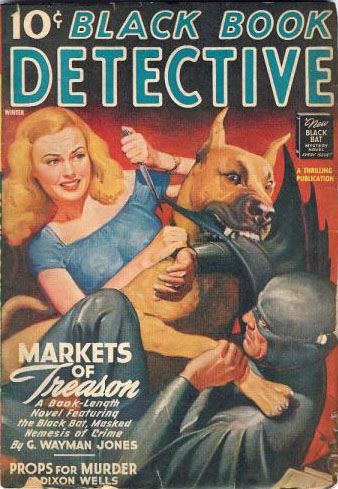
The second is the story of the Bat, a minor pulp character appearing in the pulps’ Popular Detective circa 1934. It concerns a private detective who is framed for a crime and adopts the masked identity of the Bat to fight crime. He carries a gas gun and leaves little stamps of bats on the crooks he catches. The latter was a popular motif with pulp characters and the later pulp-inspired masked men of comics.
The reason for the history lesson is that I came across a website: www.originalbatman.com that discusses how struggling artist and would-be cartoonist Frank Foster created a character actually called Batman in the early 30’s and even shopped him around to the comic publishers later that decade. Imagine his surprise when just a little later, one of those publishers would come out with a title called Batman! Another coincidence on top of that is the fact that as an alternate name scribbled on the back is “Nightwing” a Batman-esque identity adopted first by Superman when in Kandor (1963) and then by Dick Grayson/Robin in the 1980s.
On the surface, it seems pretty damning for DC. Kane has a history of not only doing swipes in his artwork but also for a long time claiming sole credit despite the fact there’s heavy contributions to the story and later the art by creators Bill Finger, Jerry Robinson, among others. Plus, we know Kane was in the area at the same time that Foster was working on the World’s Fair mural, the two could’ve met. The editor of that Superman story is Mort Weisinger who brought many things to Superman that were taken from the pulps such as Superman’s arctic Fortress of Solitude.
On the surface. Unfortunately, we’re dealing with an older man’s memory and his recounting doesn’t really add up to what we know. First, we can go ahead and discount the Nightwing coincidence as being just that. Weisinger didn’t start working at DC until 1941 and the writer Edmond Hamilton in 1946. As Foster claims his work was returned to him, there is no way to connect the name to either of the gentlemen responsible for creating the DC Nightwing character. And, frankly, it just seems highly unlikely in comics’ early days scrambling to reproduce the successes of Superman & Batman, an editor or creator would remember the name Nightwing and yet hold onto it for nearly two decades while various Phantoms, Ghosts, Ravens, and other dark winged birds flitter across the superhero landscape.
Despite Bob Kane’s rather dubious history, it’s also hard to lay blame at his feet. Again, there’s no direct connection. We don’t even know if the editor that he dealt with was the same as whom Foster showed his drawings to. Then you have to wonder why Kane would take time developing an idea that had already failed to sell at DC. You can put both at the World’s Fair. Dollars to donuts, probably half the people in the comic and pulp businesses in New York at the time were also at the Fair at some point.
Sure, it’s all extremely coincidental. But recall that almost simultaneously as Batman’s debut was the debut of the SECOND Black Bat character with a costume looking a lot like Batman’s with the scalloped cape and dark colors. It’s even more familiar to modern readers as Kane at Finger’s suggestion did “borrow” a design element from the Black Bat, the fins on the gloves. Batman originally wore very standard gloves that ended at his wrist. And as I stated there was another Black Bat before that one, though he didn’t wear a costume and we never learned his real name, he was just a detective called the Black Bat. And you had the Bat before that (which Finger almost had to have read and borrowed Batman’s origin scene, it’s too specific). Across the seas there was that Human Bat (though more than likely almost completely unknown over here at the time). Couple that with the Shadow and detectives and rogue heroes called the Shadow, Spider, Ghost and plethora of Green Ghosts and Phantoms, a character called Batman seems almost inevitable. More than a circumstantial case is needed.
Foster’s own faulty memory really messes the issues up. He didn’t remember the editors or people or exact dates (and no real reason he should after all that time). But, those facts are significant as this time period covered 1936-1939. Superman didn’t debut in comics until 1938! Before 1938, DC Comics might be a vehicle for some of his cartoons, but Batman would have been too different. Superman had the luxury of a sympathetic editor, space in a new book to fill and the fact that Siegel and Shuster were already doing a variety of strips for DC. Post – Superman and we’re looking at DC turning down an idea when they were looking for just such an idea and then somehow for some reason passing it off to another creator in a very short period of time.
Yet we know Foster’s Batman (as well as Siegel & Shuster’s Superman) pre-dated 1938 according to the notes. But even then there’s conflicts between history and testimony that needs reconciling. Foster described this in a 1975 interview with a Boston attorney: “ … he got me interested enough to make some ideas up. And it seems to me that in those days, and even now, that most all of the strips were the heroes of the day – such as, flying through the sky during the day and doing good deeds and so forth and so on – and I thought, well, why couldn’t that be done at night? Have a good guy do stuff at night. So, I started working, just briefly, very briefly, not too seriously, with Al Capp, and cooking up a couple of ideas. … one of the things was Batman … “
See, the site says the early drawings are 1932. Superman didn’t debut until 1938. So, who the heck is he talking about flying and such? Just what was his inspiration for the character because the obvious ones just didn’t exist according to the dates on the drawings. Mandrake the Magician was 1934, the Phantom (1936), Flash Gordon (1934). The closest thing to these drawings in the strips was Buck Rogers but it’s quite a leap from Buck Rogers to Batman, even if you have Buck’s anti-grav belt.
Doc Savage maybe? Except Doc didn’t debut until 1933. The only notable hero before this drawing is the Shadow and he was hardly flying around doing good during the daytime. Foster’s other hero on the site is of the Raven, complete with a council of agents it appears is dated the same year as the Shadow’s appearance. But, once you start looking at the pulps, the costume being tights is an anachronism.
Beginning to see the crux of the problem? Foster’s Batman not only pre-dates Kane’s, but it also conveniently pre-dates many of the evolutionary steps along the way, as if he sprung out Athena-like from Zeus’ forehead as a fully realized conceptual costumed comic mystery-man. Foster’s Walt Gibson, Lester Dent, Siegel and Shuster, Alex Raymond and Lee Falk all rolled into one. With a touch of Dave Cockrum/Gil Kane as his costume is very stylized with its design elements compared to the far more simplistic and minimalist costumes of the early mystery men. His cowl alone with the flanged eye pieces is more a design element that would be at home more than a quarter of a century later. Foster talks about his creation as if it’s in response to other characters out there which should place the drawing 1937 at the earliest, but the dates the site claims are the dates of creation would indicate that instead he was creating something truly revolutionary, the first American comic crime-fighter ever to wear a distinctive mask and skin tight costume.
Yet, in 1998, the Boston Globe did run an article on Foster and Batman. You can search for it on the archives of their website. And, as far as my research online reveals, Al Capp was indeed in Boston in the early 30’s.
Posted by
cash_gorman
at
4:42 PM
0
comments
Labels: Batman, Black Bat, Bob Kane, DC Comics, Detective Comics, golden-age, Human Bat, Mort Weisinger, pulps
|