Showing posts with label comics. Show all posts

Tuesday, July 30, 2013

Comics and DC's Golden Age

 Comic Strips: With Comi-Con, it appears a few of the strips over the last couple of weeks wanted to get in on the act. Gotta love "Fox Trot" for embracing the various ages. Where else are you going to run the gamut of Hit Girl to the Jay Garrick Flash? Even DC Comics doesn't want to do that. OK, the "Get Fuzzy" comic has nothing to do with superheroes. Sometimes a pun is its own reward.

Herogoggles: Speaking of Golden-Age DC, over at my golden-age superheroes/supervillains website, I have added pages devoted to DC's heroes and villains of the Golden-Age.. As my brother pointed out, I basically am admitting the project will NEVER be completed because there's no real way for me to read all of DC's comics of the Golden-Age. I don't have the money to buy them and that limits me to the ones they are willing to reprint. And, most of the reprint books like the Archives are devoted to characters, rarely the whole comics. Luckily with the All-Star Archives, they included the Hop Harrigan text stories for example since that wasn't part of the JSA. Marvel's output was a bit smaller with titles and characters having much smaller runs once you look past the big three of Captain America, Human Torch, and Namor. So, it's a bit easier for them to devote a hardback to Mystic Comics for example. It does mean, that certain stories tend to get reprinted a half dozen times. Such as their recent "Marvel Firsts" devoted to the Golden-Age. I was tempted, but I already had half the book in other volumes!

In putting together the lists of characters that I wanted to cover from various sources, I started also looking at the copyrights of a few of the early titles. It was interesting to discover that "New York World's Fair Comics" was not renewed. In addition to having a few Superman, Batman stories in public domain, it's also the first appearance of the Wesley Dodd Sandman! It also occurred to me that some of the public domain comics might actually be availabe. And, a few of them are, over at comics.org! Of course, the quality of the scans vary wildly. Which is sad, since stories with characters like "Wing Brady" and "Barry O'Neil" look like they'd be fun to read. The latter especially has wonderfully dense and detailed artwork, heads above much of what was being published at the time or even years later. You'd have to look at Milton Caniff, Hal Foster, or Alex Raymond for comparable work. However, this makes the strip pretty much a strain on the eyes and unreadable when it comes to low resolution or microfiche reproduction. Barry O'Neil's ongoing war with the Yellow Peril menace Fang Gow continued from the public domain comics over to Detective Comics.

What's enjoyable is to see all of the Siegel and Shuster strips: Radio Patrol, Dr. Occult, Henri Duval, etc. The artwork is open and expressive. Plus, the duo really exploded the limits of the medium, they exploited the visual sides of the medium. The heroes were men of physical action, the menaces larger than life. It's a shame there are a few holes, but how great to see Dr. Occult in action. Henri Duval was a musketeer hero whose storyline just sort of ends to be replaced by an adaptation of The Three Musketeers itself.  The duo must have liked the name as they used it again for a villain to face Dr. Occult.

Sadly, the comics they have seems to run out before getting to Captain Desmo and Nadir. Nadir is a fascinating character. In some ways, he seems to borrow a bit from Chandu, Mandrake, the Shadow... a man brings knowledge gained in the Far East to fight crime. The difference is Nadir reverses the status quo. He's a prince of India! His origin might seem a little familiar, his parents killed when he was a lad he decides to turn his back on his title and devote his life to fighting crime! He masters not only ancient knowledge of the East, he also masters the sciences of the West and now makes his home in New York City!

Then there's the Flying Fox. An aviation hero whose aviator's cap doubles as a fox mask. Sadly, he's not public domain, so the only way to see that character will be buying the original comics or hoping DC makes it available some day. DC would be smart to really gather a lot of this material for posterity and preservation. Even if not making any plans for printing, just making them available digitally for historical purposes. Although a volume of Siegel and Shuster's work would seem to be easily feasible. Most of these were b/w or one color to begin with so reprinting would be cheap enough and you'd imagine there would be some interest in seeing these stories from the creators of their flagship character.

While DC has acknowledged the Crimson Avenger as pre-dating Superman as a masked hero, it's interesting to see Dr. Occult as a brief caped hero with super-powers. Captain Desmo, who like the Flying Fox was an aviation hero whose cowl doubled as a mask, also squeaks by debuting before Superman.  Desmo had some kind of issue, he wore the cowl constantly, even when lounging in his own home. His sidekick asks him about it, but Desmo doesn't get around to sharing that information. The Flying Fox would debut just a few months later.


Thursday, May 16, 2013

More Fred Guardineer

I've mentioned before I'm a big fan of Fred Guardineer. His strong, deliberate line, his use of parallel lines to define shapes, mass, and patterns and juxtapose them against other lines. And, knowing when to leave space open to define shape and dimension. With Zatara, he'd become famous for magician characters, especially the backwards speaking variety. There couldn't be too many companies for which he didn't do a magician hero or two.

Yet before that, he worked at the short-lived Centaur comics where he seemed to be their go-to artist. He did illustrations for various text stories, most notably Dan Hastings, but also other he-man adventurer types. He did sci-fi comics in the Flash Gordon/Buck Rogers type. While he didn't have quite the natural feel of Alex Raymond, he was quite a bit slicker than the art found in the daily Bucks. He also did illustrations for advertising, and slice of life pieces. In this day and age where the time period seems to be one of black and white, his pieces were full of vibrant color.

During this time, his weaknesses came from his strengths. That deliberate line lent a certain artificiality to the world. He was great on patterns, but rarely captured textures and atmosphere as things were often a little too pristine, too ordered and organized. He was Art Deco when he could stand to be a little Art Nouveau, to let a little wildness and seeming arbitrariness in. Figures were often stiff and posed, as life-like as store mannequins. In ten years, he'd show that he conquered some of these shortcomings when working on Durango.

Still, looking at his artwork in the context of what would come after, what would make up the great variety of 1940s comicbook art, and his technical skill and mastery is undeniable. Admittedly, during the later years, many of the more technically proficient artists would be at War as well as being influenced by the bombastic styles of Lou Fine and Simon & Kirby. And, Guardineer was here a bit before them, showing the level of detail and clarity that was obtainable. When looking at his backgrounds and scenes, it's not hard to see echoes of it in Simon & Kirby's depictions of city life or Fine's fantastic buildings, weapons and explosions, the clarity in C.C. Beck's Captain Marvel story-telling, and Mort Meskin's own atmospheric use of lines, patterns and shapes.

These few illos are from 1938 issues of Star Comics and can be found on comicbookplus.com. With that one Dan Hastings pic from below, he came close to doing the first patriotic themed hero!


Tuesday, April 23, 2013

The Fox, The Beetle, and The Gray.

Archie has announced a new series based on one of their original superheroes, the Fox. Here's the first paragraph of their press release:Eisner Award winning writer Mark Waid (Daredevil, Thrillbent) and Emmy winning writer/artist Dean Haspiel (Billy Dogma, HBO’s Bored To Death) are teaming up to launch a brand new series – THE FOX. Taking place in the Red Circle universe, this exciting creative team will deliver an innovative, action-packed superhero story starring the fabled pulp hero.

AAAAARGHH!!. NOT A PULP HERO! It seems fashionable these days to call every character that comes down the pike who debuted in the 1930s and 40s, "pulp". Green Hornet: radio, movie serial and comics, not pulp. Captain Midnight: radio, comics, big little books, movie serial but not pulp. Miss Fury: comic strips and comic book reprints, not a pulp. The Fox: comic books only (and even then a back-up player in anthology books in the 1940s).

What's annoying is one of Archie's heroes did make it into the pulps, but that was the Black Hood. One of the few to start in comics and branch out into pulps and not the other way around.

Is it a big deal? Well, imagine if they said that Mark Waid was the Emmy winning writer and Haspiel was the Eisner award winner. They're both award winning writers so it doesn't matter if you got the specifics wrong, right? If you are going to talk about the history and pedigree of the character, at least get the terms right! It's funny in that they even say he's a "fabled pulp hero" as if these non-existent pulp adventures are well known! Just further drawing attention to the ignorance of the writer. 

Can you imagine any other industry not knowing their own history, apparently superhero writers, editors, publishers and fans not knowing or caring about the distinction between comic strips, comic books and pulp magazines? Would you say Peyton Manning is known as a professional Rugby or Soccer player? Would you read a newspaper or watch the news that regularly called North Korea South Vietnam or take seriously a sportscaster who didn't know the difference between referees and umpires, said that the players, cheerleaders and band members wore costumes but the mascots wore uniforms and that a "match" of football was divided by "innings"? Or a retrospective on Andy Griffith talking about his home-state of Alabama which also served as location for the fictional town of Mayberry, the movie drama where he played a police commissioner? This is not the first time. It's a recurring problem with articles, CBR, the companies and the writers, all using the term with a fairly specific meaning incorrectly. It shows a ignorance of their own history and industry terms. I expect a press release to KNOW what they are talking about and since they are advertising the character and trying to talk about his history to actually get it right.
----------------------------------------------------------
Black Beetle: No Way Out #3. Franchesco Francavilla's Black Beetle mini-series appears to be a success. Francavilla has been making a name for himself with his covers and artwork, reminding me of old-style movie posters from the 1960s and 70s but his subject matter incorporating all kinds of kitsch and love of campy horror and science-fiction television, movies and pulps. Much as Mike Mignola has done with Hellboy and his interest in giant monsters and the late Dave Stevens did with the Rocketeer, Francavilla has channeled his interests into his own character and series, the Black Beetle. The Black Beetle has his roots in pulps and pulp-styled characters, and while there's a hint of mysticism and darker going ons in the "Zero" issue, this mini is more crime oriented, with him investigating who would put the hit on several mobsters as well as having a colorful, larger than life villain lurking in the shadows. The artwork and limited color palettes that Frankavilla loves so much makes it seem both rich but full of shadows and atmosphere.

If there's a weakness, it's in that we don't really get a sense of who or why the Beetle does what he does. In this issue, he's seen without a mask though his face stays partially obscured by shadow most of the time and even then we discover, it's a mask. Now, there are several pulp heroes who we know little or next to nothing about, but in those cases it's also clear that it's a deliberate part of the character's mystique. Also, unlike the Black Beetle, those characters are surrounded by other people who we do get to know a bit about. In writing The Shadow, Maxwell Grant dubbed "proxy heroes" as a term for heroes that could investigate and drive the story while keeping the Shadow mysterious and in the background.  The Black Beetle doesn't have proxy heroes though, nor normal people such as agents, aides, or friends that he can interact with, to give us more of an idea of what kind of man he really is.

I also didn't care for the big fight scene this issue as it goes meta-fictional on us, appearing as if shot from a comic book that wasn't properly lined up so everything at an angle and panels running off the page and the proper order of reading the panels obfuscated by the bizarre layout. It takes the reader out of the world and the immediacy of the action. Interestingly, it shares this with the other pulp-like title that came out this week.

Five Ghosts: The Haunting of Fabian Gray #2. The second issue is a rocking roller-coaster ride from start to finish. Fabian and friend are captured by some odd natives and taken to be sacrificed to giant spiders at the supposed abandoned temple. They make friends with a martial artist who carries a charm that has some kind of link to Fabian's powers. And, we see where the powers can be truly dangerous, especially when one of the ghosts you call up is blood-crazed vampire.

The first several pages is an example of decompressed story-telling where it works. No words, but we see who the woman in the coma is and what she means to Fabian. It uses cinematic storytelling and widescreen panels to good effect. However, it also fails in that it goes just a little too far in being clever for clever's sake and not simply for good storytelling purposes. Because, the method is that each panel on the page is from a different point of Fabian's past. The top panel of each page tells one narrative, the second from each another and so on. However, it's more than two pages and starts on page 1. It's only when you turn the page that you see what they are doing. And, then to properly follow the sequence of events, you have to turn the pages back and forth for each narrative. This would work fine on a two page spread where you can read straight across the spread, but doesn't really work for more than two pages as it makes the reader aware of the mechanics of following the story.

Likewise, the sequence really was needed to have been in the first issue as it explains a lot of the motivations and relationships of the characters especially in terms of this specific story. Probably will read fine when read in one sitting or in the eventual trade.

Masks: It appears as if Masks is throwing the other conceit or premise the mini-series was based on out the window. The first being that this is a team-up of various pulp characters. Several are not only not pulp, but others are given new origins and back-story for the purpose of the mini, so it's not the characters at all but thin copies. The other premise was that this is supposed to be a retelling of sorts of a specific Spider novel. Thus, you expect some fidelity to that source material. However, the latest issue that I've received seems to be setting up the Clock as the main bad-guy. Now, I've not read the original Spider novel this storyline is from, but I'm reasonably sure that the Centaur/Quality hero was not behind it all. Not to mention the cliche of having it being a former hero going bad or trying to justify extreme actions through "ends justifies the means" excuse. Again, the premise works when the creators byword is "fidelity". As the series is winding down, can only wonder, what's the point of it?
 ----------------------------------------------------
 One of my favorite revivals was in the 1980s when Archie published The Mighty Crusaders. Of the many times that companies have dusted off old properties and characters, this is one of the few times that I thought a company did it right. At least in the beginning. At the time, I had no awareness of the original comics of these characters or the history of them other than what the press releases told us that these guys had been around for awhile.

See, it didn't matter that the last time most of these characters had been seen were almost two decades before. The series played it as if it was just two months ago.  The series didn't act like they had been retired or away for any extended period of time. A nod to the 1940s history of the original Shield, but no one asking where the others had been since they last appeared. The first few issues worked great at reintroducing these old characters, allowing them to have their history without bogging a new reader like myself with continuity knowledge. The fact that each of the heroes could have their whole origins explained in about six panels in the back is a testament to the power of a good concept and compressed storytelling.

Recognizing they were a little light in diversity, instead of changing the gender or race of established characters, they created a couple of all new ones! Won't say that Darkling and Malcolm Reeves were necessarily stellar creations, but they could be accepted on their own merits without sacrificing the standing of any other characters.

Every revival of the team since then has been "let's not do that". Admittedly, that revival didn't last long, but I chalk that up to the quick downturn in quality. Dull writing, lackluster villains, even the printing became cheaper. Somewhere, they forgot that Steel Sterling should be the equivalent of Superman and became just a body-builder hero with teen hanger ons and social interest storylines that felt almost like recycled plots from afternoon specials. I think if they kept up with the richness of the superhero-verse they started with: giant robots, space aliens, beings from other dimensions, magic and science-fiction, dangerous supervillains, etc. Heroes being heroic fighting villains being bad, it might've been something really good.

So, not much interest in Archie's current take. Most of the heroes are back long enough to be shown to have gotten old and then getting killed. The focus is on a diverse cast of teens taking on the predecessors' names. Right off the bat, it's more like the other attempts with these characters in that it's about people with the same names. And, despite all the death and teen angst, the artistic style is cartoony as if that's all it takes to make it "fun".

Remember when DC wanted to youthen the JSA a bit so they brought in a grown up Robin, a time-tossed Star Spangled Kid and CREATED Huntress and Powergirl. Later, Thomas would create Infiniti Inc., new characters that didn't automatically overwrite the old ones


Saturday, March 09, 2013

Bob Larkin needs help

Most of the pulp fans are probably already aware of this. But, I thought I'd share this with some of the comic fans that may be unaware.

I first became aware of Larkin's name when he became the main replacement for James Bama on Bantam's Doc Savage series. He was a good choice in that he had much of the same sense of heroic realism of Bama and Boris. He also managed to get Doc in some other clothes for a few of the covers. It was only in retrospect that I realized I had seen his art for awhile as he did quite a few painted covers for Marvel's comics and paperbacks as well as the painted and pulpish covers for Warren's Rook magazine among others.

Bob's wife, Fran, has been fighting cancer for the past 12 years and the medical bills has put them under an incredible financial strain. She is currently recovering from her latest surgery and Bob has become her caregiver around the clock, leaving him unable to take on new work.

Thankfully, fantompress.net has been working with Bob the past few years, doing primarily Doc Savage based items with the profits going to Bob and family.

They've also been working with Bob about putting together a sketch book featuring Doc Savage as well as Batman, Stewie, the Shadow, and a bunch others. It has finally come to pass as the books are fresh from the printers. Each is square bound, 8 ½ x 11" 48 black and white pages and are individually signed and numbered by Bob. The paperback is b/w, signed and numbered of 500 copies and is $20 per. The special hard cover includes an extra 8 pages of color of new paintings of Doc and friends. Thirty signed and numbered copies for $60 apiece. The Deluxe has the extra 8 pages plus choice of original water color illustration (5x7 on 8 1/2x11 board) along with custom storage case. Only 20 copies and is $500.

100% of the sales are going directly to the Larkins as well as anything else that might interest you on the site.

www.fantompress.net

Tuesday, December 04, 2012

Masks and other comics

Masks #1: A solid if unexceptional first issue focusing mostly on the Shadow and the Green Hornet and Kato and laying down the foundation of the threat, of the "Party of Justice" taking over control of the city of New York, its police and courts. Likewise, the painted artwork by Alex Ross is pretty to look at. I personally chose the Francavilla cover. He is one of the stronger artists with a more unique style and approach to layouts and colors and perfectly suited to the pulp and noir storytelling feeling of such a book.

I don't know much about the particular Spider novels that serve as the inspiration and source for the plotline. Kudos to Dynamite to running an ad for places to get more about it. However, I've read several that have a similar set-up and feel.

There are questionable things concerning it, still. The story is to feature the Black Bat and we see him as Tony Quinn his alter-ego here. However, it's from the time before he was blinded and became the Black Bat. He's one of the few pulp heroes whose origin is pretty much given and does not leave much wiggle room to fit in another epic. In his pulp origin, he's a lawyer as seen here, only is blinded by a criminal who smuggled in some acid (the chemical not the drug). An act that will seem familiar to most comic fans as that's the origin for both Two-Face and Dr. Mid-nite. He retires from Law and becomes a recluse. He's visited by the daughter of a slain sheriff and agrees to an eye-transplant with the lawman's eyes. The operation is a success and leaves him with the extra ability to see in the dark, though he still has the acid scars around the eyes. With the sheriff's daughter and two other aides, he decides to let the world to continue think he's blind while he remains retired, acting as a sometimes consultant and the masked and costumed vigilante the Black Bat.

Nor does this crossover actually line up with the portrayals of the Spider in his own comic. Visually, he looks the same, but this is set in the late 1930s and his pulp novel while the main series is full of retcons and set in the present day. Time will tell if his supporting cast will be at least truer to the pulps or to the retcons. The story continues the Bruce Lee influence of Kato, which makes it hard for Green Hornet to seem really a peer of the likes of the Shadow and Spider.

Conversely, the upcoming covers featuring the Black Terror have him in his classic costume and not Alex Ross' redesign. But, Miss Fury is being shown in a re-designed costume.

Storywise, the main thing that doesn't really add up is the discussion between Britt Reid and Lamont Cranston concerning Law and Justice. Thematically, it fits as the Party of Justice is about a group taking over and subverting the law with criminals being enforcers and agents of the new corrupt laws, leading to men of justice becoming outlaws. However, the discussion doesn't really fit. Reid as the Green Hornet is a man who fosters the idea of him as a criminal, to act outside of the Law. If he truly believed in the Law over Justice, he wouldn't be a masked vigilante but fight solely from within the system as a crusading newspaper publisher. It's a scene for the sake of the story and not growing out of the characters.

Otherwise, the writing is solid. It introduces the heroes, a brief hero vs hero fight (though it should be the Shadow vs Green Hornet, Shadow vs Kato is akin to Batman fighting Bucky or Captain America fighting Robin... even the tv show got that right and had Kato fighting Robin), A discussion of the heroes in civilian identities over the problem. We get the introduction or teases of a couple of other characters but otherwise see the criminal group in action, enforcing the new laws. Ends with the heroes fighting overwhelming odds and the addition of another hero to the ranks. The writing is tight. It doesn't try to introduce every character at once. Where it does offer glimpses of future heroes, it's in scenes that also serve in showcasing the corruption of the Party of Justice and building storytelling tension. There's talking, but also plenty of superhero action.

While Ross did the artwork on the first issue, he's not the artist on the subsequent issues and as far as I know the future artist hasn't been announced. The cynic in me is so that retailers and readers will have to commit at least to the first couple of issues. Ross is a good painter. However, he's not a great storyteller. Panel flow is often clunky and he overuses his trick of casting the viewpoint beneath the characters to make them seem larger than life. Combined with tilting the angles of the panels making it seem some heroes are flying and shifting the viewpoints from low to high can cause a bit motion sickness. It feels as he's almost approaching each panel individually without much regard to the storyflow from panel to panel. His Lamont Cranston looks like an old man, and I've never found his women to be all that attractive. So, the scene of the Cranston and Margo in the Cobalt Club doesn't really give a feeling of jazz, glamour, or sophistication.

There are many that don't see a problem with the portrayal of women in comics. One can look no further than this comic to see the gap and issue. This comic will feature heroes from pulps, radio and comics the Shadow, Spider, Green Hornet and Kato, Zorro, Green Lama, Black Bat, the Black Terror and Miss Fury. Among all those men, one woman out of all of comics and pulps from the era though there are several that would fit. Instead of the oddballs such as Zorro and the over-powered Black Terror, women heroes like pulp's Domino Lady and comics Woman in Red, Invisible Scarlet O'Neil or Phantom Lady would  better fit. To add insult to injury, one of the alternate covers of the first issue featuring Miss Fury is her half out of costume as is one of the future alternate titles. There is no similar depiction of any of the male heroes.

There are a few other male pulp heroes I wouldn't mind seeing over the Black Terror and Zorro either: Jim Anthony, Phantom Detective, the Black Hood, Angel Detective, the Park Avenue Hunt Club, Operator 5, the Avenger, Secret Agent "X", the Crimson Clown, the Ghost, the Purple Scar, Skull-killer and the Octopus/Scorpion. Maybe the latter can be the next story. A sequel to the the Octopus and Scorpion pulps, clearing up some of those loose ends and having the two villains teaming up with Wu Fang bringing various pulp heroes together again.

Another big flaw is that at the price of comics today... the first page is wasted to a black title page with credits and acknowledgements. The second page is all black with the publisher information at the bottom... the story doesn't start til page 3!!? Why aren't those two pages just one page? Or better  yet, at the bottom of one of the story pages as most comics do? Sure, that would mean reducing a page of Ross' artwork or putting non-story text on it, but it would free up two more pages for art. At the very least, print some of the alternate covers, original pulp covers or sketches on the pages. Seriously, an all black page at the front of the book? Before I even began the story I had a bad taste in my mouth.

Talon #2: Ok, second issue (or 3rd if you count the zero issue) and there's a guest-artist? Right on the heels of Snyder online praising the work of the artist. I'm out.

Aquaman #14: Like Masks, a set-up issue, following up the the events of the last issue and setting up the next arc. It tells us what happened with Black Manta, though not a single mention of The Others.

This issue has been billed as a good jumping on point, but it's not really. Because, for the most part it is incredibly dull with a lot of talking and Aquaman not doing much. We get some heavy handed dialogue as to why Aquaman is cool and tough, while Black Manta turns down an offer to join the Suicide Squad. Only, there's nothing to tell new readers who or what the Suicide Squad is. There's a tease in dialogue concerning Garth. However, as this is a new reality, how much this Garth will be like the old Garth remains to be seen. A long dialogue between Ocean Master and Aquaman concerning past events. A scene with Vulko as an Atlantean body washes onshore conveniently near where he's been in exile. A bunch of disparate scenes, with little to tie any of them together, especially if you've not been following the title and very little action, but a whole lot of talking. The only scene with oomph is Black Manta asserting his Bad @$$-ery while in prison while talking about Aquaman and turning down the Suicide Squad.

Pete Woods is the guest artist for the title and he does a good job, didin't really miss Ivan Reis. Being aware that it was a guest artist, I looked to see if the odd widescreen panels would occur. The answer to that is "yes" and there was a page with just 4 extreme vertical panels. Woods does a better job at disguising it though, there's not a lot of empty space or odd croppings of figures other than a couple. This leads me to conclude that while Reis is the flashier artist especially when it comes to the figures and faces and with more finer line detail, Woods is actually the better storyteller and better at executing the script. And, that much of the fault of the odd panels and its effects on the storytelling as well as padding out the comic is coming from the writer and not the artists. Will be interesting to see what new artist Paul Pelleitier will be able to do.

Friday, August 17, 2012

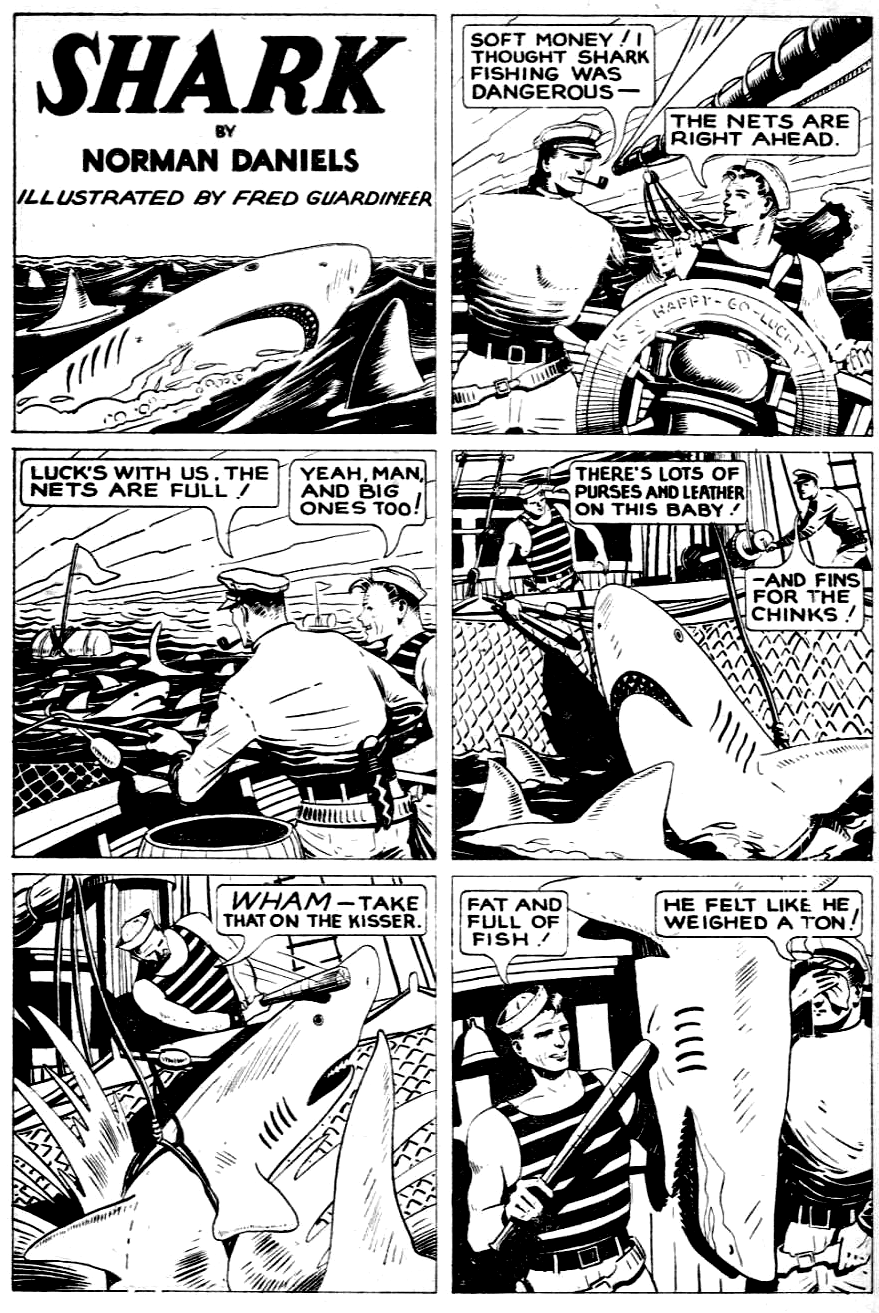
 Been reading some golden-age comics over at comicbookplus.com (formerly goldenagecomics.co.uk). Going over some of the Centaur comics for info for my golden-age encyclopedia website and I am again struck by the talent that was working at this relatively short-lived company. In Keen Detective Funnies #6, there's a story written by prolific pulpster Norman Daniels and illustrated by Fred Guardineer, before he became known for doing backwards speaking magicians. Another story has artwork credited to Hoffman but shows some Milton Caniff/Frank Robbins type of style. Lastly, an early story by Will Eisner that's very much a hard-boiled story though still showing some of those atmospheric qualities he'd be honing to a razor's edge by the time of The Spirit.


Tuesday, July 24, 2012

The Dark Knight Rises

Been a point of view of mine for some time that if you are going to go off model, make sure that your version, your vision is strong enough and compelling enough to warrant it. When Ditko did something decidedly different with the Blue Beetle from what went before, his Ted Kord creation was that much better than what was being done by Charlton before. When Denny O'Neil and Denys Cowan did The Question it was very different than what Ditko had created, but they ended up like Ditko creating a series that was unlike anything else at the time.

Nolan's Batman films are along the same lines. Much of the character is still there, still recognizable under that padded armor. In some ways, his Batman is an outgrowth of Tim Burton's. The suit, the sci-fi look of the vehicles. Yet the difference in the storytelling makes it as different from Burton's as Burton's was from the 60s television show. Nolan sees and wrings out real story from the mythos. The characters are fleshed out, each having their own story, their own point of view. More importantly, he never loses sight as to whose movie this is.

So, I can forgive the liberties taken from the comics, because while watching I am fully vested into the story. I am impressed with how this movie ties into the other two, making them all feel as one narrative yet each one still stands well enough on its own. At almost three hours in length, other than the needed bathroom break, it didn't feel that long. There was just that much story going on.

Unfortunately, it's after getting out of the theater and thinking about it that the problems do come to mind. Where the themes that movie espouses on one hand are completely undercut by the movie itself. The one flaw that comes to mind while watching the movie is the ridiculousness of the suit. He is so armored that the flimsy cape is obviously a completely different material and looks out of place. Imagine Iron Man painted gray and then someone puts a cape of gauze and you get the general idea. The armor interferes with movement and having any really good choreographed fight scenes and then when he really needs armor... he is very easily stabbed.

I don't like guns but I will use cannons. A lot. He makes a point to Selina Kyle that he doesn't use guns. But, he in fact uses them quite a bit as all of his vehicles come equipped with deadly offensive weaponry and we see them getting used a lot. He even has weapons that look like guns, they just don't fire bullets.

Batman is a symbol. Anyone could be Batman. Providing they have access to millions and weapon prototypes. Tony Stark could be Batman. But, hardly anyone else. Special fighting skills not really required. Yeah, a recurring problem with the movie is that there's a lot of Batman using and fighting from vehicles. He mentions several times and the ending plays out the idea is for Batman to be a symbol, to inspire people to take up the good fight (not necessarily to become Batman themselves per se). But, for most of the movie, his being Batman is because of the cool toys he has, toys that he won't share. This is further underscored near the end when comes back after being sent away by Bane and he has lost his fortune, vehicles and weapons. This would have been a prime time for Nolan and Batman to prove what he's been saying: that he puts together a costume, one of cloth and simple leather and still fights back and wins the day. Instead, luckily Lucius had a few spare items for him and his flying vehicle is parked on a roof where no one has been able to see through the camouflage that doesn't look anything like what's around it.

Bane: I must break Batman physically and spiritually even though he's already broken. Maybe Nolan liked this theme so much, that's why it's in there twice. Bane makes a big spiel about beating Batman, not just physically but spiritually. He busts Batman's back and sends to the hell-hole of a Middle-Eastern prison that he's from. The problem with this is the movie starts off with Batman already broken. His leg is busted, he's been a recluse for years as both Bruce Wayne and Batman. He's a man just waiting to die. For the most part Bane defeated a man that was already defeated. In reality, his escape from the prison isn't about him escaping from the prison Bane sent him to but the one he already was in. This kind of lessens Bane as a villain though. He doesn't defeat or arrange a defeat of Batman at the top of his game, he doesn't really push Batman into a place he wasn't before.

 I am the world's dumbest detective. He seems oblivious to many things and has to be told about them as opposed to figuring them out for himself. A couple of revelations would have worked better if we were shown Bruce Wayne figuring them out as opposed to being told to him, one while a knife was in his back.

Ok, they have references to Selina Kyle being referred to by the press as a thief called the "Cat" but nowhere is that really explained. In fact, about the one type of thieving she doesn't commit in the movie is cat burglary. The movie also has her friend, Holly Robinson, but I don't recall the character being called by name once during the movie. Something that is increasingly becoming a pet peeve, characters with names in the credits but never named in the actual film. But, how they can get her costume pretty close and hugging every curve, not at all realistic for a cat burglar and Batman is heavily armored and padded. Beyond her being a gorgeous woman.

Another area where the film kept me guessing to the end was Joseph Gordon-Levitt's role as the policeman named Blake. Incidentally, what's up with IMDB having spoilers to one character's story arc in the credits but not another? The problem here is that there's a character named Blake that is part of the Batman comics already ie that's the real name to Catman. Someone, somewhere should have pointed out that his name needed changing. The final revelation was a bit stupid, a little too cutesy in a movie that otherwise stayed away from such stuff. Hire a woman and make the character Montoya. Or keep Levitt and name him Bradley, Corrigan, Harper, Richards, Garrett, Bard, or something. But, his being named Blake was almost as much of a distraction as recognizing so many of the supporting actors popping up in roles and trying to place them such as Burn Gorman (no relation). I kept expecting that there to be a reason for him to be named "Blake".

All in all, this is a very good movie that's close to being great. Many of the problems were easily fixable just by making the costume closer to being something a person could easily move in and have Batman do a bit more hand-to-hand and less from a cockpit.

A neat little nod, or maybe it was just me, but the logo and mascot to Gotham's football team? A dead ringer for the Shadow only with a  yellow scarf instead of red. The plot itself of Bane taking over the city, criminals holding court against cops and ordinary citizens? Straight out of several Spider novels to the point that at times I felt like I was watching something that would almost work better as a treatment for the Spider.

Friday, October 24, 2008

20 Most Significant?

I love Steven Grant's column on comicbookresources. At best I agree with about half of any of what he says, but as a longtime professional, his insights to the industry are informative and interesting. At worst, he's what Holmes would credit of Watson, while not a source of light, he reflects it and is often illuminating ie I may ultimately disagree, but what he says does make one think.

His most recent column about the 20 most significant comics fired up the boards as most lists are apt to do. Some of his choices were interesting such as American Flagg and Blackmark. Not really up on the independent scene at the time though I sampled quite a few of the comics from First and Eclipse, it's hard for me to judge how significant those and some of the others actually were.

A few of his other choices I disagreed with. Such as the Showcase debut of the Flash. If any "history" is a myth it's that of the debut of the Flash signifying a great superhero revival and the start of the Silver-Age. In an older post I explored in more detail the various "ages" of comics and the context of the Flash and the other heroes debuts. Ignore the conventional wisdom of when the "ages" were as they are nothing more than convenient constructs and look at the broad picture of superhero comics and the debut of the Flash is just one blip among many before and after, at about a steady rate all told. There is nothing any more significant about that comic than a host of others. The "Flash of Two Worlds" is a far more significant comic in the scope of superhero history.

What's also puzzling is his choice of Amazing Spider-man #1. What little of the logic he applied to Showcase would by default kick out Amazing Spider-man in favor of at least his debut in Amazing Fantasy or the true comic: Fantastic Four #1. But, even when talking about significance, everything that is significant in Spider-man is first found in the FF. When truly looking at a logical start of the Silver-Age, it's the Fantastic Four. It's the first "new" superhero comic. While it is still built upon comics and superheroes of the past, in style, themes and substance, it is new and different from how they've been done before. Spider-man may have been the more popular and the more significant character especially in terms of the Marvel Empire, but it's not the more significant comicbook in the context of comicbook history.

Of course, as talks generally go, it gets one thinking exactly what would be one's own list. Mine is more superhero-bent, it's what I read and enjoy, and it's all American based comics. But, if I had to compose a list:

If I had to list with a slightly more supehero-centric list:

1-3 of Steven's list is correct and would be foolish to try to come up with something better.

#4: Whiz Comics #1: While taken to the courts as infringement, Captain Marvel was significant: it recognized we don't want Robin to identify with, we want to be the hero. The ultimate in wish fulfillment and a modern day fairy tale in superhero form. Might be impossible to gauge whether it was he or #5 that is responsible for all the Captains that would eventually litter the superhero landscape.

#5: Captain America #1: the title that really launched the patriotic superheroes, from Captain America punching Hitler on the nose. No messing around with fictitious dictators and countries. The tail would wag the dog as Irv Novick, the artist on the earlier Shield would change his artwork to match more closely Simon & Kirby's work hyperkinetic artwork. Not the first patriotic hero nor the first of S&K teaming up, but this is where they became a recognizable force and influence on comics for the next couple of decades. Just a Robin may beat out Bucky as a kid sidekick, most of those that followed owed more to Bucky down to using their own names in lieu of code-names.

#6: Whiz Comics #21: The introduction of the Lieutenant Marvels. May not seem like much now, but this was the first attempt at franchising a superhero; not introducing a sidekick, but other characters capable of carrying their own strips based on the popular lead. Soon, Marvels were everywhere at Fawcett: Captain Marvel, Captain Marvel Jr., Hoppy the Marvel Bunny, Uncle Marvel, Freckles Marvel, the Aunty Anti-Marvel, the whole Sivana clan and culminating in Black Adam, the evil Marvel. To them we owe Supergirl, Superboy, Superwoman, Bizarro, Batgirl, Batwoman, Bathound, Bat-Mite, Man-Bat, etc

#7: Pep Comics #41: Archie debuted sometime earlier and even appeared on the cover since, but from here on out, he starts out figuring prominently on the cover, slowly edging the Shield out. He goes from being an above-average back-up strip to a cultural phenomenon. The times are changing.

#8: All-Star Western #58: With this, the title that gave the JSA a home for a decade became a Western, superheroes were going dormant. Westerns that had been around for a long time as a minor part of comics would now be a dominant genre for the next two decades.

#9: I'll concede to Crime Does not Pay for the reasonings that it helped fuel the campaign against comics and the formation of the CCA.

#10: FF #1: The first true SA comic book. DC's SA was still being fueled by the late 1940's and early 1950's, Marvel recreates the superheroes into something new. Like the GA, the heroes are rooted in their times, the fears of communism, the space race, science unchecked. The heroes bicker, they are cursed as much as they are blessed and can be motivated by selfish means (in this sense Amazing Fantasy #16 is more significant than the first issue of his ongoing, the theme that with power comes responsibility vs our selfish nature that contributes to unhappiness and undoing).

#11: The Flash #123: "Flash of Two Worlds" the beginning of modern continuity sensibilities at DC and in a sense giving a measure of power to fans.

#12: Fantastic Four #49: issue #48 started the storyline, but Galactus' first appearance is here. There had been cosmic stories and stories featuring gods, but the power and scope of Galactus and the Silver Surfer as done by Kirby, it showed what his creative mind was capable of and unlike anything before. It set a whole new benchmark for what superhero comics could be and what cosmic really meant. The Legion had the Sun-Eater, which is probably a bit more realistic, but his nature doesn't achieve the Greek tragedy heights of the characters of the Watcher, Galactus and Silver Surfer. The best creators today are still trying to catch up to what Lee & Kirby were able to do here.

#13: Mad: Another one I cannot fault his logic for inclusion.

#14: Green Lantern #76: I was torn on this or The Amazing Spider-Man #96 which ran without a comic code seal of approval. But it's with this issue of Green Lantern, that superheroes started rediscovering their relevancy. The true significance of these titles was far more subtle than generally recognized. After all, the more serious and relevance take didn't signify higher sales and it went back to being more straightforward space-opera soon enough. However, Denny O'Neill brought a bit of that sensibility to every comic he wrote and edited. Writers and editors would follow suit in other comics, reflecting more of the culture and society unrest, expanding the types of stories superheroes could be about and the power of the CCA was weakened as not carrying the label didn't bring doom and gloom upon a comic. There's a reason why issues of this run are among the most reprinted comics in one format or another, never staying unavailable for long.

#15: Amazing Spider-man #121: There have been deaths in comics before and Peter Parker had his share of heart-ache and break-ups. But no character's death has ever really served as a watershed moment as did the death of Gwen Stacey. That the hero would not only fail but be partly responsible for the character's death, it's a true landmark comic. If Quesada and company were really daring about rebooting the character, they should have undid this issue along with the wedding. That really would have set things in an uproar and made for some interesting stories.

#16: Swamp Thing #20: Alan Moore takes over the character and redefines the concept of horror and superhero-esque titles written for adults. To be fair, he had done this before this title but it's here where he made his name and where he laid the groundwork that would give rise to the British Invasion of comics writers and make works like Neil Gaiman's Sandman, Morrison's Animal Man and Doom Patrol possible and eventually lead to the creation of a whole imprint, Vertigo. It is doubtful that we'd have seen other revisionist superhero works like Miller's Dark Knight Returns, O'Neil's Question, Grell's Longbow Hunters if Moore hadn't paved the way here first. I say this and recognize this, but I miss the way Swamp Thing was before Moore got his hands on him.

#17: Maus. I've not read it, but I respect and recognize its achievements.

#18: Cerebus. No specific issue and I don't agree with a lot of Sims' point of view. But, it is a testament of a creator forging his own path and creating his own work and unique vision. A lot better example to hold up than Youngblood.

#19: Teenage Mutant Ninja Turtles. Not every one was significant for being good. I agree with Steven on this one. I think one has to acknowledge the success of this questionable comic parody lead to a boom in independent comics and readers recognizing that b/w is a viable option and at least trying various b/w comics whether it be various output of Dark Horse, The Southern Knights, Cerebus, Zenazoic Tales, or Adolescent Radioactive Black Belt Hamsters. 90% of what it helped spawn was dreck, but there was some good stuff too. Wish someone would bring back the Southern Knights.

#20: Crisis on Infinite Earths. This is basically a tie between it and Watchmen. Two great and landmark works yet, both have lead to the excesses of the 90's of modern revisionism and strip mining continuity while pretending to be honoring history by recasting heroes as ineffectuals, fascists and closet fetishists, where creators' egos feel their version trumps all that went before... to write continuity driven stories while creating retcons right and left, stories about continuity instead of with continuity.

Somewhere in there I would have liked to include the likes of Camelot 3000. I may be wrong but it is or close to being the first maxi-limited series, not based on superheroes or continuity, had Brian Bolland artwork, printed on high quality paper-stock AND intended for the direct market to boot. One of the first showing DC taking away from Marvel the role as being the innovator and producing comic intelligent comics for adults and not just kids. But, then again, some of that can be credited to Alan Moore's Swamp Thing as well. Then, there's The Death of Captain Marvel, the first original graphic novel that lead to some pretty good original graphic novels out there. And, one of the best death of a superhero stories ever done. Had the graphic novel format been a bigger ongoing success, who knows. Maybe it was just too early, the trade market not really existing like it does now.

Wednesday, August 01, 2007

Who's Going to Watch the Watchmen - Watchmen movie confirmations

the WatchmenMy brother sent me this blog link at Rorschachs Journal saying the Watchmen movie cast has been confirmed. The only cast member I recognize is Jeffrey Dean Morgan (Supernatural, Grey's Anatomy) cast as the Comedian - an important role, but not a very extensive one! While we're on the topic of Morgan, I find it interesting that last season both of his characters were both killed off on their shows, but this past season he was able to reprise both roles and yet remain dead in both!

It's interesting that the Watchmen movie may be coming to fruition now, on the heels of DC's Identity Crisis saga. The Watchmen story originally was an exploration of the heroes from Charlton comics that would have left these iconic characters unusable:

  • Dr. Manhattan = Captain Atom
  • the Comedian = Peacemaker
  • Ozymandias = Peter Cannon, Thunderbolt
  • the 2nd Nite-Owl = the 2nd Blue Beetle (Ted Kord)
  • Rorschach = the Question
  • Captain Metropolis = Judomaster
  • the 2nd Silk Specter = Nightshade
What Dave Gibbons and Alan Moore (who has a history of mucking about/deconstructing established characters) chose to do instead, was to create characters from scratch that built on the archetypes of the existing characters, so that they could express their story while leaving the originals intact. DC, on the other hand, has recently chosen to take another route to revise old characters by introducing successors after killing off the originals.

I've always had a fondness for both of the Blue Beetle characters and felt that Ted Kord's death in Identity Crisis was pointless, as they could have easily used any number of characters that have lapsed into obscurity, such as one from the Bloodlines story arc, for the same effect. And why not resurrect a youthful Dan Garrett with a new look (Ditko left plenty of room for even a writer of limited ability) in stead of giving the scarab to a new kid?
- But I digress!

While they may have a cast lined up it's still way too early to start planning your Watchmen parties as we've seen time and again great comic to movie concepts fall victim to a variety of early deaths and indefinite delays. That being said, Warner Bro's has set up an official site, though there's nothing there but the proposed date of March 6, 2009, and IMDB has a listing for the Watchmen movie. Additionally, according to a Wikipedia listing, this single frame of Rorshach was imbedded in Frank Miller's
300! Again, this is Wikipedia, so this may not necessarily be true, but possibly may be! I'll be keeping my fingers crossed.

Watchmen movie

Tuesday, April 10, 2007

Ghost Rider creator sues Marvel, Sony, Hasbro, Take Two, ...

I just read about this lawsuit on Yahoo news. Apparently creator Gary Friedrich alleges that ownership of his characters used in the Nicolas Cage film and ensuing toys, games, etc. reverted back to him in 2001 due to Stan Lee's Magazine Management, now Marvel Entertainment's, failure to register their claim for the copyright. Click here for the full article.

My first thought was that he probably wanted his name removed from the thinly plotted film (I wasn't impressed with the movie and felt that with minor changes it could have been loads better. You can read my review here. Personally, I blame director Mark Steven Johnson, who also directed Daredevil, which came across arguably more cookie cutter flat).

My second thought though is why wait this long to file a grievance? Marvel announced their intent to make the movie way back in May of 2000 at the Cannes Film Festival. I think the answer may be that Friedrich, feeling that his character creations and their comics were intentionally misused resulting in his being under-compensated, let Marvel continue their production and release until the movie had run its course in the theaters, so that he could hit them with this lawsuit now and capitalize on all their hard work to date.

Maybe Friedrich felt that if he waited until after the dvd's hit the shelves it would be a little too "on the nose" for a judge to think it was just another case of slow to act lawyers.

Monday, April 02, 2007

Marvel Brings Back Hawkeye


Well, kinda anyway!

Tuesday, March 27, 2007

Marshall Rogers

Don't know all the details, but Marshal Rogers passed away at age 57. He hadn't done a lot of work in recent years, a mini-series here and there which really is a crying shame. Loved his work that I came across back in the 70s, reminded me as a more polished slick Walt Simonson. He helped redesign a couple of the Batman villains: Deadshot and a new Clayface. Despite quite a bit of work on other characters and projects, it is with Batman that he's chiefly associated. Here are some samples of his work:


Saturday, March 24, 2007

Before Frank Miller's 300

This came from an old Captain Marvel comic. It was a one page splash to interest the readers, usually kids, in historic events. Click on the picture for a larger view.

Thursday, February 22, 2007

Special Effects is No Substitute for a Good Story

The past two nights I've gone to the movies. The first night was to see Ghost Rider, and the second was to see Indiana Jones and the Raiders of the Lost Ark again on the big screen. Wow, what a difference!

Ghost Rider was mildly entertaining, and I liked the nod to the western comic character, but just wasn't as good a movie as it could have been.

Movie Plot Outline:
1. In keeping with the traditional comic book style, the hero must first defeat the big baddies henchmen. Cut!

2. Then he must defeat the big baddie himself. Cut!

3. Then he must make a speech about how he'll always be vigilant should a similar threat arise. And .....Cut! That's A Wrap People!

My 3 chief complaints about the movie:
1. The henchmen were too easy; There just wasn't enough conflict! Ghost Rider took them out one by one with no problem. They could have easily remedied this by either having them gang up on him at first, leaving him for dead, and have him actively go out to take them on individually or have him learn his own limitations and apply them to defeating the villains. Which brings us to point #2.

2. The character didn't "grow." You just didn't know anything about the character so you really didn't care. Wasn't it a curse? He never seems too broken up about it. I believe they tried to cover this by showing how Blaze has stacks of books about the occult but it just didn't stick. You didn't see him as being desperate to find a loop-hole. I know, you can argue that he just wasn't sure the deal he made really happened, but there wasn't any indication that he was actively trying to find out (questioning priests, mediums, etc.) Which brings us to point #3.

3. The "I'll never rest until I stop you" speech at the end was completely out of character. They showed that Blaze had all these books on the occult, and that he enjoyed watching National Geographic, but they never showed that he was intelligent. If the Lady-in-Distress hadn't been named Roxanne, all of Cage's lines might have been mono-syllabic. Once again, easily fixed perhaps by showing him translating the occult text from latin, or by showing that he put on a dumb adrenaline-junkie act for the press.

All-in-all I was disappointed in the movie. The special effects were very cool and well done, Ghost Rider is just a cool looking character and its great that movie technology can do it justice, but there has to be more than just special effects.

Indiana Jones and the Raiders of the Lost Ark

Raiders came out in 1981; that's 26 years ago (I know that's obvious but until I stopped to do the math '81 just didn't seem to be that long ago!) Oddly enough Raiders is also based on a comic book (Disney's Uncle Scrooge comics that had Scrooge, Donald, and the nephews searching for lost treasures) that both George Lucas and Steven Spielberg had read. But the movie has more of a pulp novel feel. I wouldn't be a bit surprised to find out that Lucas and Spielberg applied Lester Dent's Master Plot to the script, particularly the varied fight scenes (sure Indy wins 'em, but he takes a beating in the process: "It's not the years, it's the mileage!") The movie stands on the solidity of the story. In fact the only real special effects are in the last ten minutes of the movie.

Now I'm not in the movie industry, but it seems to me if you take a good story, with good characterization, and good acting and then add to that modern day special effects if you must, you'll be left with a great movie that is long remembered and people will watch over and over when it comes on TV (I've seen Jaws hundreds of times, but when I'm flipping channels and stumble across it I usually stop and watch it to its end, and thats saying something considering how often its on TNT and AMC), and will probably want to own on DVD. Wouldn't that create more residual income for all involved and be a good reason to not rush an unfinished project. Not to mention the added potential for sequels, prequels, re-makes, and franchise options.

I mean, who's not going to watch the forth-coming Indiana Jones movie?

Saturday, February 10, 2007

Yesterday's Post That I Didn't

Yesterday, I thought I would make a post inviting feedback. The topic would either be:
1. Most memorable comic book scenes or
2. Overall favorite comics (individual, mini-series, or ongoing titles).
I told my brother to get his input, after all this is supposed to be his blog as a companion to his golden age comics site.

But then I got distracted with installing Norton's Internet Security 2007 on my computer. For my computer it's a pain in the @$$. I had forgotten how I did it for 2006 and all in all ended up spending about 4 hours on it, with an hour of that just being on hold with tech support. For my brothers computer, that I'm working on now, no problems whatsoever. As a helpful note to others who may have the same difficulty, i.e. installer not downloading the product, download the trial-ware version (basically the full version but you're skipping the installer), then put your product key into that and its done.

Anyhoo, so then my brother comes home and tells me that someone had posted the exact same topic (most memorable comic scenes) on the John Byrne forum!

Most Memorable Comics Scenes

Just off the top of my head. There are a lot of truly great scenes out there, but if you have to ponder about it, then that defeats my intention.

1. Superman Annual For the Man Who Has Everything. Not the whole story but the part where Robin finally gets into position to save the day, then the fight plummets several floors down.

2. The Boy Who Collected Spider-Man. Probably the first truly touching comic book story I ever read, and thus why it's one of the first to spring to mind.

3. The last comic of Grant Morrisons run on Animal Man where Animal Man meets his Creator (in this case Morrison) and asks how come all this $h!t has been happening to him and The Creator tells him the touching story of trying to nurse a kitten back to health only to have it die. The Creator, after all, is only human and has become morose and brooding.


Favorite Comics

1. D'Arc Tangent. I'm a longtime fan of Phil Foglio's work from back when he did a monthly full page strip in Dragon Magazine. It's also a great companion to Byrne's Rog 2ooo.

2. Chris Clairmont's X-Men Graphic Novel God Loves, Man Kills.

3.
The old Brave and the Bold's featuring Green Lantern and Green Arrow. After 20 years, I still enjoy going back and re-reading those. You can also get these now in a TPB (trade paper back).


Send me your lists and I'll post 'em, or just to comment on my favorites. All replies welcome!