Saturday, February 25, 2017
Pulpy Motifs in Pop Lit
So, I was at the comic book store and looking over the titles and the one for Hellblazer struck me as being very familiar. It probably wouldn't have been immediately recognizable if not for the fact that I got a Fantomas paperback using the image from the original cover. From the online Hellblazer previews, the story does take place in Paris so the swipe obviously is meant to be an homage or a parody. However, Cassaday does not cite from where his cover comes from. Plus, it is an image that probably only a small percentage of comic readers are going to be aware of the reference. You know the old saying, "if you have to explain the joke..."
Astro City #41/100: I will warn you, the issue comes with two different covers. At the store I frequent, the issues with the Astro-naut on the cover all had printing/binding issues. In two different places, several pages were duplicated in place of the proper pages. I returned mine and swapped it for the one with other cover as the issues they had left with the same cover had the same errors.
Busiek has lately been knocking it out of the park using the superheroics to explore the history of music and race relations and tensions around the turn of the 20th Century. In this issue, the lead character and his story and relationship to the colorful superheroes of Astro City are definitely meant to evoke the era of pulp heroes and the relationship and popularity of them to the rise of the comic book heroes of WWII. As usual, Busiek does a great job telling a story that is meta-fictional in its use of history and archetypes but in a way that's not mocking or parodying by focusing on creating rounded characters and character driven stories. Prior knowledge is not required for the enjoyment of the stories on their own merits.
Books:
Her Dark Curiosity by Megan Shepherd. Several years ago I heard about Megan Shepherd, a new North Carolina author whose debut book The Madman's Daughter was coming out. The book features Juliet, a 16 year old girl in late 19th Century London. Juliet is strong-willed and talented in sciences despite the limitations on her due to her gender. She finds out her exiled father is still conducting his mad experiments on a secret island, the same experiments that got him exiled. She decides to find out if it is true. The catch, her father is Dr. Moreau. That story is a compelling retelling of H.G. Wells' classic tale. The retelling does take quite a few liberties beyond simply inserting the character of Juliet. It is a re-writing of the story, using it to explore similar and different themes and constructing a powerful new story that follows some of the same plot points.
For some reason, the first book was in the local bookstore and library under regular new fiction. With the second book, it was classified as "Young Adult". I also discovered at the local library that carries the book, there is a difference between "Young Adult" and "Youth" fiction which explains why I was having trouble looking for it amongst the Harry Potters and Percy Jacksons of the latter. While the protagonist is of an older teen, the storytelling is every bit of sophisticated and even moreso than much of the fiction that finds itself on the adult shelves of genre and normal fiction.
Her Dark Curiosity picks up after the first with Juliet back in London. A professor that had once been friends with her father has taken her in. Meanwhile, she is living a double life as she is conducting research in trying to find a cure for her illness and dealing with personal fallout from the first novel. There are killings occurring across the city, gripping it in terror. Juliet discovers that there are links of the killings to her own past and the methods seem to indicate that maybe not all of her father's beast men died on the island.
Like the previous novel, the story uses a pre-existing classic to explore different themes and issues of a person trying to find her own way in a highly gender divided society. In this case, it is Robert Louis Stevenson's Strange Case of Dr. Jekyll and Mr. Hyde. Shepherd takes more liberties with the original novel and characters. But, she uses it to explore some of the same themes just recasting for a new generation. Juliet struggles with the nature of good and evil existing in the same person, from seeing the world in black and white vs shades of gray. In some people, the demarcation between good and evil are literal. But some are more successful in keeping their bestial sides hidden from view. By the novel's end, Juliet and the reader find themselves in a world where knowing who to trust is difficult and trusting the wrong person can be fatal.
The novel ends on a note setting up the third and last from the trilogy drawing inspiration from Mary Shelley's Frankenstein. Now, I know where in the library to find it.
Reanimatrix: The Horror of Lovecraft's 20th Century by Pete Rawlik. I am only a few chapters in to this book. The opening chapters are in the format of letters from a soldier in France in the days after WWI to his brother. Each chapter is a whole short story of horror and dread and are setting him up to be the proper character to return home to the town of Arkham, Mass. to handle crimes and horrors that the regular cops cannot.
As the novel is based on Lovecraft, I expect references to characters, creatures, and places from his works and those that continued the mythos. However, Rawlik is in full Wold Newtonian mode. In the first few chapters, there's references to The Great Gatsby, The Phantom of the Opera, Robert W. Chambers' "King in Yellow", Talbot Mundy's Meldrum Strange (who is related to a Hugo Strange, whether the superhero Doc Strange or Batman's villain is untold), the pulpish French master-villain Cornelius Kramm (http://www.coolfrenchcomics.com/cornelius.htm), Frankenstein, works of Clark Ashton Smith (Beasts of Averoigne, events around the fictional location of Yvones) and even Bela Lugosi's Dr. Sangre from King of the Zombies. There is also a reference to the real legend, the beast of Gevaudan that served as the basis for the movie Brotherhood of the Wolf.
On one hand, once you realize the references are there to such a degree it becomes distracting from the novel. With each character or concept introduced one wonders is it from a specific source? It's akin to all the Easter Egg in Moore and O'Neill's The League of Extraordinary Gentlemen. Yet, Rawlik so far is excellent at telling disquieting stories, building a novel from short short stories. His writing skill is strong enough to override the name-dropping. As I am still under 40 pages into the book, here's hoping that he is able to maintain the quality. At the worst, he has already directed me towards some other writers and short stories to check out.
Posted by
cash_gorman
at
8:52 PM
0
comments
Labels: Astro City, Fantomas, Frankenstein, Lovecraft
Wednesday, July 28, 2010
News & Reviews

Comic News: It has probably been a while since there has been quite a bit of good news concerning upcoming comics, especially linking the names "Dynamite" and "Alex Ross".
Dynamite has gotten the rights to various Kirby characters, specifically Captain Victory, Silver Star, Phantom Force and his various Topps-verse characters and Alex Ross is associated with the project. That's not the good news, though. The good news is that Kurt Busiek has been roped in as writer! Kurt Busiek frequently proves himself as a writer that understands the power of continuity and history, that they are tools to be used not hindrances. His writings show that he understands the genres of superheroes, where they overlap other genres and what defines them. He has proven time and again, that he understands characterization and how continuity and history plays into that. His characters are defined by their history, the choices and lives they have lived. Even if you don't really agree with a particular characterization or direction he may take, you cannot argue that it's not at least grounded and reasoned out. So, instead of seeing the typical project by Dynamite and Ross of re-writing the characters to fit an arbitrary artistic vision, we can look forward to a book that truly starts with the basic concepts and characters Kirby came up with and grow out of that. Already, the promo art looks more faithful to the source material than the Phantom artwork did.
And, Busiek already has a history with some of these characters as he had been working on many of these characters for Topps with first issues being published of his Silver Star and Victory mini-series. Hopefully, we'll be seeing more faithful renderings by the artists this time around than Giffen's wholesale redesigns for the Victory comic.
Jurassic Park, Angel & Frankenstein, and Next Men! In the space of a week, three different titles have been revealed coming from John Byrne. Admittedly, the first two are just mini's or one-shots, but all should be a lot of fun with plenty of mayhem. Personally, I liked Danger Unlimited and the Torch of Liberty more than Next Men. But, I'm a superhero type of guy. Still, Next Men was some of the best out and out genre breaking writing to come out of John Byrne with complicated characters and motivations and intricate plotting, the top of his game. It will be interesting to see if he can recapture that lightning for I've felt that sense of depth hasn't been in the majority of his work of late. I'd like to see Byrne create and do his own full-blown superhero universe, full of costumed heroes, super-villains, magic monsters, lost civilizations, prehistoric jungles, alien invasions, etc. The stuff that actually makes superhero comics fun to read. The type of stuff we found in his Fantastic Four, Namor, Alpha Flight, Superman, etc.
Reviews:
Astro City: Silver Agent #1: After all this time, and a very long arc looking at him from the outside, we get an inside look at the Silver Agent, his origins and motivations. First up, Ross pulls off a nice Steranko pop-art feel to the cover. I love the start of the book, looking at some of the heroes of Astro City's past in action filled cameos then moving on to the far future with the Silver Agent fighting alongside a Legion of Superheroes/Alien Legion mish-mash against a cosmic menace that comes across as something that Jack Kirby would have come up with. Unfortunately I just don't buy that anyone would willingly choose to be innocently executed when there were other viable options available that wouldn't damage the outcome of history. He could still travel through time making those sporadic appearances and sending a "geneti-copy" to be executed. The problem is that with the sci-fi elements and raising the issue that they do have the technology to send a copy back through time, it's next to impossible to come up with a truly plausible reason not to take advantage of any logical outs.
There's some art issues. To be a broken record, we have instances of coloring that's too heavy and intense, muddying the clarity of the artwork. In fact, there's one scene that's almost laughable as the coloring of the Silver Agent out of costume with him looking at his palms, it looks like he's fondling his own chest. Then the flashbacks, look like they are going for that large dot pattern of comics past effect, but in this case we are getting a moire pattern that just mars the whole thing. Instead of going for a printing trick or special effects, such scenes would really work best by simply using a limited or muted color scene. It's not as if Anderson is trying to make his work look dated or old, so why should the printing?
Still, page for page, there's more story, more depth and pathos and action than found in many of today's comics.
DC Universe Legacies #3: Wow, three issues in and it already jumps the shark. Tthis issue even has more problems than the others. It seems like it cannot really decide what it's supposed to be. On one hand it seems to be a version of the modern history of the current DCU, which would be fine. On the other, it's a meta-fictional history, explaining superhero continuity and publishing trends through a story such as the fall of the GA heroes, the rise of the detective heroes and western stars (using television to stand in for comics, and the coonskin hat craze explained as a Tomahawk fad...). Except for the fact that the timeline in this issue is all sorts of screwed up. If the kid was around 8-12 in 1939, this story (and many of the characters used and referenced events) suggest that it's taking place in the 1950s. Which is fine when talking about the rise of the cowboy heroes after the GA masked men mostly leave the stage. But, the story then has that the Silver-Age heroes Superman, Batman, Wonder Woman, Aquaman, Green Lantern and the Flash all debuted in the mid to late 1950s while our older narrator was still a young man! Which is true publishing wise (for Green Lantern and the Flash anyways, the other four never really left), but no way that jibes with modern continuity! And, considering the age of the narrator, that means that he would have to be narrating from some point in the future, or we're going to acknowledge on some level that the modern heroes have been active for 50-60 years! Where's the editor on this thing? He's definitely not trying to have the story make sense. Or even correct spelling errors unless there's an alternate spelling for "brunette" out there. The only thing going for it is the wonderful art as in this one issue, the comic has no reason for being. It's telling a retcon history so it's all about continuity but it is a history that is completely inapplicable to any known incarnation of the DCU. Worthless.
Green Hornet: Year One #4: This is the first issue that falters a bit. Aaron Campbell's artwork is a bit inconsistent with the faces of Britt Reid and Kato, the two sometimes seem to be drawn from the same model, one with a rather sizable nose and weak chin! Nor do Francavilla's color combinations work as well this time out. The opening page with magenta and purple skies while the city is bathed in reds and yellows and carrying through to the interior scenes makes the color choices seem almost random and work against establishing mood or even place as it lends an otherworldly alien atmosphere to everything.
We get yet another story that depicts Reid being trained by Kato, but that is at least defensible in that a) it's four issues into the story, b) so we've seen how Reid is a hero and the driving and passionate force behind the team without sacrificing Kato as a developed character and c) we promptly see him in physical action showing himself to be a quick study and very capable fighter in his own right. So, while it's Kato training Britt how to fight, it's not Kato being the mentor and dominant factor of the team with Britt just stumbling along the best that he can that most modern Green Hornet takes fall into.
Justice Society of America #41: Not really impressed with Robinson's JSA story. We have have an inappropriate comment between Mr. America and Lightning, Wildcat doing the cliched "poor me with no superpowers but a good left-hook and on an adventure involving magic/superpowers/etc" monologue, Obsidian taken over right after a whole arc whose ultimate issue was about how he'd never be taken over again, Dr. Mid-nite getting sidelined out of an adventure in order to do real doctoring yet again, and by the end, the story's main heroes being just legacy heroes as all the originals or primary ones taken out. And, conflicting accounts as to how the starheart's possessions work. Is it random, possibly targeting anyone with a modicum of superpowers, or just the ones powered by starheart/chaotic energy? We are pretty much told both by Dick Grayson. As the majority of the team that Batman nee Nightwing nee Robin are superpowered, exactly what is his logic that these heroes are the least susceptible, when the whole start of the comic points out to both the reader and Dick Grayson that it is targeting even those with very little super power, that his original assessment was wrong? It's not that the story is following an internal logic we and the characters cannot see yet, it's there is no internal logic between what the characters know and their decisions and how they react.
Otherwise, Robinson does a decent job at telling the story without actually requiring a reading of the previous JLA. Of course part of that is that it's a relatively simple plot despite it's internal inconsistencies. And, Bagley does a good job on the artwork.
I am a bit surprised by how many people don't see anything wrong with a mid twenties at his youngest federal agent Mr. America making innuendo flirtations and holding hands with a girl of about sixteen years old and actually defend it.
Spectacular Spider-Girl #3: Not more that I can say that I've not already. Each issue is better and stronger than the one before. There's plenty of superhero action and characterization. As I've been a long time reader of the character, I'm not the best to judge on the reader friendly quality. New readers might wonder exactly what the Black Tarantula's relationship with Arana and Spider-Girl is, what the whole deal is about April and May and who's the clone questions. Heck, I'd be hard pressed to sum it all up and I'm not really sure exactly what the deal with Arana is, but it didn't hinder my enjoyment of the ride on this title. I give DeFalco props for not trying to draw out the mystery of who Wild Card was as it was very obvious. Of course, it was obvious because DeFalco wrote him as being in character even with his identity hidden. Straight-forward superhero fun by all involved.
Time Masters: Vanishing Point: This title has a few strikes against it. One, the comic has a built in flaw in its very premise of a plotline. It's all about Rip Hunter, Booster and several of the heroes looking for the Bruce Wayne Batman who's lost in time and whose very present is damaging the time stream. That's the mega plot to the story. The problem with that is it's a plot whose resolution will not be in this title as Batman's journey to the present is a whole other mini-series. Either this and that series will cross over before they are through or one of the two cannot really deliver on the story it's promising. Remember the "Death of Batman" mini from not too long back when the actual "death" of the character was in completely different title? It's the same thing here. Imagine a Star Wars story where a young man blames the jedis in general and Darth Vader specifically for the death of his father and sets out to kill him. Only that young man is not Luke Skywalker. You've set up for yourself a story whose logical climactic conclusion cannot be contained in your story because it's covered pretty well in another story. What Dan Jurgens has to deliver is that while the search for Batman is the goal of the heroes, it's only the starting point of the story, what gets the ball rolling and what the story is really about is something completely different. Jurgens does a little bit of that as he throws in a lot of other stuff such as the destruction of the Vanishing Point, where/when Booster and company normally make their home. Of course, that leads to the next problem... if like me you haven't been reading Booster Gold or really following all that's going on, it's hard to keep up with the storyline and characters. I don't know if this Rip Hunter is the same as the old Rip Hunter or the retcon post-Crisis Rip Hunter. He's not blond, no hint of a team nor a Time Sphere and he's a bit too world weary for my tastes, I like the idea of a time-traveling swashbuckler adventuring scientist. I don't know who Supernova is or his powers and we have three pages of him without identifying him. This is endemic of modern comics across the board. In trying to avoid clunky exposition whether in dialogue or captions that slows down stories for long time readers, we have more and more comics written as if everyone reading it has the complete scorecard, knows every character and their stats by heart. It's watching a sporting event that never bothered to tell you what player is wearing what number, what the team or player's stats were nor even bothered to tell you the score because you should be tracking all of that by yourself. That's modern comic book writing.
So, why did I get this? Because I like Jurgens' artwork. Even with the over-coloring and computerized effects (which there is plenty in this alas), his work stands out. I like odd pairings of heroes and characters (personally, I'd love to see obscure out of the past characters such as a pre-Alan Moore Swamp Thing, Ultra the Multi-Alien, DC's original Black Orchard and Shade, the Changing Man, or Prince Ra-Man and Mark Merlin). I generally enjoy time-travel stories though they can be overdone. And, I thought it was cool seeing Per Degaton and Despero in a story that doesn't involve a team-up of the JSA and JLA. It's an odd super-villain team-up and I'd like to see how that comes out. And, despite the link to the Batman mini, I hope for an enjoyable adventurous romp that doesn't require me to read too much of other DC comics as it jumps around in time. Heck, in a mini like this is about the only place where I stand a chance of seeing the above characters without a veneer of cynicism and darkening applied to them. So, I'm willing to give it an issue or two to establish its story and themes before deciding whether to continue or not.
Posted by
cash_gorman
at
2:14 PM
0
comments
Labels: Alex Ross, Astro City, DC Comics, john byrne, JSA, Jurassic Park, Kurt Busiek, Next Men, spider-girl
Monday, April 12, 2010
JSA, Lorne, Black Terror & More

Angel Special: Lorne: Actor Andrew Hallett, who played the other-dimensional demon and karaoke bar owner Lorne from the television series Angel, died 2 years ago from congestive heart failure at the age of 32. John Byrne wrote, drew and inked this special book that serves as a tribute to the actor and his beloved character with proceeds going to charity. In addition to the comic story are photos of Hallett in and out of the make-up as well as a tribute by Hallett's friend and co-star Mark Lutz. Lutz' character, the Groosalugg likewise figures prominently in this tale.
Byrne tells a story that fits in well with the tone and continuity of the television series while also including things that wouldn't translate as well to live action on the small screen (and budget) such as a large flying dragon, huge monsters and ancient nigh omnipotent beings as designed by Byrne. It's a story of fate and sacrifice that while Lorne faces a personal crisis, a threat arises that he alone is specially suited for. In the days of epics that span dozens of issues and hundreds of pages, it's a tight little tale and a fitting tribute.
Byrne has a knack for drawing supernatural and horror stories, and he has found a good synthesis with his Angel projects that allow him to draw the fantastic alongside the every day. The opening scene of Fred walking down the street and getting attacked by vampires is beautiful stuff. If there's a weakness, it's in the likenesses. Angel and Lorne look reasonably close to their screen counterparts, but Fred and Groo look a bit more generic than specifically as Amy Acker and Mark Lutz.
Astro City: The Dark Age Book Four #3: I'd love to John Byrne do a special issue or two of Busiek's Astro City, tackling some of the strange and yet identifiably iconic characters created in the comic. Especially given Byrne's talent at distinctive architecture. Not a slam against Brett Anderson at all, as he does a fantastic job. Most artists excel either at the everyday and mundane stuff but couldn't really pull off a cosmic Kirby sky-god or then switch gears and have vampires and giant bugs and have it all look like it belongs existing side by side.
The story continues as the Williams brothers continue their denigration into what they hate as they pursue the man responsible for the death of their parents. Such as their disdain for heroes in general and the Silver Agent in particular because of the innocent bystanders caught in middle of the battles like them and their parents. Yet, when they are given the choice to help the victims or pursue their foe, they chose the latter. "Another line crossed."
As this tale has possibly drawn out a little too long, the constant influx of new characters and designs of heroes and villains grabs my interest. In this case it's the deadly Pale Horseman who goes after and executes all criminals no matter how petty their crimes, reflecting the time of the grim and gritty comics and the darker and more violent heroes.
Black Terror #9: Probably the best issue of the series so far. One, it's a story that is self-contained, done in one. Two, it is finally moving a bit of telling stories whose plots are dictated by events of Project Superpowers (such as his rescuing Tim in the mini, and the setting free and avenging of the American Crusader that kicked off the ongoing). Lastly, it's a real story with believable motivations and logical extrapolation of character. Such as seeing Mystico looking like a mummy as opposed to a man in a suit. At least here it acknowledges it's not the way he normally looked and gives a logical reason for it in the same book. It's not the way I would have handled the character, but it's a logical take. Just as the character's darkening which is all too prevalent in the Superpowers books is handled completely in this one book as it's about both his fall and redemption.
I disagree with the set-up, that an innocent bystander is killed when the Black Terror tackles a bank robbery and a bullet ricochet's off his chest. It's introducing something that would happen in the real world, but it doesn't really follow through with it. It's such an occurrence that sparked Marvel's Civil War (admittedly on a bigger scale), that superheroes act without oversight and controls. As the story isn't about the role of the vigilante and the problems of vigilantism vs legally appointed cops, that set-up needs to be tweaked so that the Black Terror is not even indirectly responsible for the girl's death other than in his own mind and sense of responsibility. That he apparently easily dismisses the concern and sees himself as the hero makes him seem even more dangerous as an individual NOT more heroic.
Another disagreement stems from the the whole pirate motif. This story at least starts off by seeing that the Terror's other path was one of a healer of sorts, one that helped cure people's ills and showing him what the path not taken could have been. But, it ends reinforcing that his costume & character do not reflect his medical background but the pirate connotations.
This goes hand in hand with something I raised in the Torch mini-series by Marvel. Part of the problem is that nine issues in, and we still have a character who hasn't taken one step at setting up a life outside of being the Black Terror. He takes a taxi but we haven't seen any indication that he does anything that would earn him any money. Where does he live? What does he do on his down time? The scene of him seeing what life could have been is about the closest we've gotten to really seeing the man behind the mask since he became the Black Terror, that he might have other dreams and desires. We need to see Benton have a life outside of the Black Terror because it gives his role and actions context and ramifications. It adds a personal dimension and personal sacrifice to being the hero.
Dragon Age #1: I got this for two reasons. The first being that I would like to see a good fantasy comic. It's interesting that everything comics do so well, yet I've not seen a really good "Lord of the Rings" type fantasy. The second, and main reason, was that Orson Scott Card's name is attached as co-writer.
Card has written a few comics, but he's known mostly for his science fiction (and some horror and fantasy as well). I've taken a writing class under him and enjoy his reviews and commentary printed in The Rhinoceros Times. This makes an interesting counterpoint to the comic as he comes across as being pretty definitive of what he likes and dislikes, especially in fantasy. He's not a fan of much fantasy that seeks to follow the Tolkien model (not to say that he dislikes Tolkien, just that most that follow it are not very original or thought out).
Yet, this is a very, very bad comic. There's a decent story in the core concept: a man and a woman find themselves in a Romeo-Juliet relationship ie they are in love but are of factions that are mortal enemies, in this case Templar Knights and Magi. When word gets out that she's pregnant, the Templars order her death. It's a mission he is willing to carry out as he mistakenly thinks she has been with someone else. And, by the issue's end, he's killed her and presumably their daughter is the main character in the following issues.
The storytelling is what kills it. First the manga influenced artwork does a miserable job at telling the story and getting across the action of key scenes. Such as when the would be Templar sees his girlfriend being comforted by a friend and mistakes it for something more intimate, he is unrecognizable. He could be any other character. A lot of stuff goes unexplained that don't make sense but play important roles in the way the world works. As this is something Card frequently harps upon, it's hard to believe that his name could be attached that makes such fundamental errors. We don't know exactly why the two factions hate each other though it seems to be religious based. We know the Magi and Templars hate each other, but we don't know how their world works. We don't know who is actually in control, that makes the laws, that the people follow. We don't know what gives the Templars their authority to hunt and kill Mages nor do we know exactly what offenses lead to a death sentence. Nor do we know why the two "towers" that train the Templars and Magi would exist so close together, in the very same town it appears, if they hate each other to the point of willfully killing each other. We don't see these characters or the two factions in context of the world they inhabit, so the conflict comes across as being baseless and ludicrous.
Dragon Age is first a video game; some of those details may be found there. But, the story gives only an extremely shallow feel of the basic concepts. Card knows better. He knows that most Fantasy stories are partially a milieu story ie one of world-building and exploration.
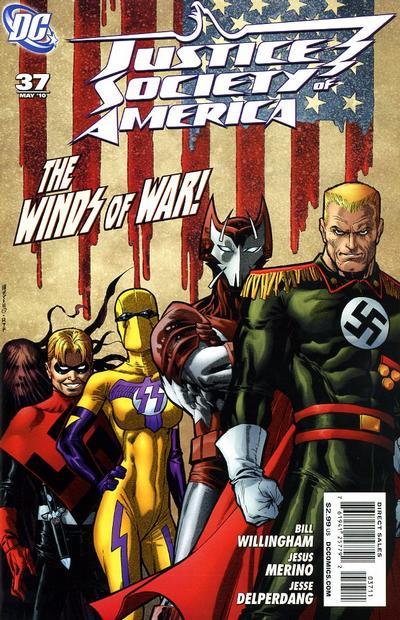
Justice Society of America #37: Twenty years in the future, Mr. Terrific relates the battle of the JSA against the Fourth Reich and how just when victory seemed to be in their grasp, they lost it all. What is unrevealed is exactly how that led to the fall of ALL superheroes, especially as the majority of the villains don't come across as that big of threats. We see Lightning and Mr. America enter the battle but it's Lightning is the one who we see take down an impressive foe with ease. The story then transitions to what the older, depowered and captured heroes are up to and hints at their big plan to set the world aright.
The story comes across as a good old-fashioned piece of fun and fluff. I couldn't help but think of the classic "Days of Future-Past" that told a similar story of older heroes facing extermination try to undo the events in their past/our present that set the world on that particularly dark course. So far, this story doesn't threaten to usurp that one in classic status as that story so easily gave so many iconic yet tragic and bittersweet moments and scenes such as the final charge against the Sentinels. But, the story succeeds in entertaining and providing some good superhero throw-downs with twists along the way even while the reader knows the pre-ordained conclusions. Of course part of that is probably due to the fact it's a title that doesn't require reading a host of other books to understand what's going on, there's not rampant death just to increase body counts or make the books seem more serious and edgy ala Robinson's Cry for Justice and Justice League.
Mr. America's place on this team continues to be a bit of an enigma as he doesn't add one iota of presence. Of the young guns, he should be the one that comes across more strongly and with a certain amount of experience and world-view. He has had formal training and presumably faced some very bad guys as part of the FBI, he already was a professional crime-fighter. He dresses the part of Captain America, but he remains a complete cypher and rank rookie. A bit of that is because it has the same shortcomings listed in the Black Terror book ie there's no real sense of who these characters are outside of the team. A little of that is forgiven in a team book as the focus of characters has to rotate through the larger cast. When you have a book like the traditional JLA, the job is made easier as many characters have their own books and there can be more focus on the secondary characters in terms of subplots and characterizations. Heck, it's part of the reasoning behind having B and C listers joining the teams to begin with. It allows for character growth and subplots without worrying about the events in the solo books.
Kid Karneval is taken out with one punch after a lot of build-up. The rest of the Reich is identified as if they had been seen before this storyline but most of them are just place-holders, we aren't told anything about them (especially as half are based on characters from MLJ and thus have no prior context or continuity to the DCU). In fact, the Fourth Reich is the weakest part of the story. As a group, they aren't threatening, their powers and abilities are not defined. Nor do we see an actual face to this new Reich, who is behind it all. On one side, the story is Mr. Terrific's story, we see it through his eyes. He personalizes the superhero side. We don't really have his opposite number though. We don't know who the villain is that set all of this up, that put together this team (or, how other than being a psychopath, the Kid fits in with the group ideologically). It needs a Red Skull/Zemo/Baron Strucker to stand on the opposite end and serve as the focal point, to be the villain whose plans and desires are the motivating forces for the story, to embody the opposite side. Especially since this is NOT really a story about the evils of Nazism. The villains are Nazis, but that's short-hand here for them wanting to conquer the world, it's not about heroes fighting Nazis per-se. It could be any world conquering type with some super-powered joes at his disposal. Thus the importance of providing the story with a character that embodies what the conflict is about, especially this far in to the story.
Project Superpowers Chapter Two #8: To bring down the mad god Zeus, the heroes that have been at odd purposes combine forces, those that serve the President and through him the Supremacy and those that have set themselves up as bringing down that group and restoring America to the people through creating seeming anarchy. The plan doesn't seem to go very well as characters with their false allegiances are found out or on the cusp of being found out.
There's some great scenes artwise. Salazar's art is steadily improving in quality and clarity in storytelling. I don't know if Ross and Krueger are deliberately aiming for meta-textual commentary, but the revelation by the Green Lama that the heroes of the urn have achieved a near mythic status and possibly may not be able to die could easily be taken as a commentary on the status of the heroes of the 1940s. Due to their public domain status several of them have popped up at various companies and in different incarnations, especially in the last couple of years. Of course other meta-textual concerns pop up across the book such as the pairing of the heroes of Big Shot comics together. It's not a bad idea per se, but no story-logic is given. They have a task to accomplish, some vision to construct a mysterious object that will help defeat Zeus. Which makes a little sense with Marvelo who is a magic hero and Skyman who is a technological/inventive genius. But, the inclusion of the Face doesn't really follow. Likewise we have Lady Satan, the Woman in Red and Masquerade nee Miss Masque are grouped solely because they are women and the use of the color red.1 Or the joining of all the Ace heroes into one group. It's a little cutesy nod to the characters' histories but without providing real story context.
________________________________________
1 Of course, there is a history of the use of the color of red and women in literature and culture. First, it signaled women of a loose sexual nature. By the thirties, there was a pulp called the Scarlet Adventuress signaling by that time the pairing didn't necessarily mean of a sexual nature, but women who didn't conform to the traditionally gender defined standards, mores and roles.
Posted by
cash_gorman
at
4:04 PM
0
comments
Labels: Angel, Astro City, dragon age, john byrne, JSA, orson scott card, Superpowers
Thursday, March 04, 2010
Hornets and Savages
Astro City Dark Ages Book 4 #2: I admit to tiring of the Williams brother saga. I like the various characters and character designs that we've been getting such as the neon Mirage and the green goo Floo. I like the pseudo costumes the brothers wear, very Steranko inspired. However, as their story went from being normal men to actually ingratiating themselves into the super-villain community and acting more and more like the dark heroes they profess to despise, their story has grown uninteresting. Part of it is that it has meandered and expanded with all of these little threads of other things into including a time jumping Silver Agent and a empathic threat from another dimension. Their tight, personal story of tragedy, vengeance and transformation has become more one note. The brothers started off with individual voices, individual outlooks; but, now, like the uniforms they wear they've become interchangeable. I find myself more interested in all the little side characters in the story than the main plot and had to struggle to get through the opening narration that just seemed verbose and dense to communicate a simple question of meta-storytelling, did dark heroes call to the other dimension's dark force (ie the real world and fans/creators of that particular storytelling) or did the dimension make the characters dark (ie the characters simply reflected a shift that was going on in the real world)? Yet, for all that, it's a dense read. Busiek knows just how much is needed to communicate secondary and tertiary characters to move a story forward without them all just being cyphers.
Posted by
cash_gorman
at
4:26 PM
10
comments
Labels: Astro City, Brian Azzarello, Doc Savage, green hornet, Kevin Smith
Tuesday, October 13, 2009
Comic Reviews and Doc Savage musings
Astra #1: Astro City and Kurt Busiek are exceptions to the rule for me in regards to the longer stories. Instead of feeling like he's stretching things out, he seems to pack more things in whether its character development or plot twists. He takes advantage of the longer story arcs to flesh things out but without forsaking the thrill of telling a story with superheroes. The longer stories are just denser and more layered instead of simply padded. Each issue is a satisfying read even if it leaves you hanging. The problem has been it has just taken so long between issues, but now there seems to be a renewed commitment to making Astro City more regular. The other thing is Busiek doesn't just tell the long big stories, but also the small short ones. Such as this, the first of issue of 2. It's more light-hearted than the recent storyline of Astro City, but it still manages to capture the times and cultural references, in this case the today of Hannah Montanna, Paris Hilton, celebrity tabloid journalism. Brent Anderson continues to excel at being a realistic artist with an organic line while still being able to capture the outlandishness and gosh-wow of a Jack Kirby designed world and make it all fit together seamlessly.
The Brave and the Bold #27: JMS delivers a fairly strong story with excellent art by Jesus Saiz (other than the cover with Batman's utility belt pouches being ridiculously big and out of place looking). Most of the story mines the human interest personal angle that Busiek does so well in Astro City. Sadly, the story ultimately fails in the end as it has to lessen the heroic nature of Robby Reed, that he was willing to let someone else die in his place and Batman just lets him off the hook.
Justice Society of America #31: Dissension in the ranks of both heroes and villains, the story moves forward with little character bits all the way around. Magog makes good arguments but only because it IS stupid to have the heroes just blindly allow people to walk right in without any type of clearance checks. Although it's one of those things like characters using the toilets. It's so obvious that I don't need to see the heroes do it in order to reassure me that they aren't all seriously constipated. If something is a completely logical and natural thing that any normal person would do, it doesn't really need to be shown unless it actually serves a plot point. What is stupid is that no one replied to his arguments pointing out that superhero teams aren't just about being armies, but also police force and rescue personnel.
JSA vs Kobra #4: Proving to be an excellent mini. Of course, part of that is this is how the JSA and JLA should have been treated all along, with them actually investigating and fighting villains, showing them off to be heroes. The focus is a little too much Mr. Terrific as if he's the only smart guy and the leader of the JSA, but otherwise a strong story. Thing is, this story could have easily been told with the original JSA as well since it's not a story ABOUT continuity but more of an action-thriller that superheroes naturally are and thus a natural fit to spotlight and show off any superhero team. Instead of Mr. Terrific, you'd actually have Hawkman showing up to be the tactician and leader that he was supposed to be, that carried the team for 40 years and Kobra being the world-threat that he always should be. Tell stories like this with the original JSA and no one would be wondering if the team was past its prime.
Marvel Mystery Handbook: I almost didn't pick it up as I don't normally get the handbooks, but there were so many characters I barely knew by name in there which made me just have to pick it up. Chock full of information and artwork.
However, the book is schizophrenic in just what it was trying to be and how it was to present the information. Just the format alone, in the first half of the book, there are power grids, ranking the powers using bar graphs., then for the shorter entries in the second half, it was decided the grids were too big and presented just the numbers for the scale of the powers. From a graphic design perspective, on projects like this consistency is the key. Keep in mind that reference books like this are not required to be read from front-to-back so a consistent approach is all the more important. If the grids are too big for some of the entries, chuck them entirely. Use the same format for each entry. Likewise, keep in mind that some people don't read all of the handbooks, so in the beginning should be an explanation as to what the power grids and numbers actually mean. How does a normal person have an energy projection of one and not zero?
Likewise, if you are going to divide a book like this into two sections so the entries are NOT in absolute alphabetical order, some kind of table of contents is required!
This is carried through with the artwork. Some pieces have art from the original stories, others have modern artists' takes on the characters. Some artwork is cited, others are not. Again, how the main artwork is cited in the longer entries in the first half is different from the second half. Again, there is reasoning based on the page layouts, but there should be consistency throughout the book. If the smaller entries require it to be alongside the pictures in the margins, then it should be that way throughout the book. If the artist is unknown, that should be mentioned instead of left blank. Settle on a single format and be consistent throughout the book.
One could argue that the reasoning behind some having art from the original stories as the main illo and others not is because of the difficulty in getting a good enough scan of the original art or an image from the one appearance that would be appropriate. Except when you get to the Namor entry. His main illo is of him with a modern look as done by a modern artist. There is NO WAY THAT A DECENT IMAGE BY EVERETT OR EVEN SCHOMBURG COULD NOT BE FOUND TO BE USED. Heck, even the small John Byrne pic would have been better since that was at least more consistent with the way he originally looked.
Which gets at the core of the other problem, what is the purpose of this book? Ostensibly, it's to celebrate the heroes who first appeared in 1940 and prior of Marvel Comics. That's fine. No Captain America, no All-Winners Squad, no Union Jack, Dominic Fortune, Two-Gun Kid, etc. Yet, the book is a big failure in that regard. It's full of modern continuity and retcons and does not distinguish between information found solely in the original stories and what is part of modern continuity. Thus for Namor, we get as his main illo artwork that is nowhere close to how he originally was presented. The same is true for Red Raven, Thin Man, Mastermind Excello and the Eternal Brain. The first sentence of the entry of Mr. E is retcon information from The Twelve, a mini-series not even done yet. While the Phantom Reporter leaves out interesting tidbits actually in his original story (his mask seemed to glow and he had another identity of a rich playboy with a different name). That's just wrong. At this point, you're not celebrating these characters from 70 years ago, you're celebrating modern continuity and too worried over how they fit in the scheme of things today.
The biggest example of this is the entries for Hurricane and Mercury. They don't have one. Instead they are a small part of an entry for Makkari. It's a prime example of why I don't like that retcon, it completely subverts the original characters for a much later one. He does not deserve an entry, much less a two-page one in a book about GA heroes. He was created in 1971 and his GA ties are retcon ones. If his retcon adventures qualify him, then they should qualify EVERY character whose stories take place 1940 and before including all the Atlas Western heroes, the medieval Black Knight, Freedom's Five and the WWI Union Jack, etc. This is a handbook of the GA characters that were introduced 70 years ago (or a little prior as the case of Ka-zar) and that's the history that it should celebrate. The retcons and modern continuity should take a backseat to the originals. It's as I always said about making the characters Mercury/Hurricane part of Makkari's identity, we lost them as characters. They are now footnotes of the Eternal's character, it's two pages of information that has nothing to do with the actual GA characters where he deserves no more than a sentence in their entries. And, this just highlights that fact. The one place where they could be given to shine and stand as equals among the other heroes created at the same time, they are treated as less than Leonard McKenzie. I'd rather have seen two short entries, and used the space to highlight some villains. Likewise, Namor's entry could have just ended around his revival in the FF and the role he played in the revival of Captain America and just a summation sentence that he was still active today instead of going on. And on. And on. Red Raven who appeared in ONE Golden-age story has a two page entry!
It's just too full of retconned and modern history without any clear-cut demarcation between how the stories were originally and what they mean in modern continuity. As a true golden age reference book, it's not very useful except for the few characters that haven't been touched by modern hands.
The Ka-zar entry is the way I would have preferred all of them to be, focusing on information found in the original stories, with little to no mention of modern-day continuity. Of course, it makes him a contradiction as well. Judging from the other entries, one would expect that we'd have just gotten the history of the modern-day Ka-zar as his appearance pretty much negates the GA Ka-zar stories as they relate to Marvel continuity.
Lastly, I would have loved to have seen more villains and other colorful characters and less of the secondary characters such as Professor Horton and Namor's parents. Seriously, how does McKenzie rate a full page entry when everything needed to know about him is covered in the Namor bio? Ditto on Horton. How big of a role is he as a character in the actual GA Human Torch stories? Almost all of the information is from stories decades after the fact. Did we really need to have separate entries on Zog and Electro? Less waste and less focus on all of the modern continuity, we could have possibly gotten EVERY GA Timely character that held his own strip in a book not much larger than this, maybe even a timeline of characters' appearances and history from a strictly Timely perspective.
Project Superpowers: Chapter 2 #3: Chapter 2 continues to be an improvement over the first mini, though it's still stuck telling basically one long drawn out story. At least, there's a feeling of progression as lots of things happen and most of them not good for the heroes involved. Although, the revelation concerning the Black Terror's kid partner Tim is very reminiscent of the fate of Tim in the Terra Obscura minis. Overall though, the over arcing meta story is really kind of boring and a tired concept.
Surprise, surprise, I even approve (or at least understand) of the small change to Skyman. In this day and age, a character using that name just because he pilots a specialized airplane just isn't going to.. um.. fly. So, it makes a bit of sense to actually have him be able to fly. Although, by jet-boots? It doesn't really work with the look of his character.
Project Superpowers: Meet the Badguys #2: Joe Casey manages to make the most out of the rather non-sensical status quo of the Fighting Yank in this "story". I also find it interesting that the Revolutionary has on his chest a ring of stars as that's the look of Roy Thomas' retcon character Spirit of '76, distinguishing him from the Fighting Yank who he was visibly based on.
Sadly, that's all that recommends this book. As per Casey's habit, the character the book is supposed to be about is not explained at all. No motivation for any of his actions. No backstory. No explanation of just what are his powers or the source of them. Like almost every story I've read by him, it's all set-up and no actual story. He seems to be trying to paint him as a possible hero or anti-hero and the fact that the seems a cross between Lobo, Ghost Rider and a cracked mirror reflection of the Yank is enough for the readers to know. As we have no motivation for his anarchic behavior and willingness to use potentially lethal force, we don't know why he is supposed to be considered a possible hero. Also, these are supposed to be the "bad guys" yet this issue and the last remove the teeth from the characters they introduce. It seems to be more of showing the feet of clay of the heroes vs the more pure if violent anti-heroes. Are they villains or not? And, when you have your heroes set up to be terrorists, what exactly makes these guys the bad guys?
The artwork is painted prettily in places but is bad at sequentially illustrating a story. Pages are often too dark while simultaneously being just unclear as to what actions they are supposed to be depicting. Of course, so is Casey's script, so in that regard they are a perfect marriage.
Sherlock Holmes #5: A bit anti-climactic in the ending as it's just a quick and easy trial, with little real drama as Holmes pretty much reveals that he already knew everything. Some things seem a little unexplained as issue 4 built up a master mystery thief but that goes nowhere other than to serve as part of the frame job of Holmes. Overall, not a bad story but a little bland.
The Torch #2: Great cover. The story is decent too in that we see what makes the Thinker a formidable foe. But, it's not really going anywhere either. Two issues into the story and all we really have is the original Human Torch revived as a weapon. Too much of the story is too busy being about continuity and explaining the continuity and not the actual title characters doing anything. At this pace, it's going to be an 8 issue mini that could have been done in three.
The problem is that writers today don't really know how to pace out story lines and subplots. A more talented writer would have found a way to have Toro in the main story being active fighting villains and finding his place in the modern world of heroes and as a civilian, while having the Thinker, his research and fan-boy need to over-explain every little thing serve as a sub-plot or second tier to the main story, building to a head. What we got is mostly boring and do we really care about this fine detail of why Toro catches on fire too? Is there going to be a big enough payoff in the relevancy of these details that has taken two issues to detail in such a dull way? Because, right now, it's not the story that's carrying the book or the title characters, it's the personality of the Thinker. Other than his characterization, it's not hard to see that this is largely the same creative team behind the above Superpowers book.
Witchfinder #4: Continues to be an excellent creepy and eerie book, a throwback to what made the Hellboy books so entertaining before they became about their own continuity. A shame that the timing couldn't have made it be a complete read in time for Halloween.
Pulp Matter:
An interesting synchronicity of pulp stories lately. At a recent trip to a local used bookstore, I came across a Bantam Doc Savage double reprint I didn't own. I think it may be the last of my holes with the doubles, now it's just hunting down a couple of the omnibuses. The two stories are "The One-Eyed Mystic" and "The Man Who Fell Up". Both are excellent stories with wonderful "impossible" occurrences drawing Doc into the action. In the pulps, only Doc and Monk actually have their hair color mentioned, so it's interesting that in the "Mystic" story we find out that Renny's hair is not red as that is his hair color in the DC comics from some years ago.
In "Mystic", Renny is on his way flying out for a vacation when he gets into an argument with a mystic on the plane. He falls asleep and wakes up as a two-bit crook, even looking like him when he looks in a mirror. He finds out that while he is this crook, there is evidence linking his real body to a murder that he knows nothing about. When knocked unconscious, he wakes up again as his old self in the town he was heading to. The mystery is compounded when later Doc has trailed the mystic aboard another passenger plane and under the cover of smoke while in flight, the mystic completely vanishes off the plane and is replaced by someone who insists he never boarded the plane.
Meanwhile, in "The Man Who Fell Up" the story centers around a body that falls out of a skyscraper only to fall up instead of down, a mysterious green fog, and strange attitudes by Monk and Ham.
While originally, these stories were written years apart, it's no coincidence they are paired together in this double. Despite wildly different beginnings, the inventions behind the actions of the bad guys are remarkably similar. There are other familiar tropes and storytelling choices that are cliched if you read many of these, so it's not too terribly hard to figure out who some of the bad guys are.
Meanwhile, Sanctum Books has released the second two-story reprints of the Avenger, reprinting the stories "The Sky Walker" and "The Devil's Horns" (as well as a Whisperer short-story "Boulevard of Death"). While The Avenger pulps advertised as being by the creator of Doc Savage, "Kenneth Robeson", the reality was that Robeson was just a house name for other writers. Lester Dent who wrote the majority of the Doc novels and had a hand in most of the ghosted ones, had little to do with the Avenger written by pulp writer Paul Ernst However, "The Sky Walker" involves a jet made of transparent materials, something that Will Murray ruminates about a bit in an article in the book. According to Murray, Dent apparently wrote a short-story involving a similar plot device early in his career but never published. Murray doesn't go into any more detail than that about this short-story. Even if not true, the plane in "The Sky Walker" still pre-dates Wonder Woman's by some years. What's not mentioned is Dent did get around to using that idea eventually. In the Doc Savage story "The Man Who Fell Up", Doc has a mostly invisible jet. Like "The Sky Walker", everything is invisible except for the engine. To aid the invisibility aspect, in the Doc story, the engine is painted to mimic the sky on the bottom and the ground on the top. It even mentions the one drawback, it doesn't take long for soot and all to gather on the otherwise transparent aircraft. And, like many of Doc's planes, it doesn't last 5 pages before it gets blown out of the sky, in this case by a man falling up. As far as I know, it's not mentioned again, presumably Doc saw it as a failure and by that point Wonder Woman was zipping along everywhere in her not too original Invisible airplane. It does give credence to Murray's wondering if there was at least some collaboration between Ernst and Dent though, especially if there's that unpublished short story out there somewhere. Maybe, we'll see it see print some day too.
Posted by
cash_gorman
at
3:41 PM
0
comments
Labels: Astro City, Batman, Busiek, DC Comics, Doc Savage, pulps, Superpowers
|