Green Hornet Remastered: There are really only two things to recommend for these books. One, the wonderful covers by Joe Rubinstein that capture the Green Hornet in the middle of a dangerous situation. However, the Hornet is rendered with a simple domino mask and not the gangster style mask that covered the lower half of his face that he wears inside the comic. It also shows off just how minor of a character Kato was at the time, barely appearing in the majority of the stories. There's no doubt that the hero and star of the book is the Green Hornet. Otherwise, these stories are painfully dull and the artwork is either heavily damaged during the remastering stage or/and is really on the low end, even for GA standards. And, this is coming from someone that is generally a fan of the comics from this time. Stick to the radio shows and serials to get exciting adventures of the Green Hornet of this time.
Green Hornet: Year One #7: Not sure how long this comic is going to last and continue being called "Year One." The last issue brought together all of the various threads and backstory of how Kato and Britt Reid would find themselves coming together to fight crime as masked men and how it would result in them being thought of as rival mobsters. This issue picks up on that status quo and continues the story, but it no longer has that feeling of an extended origin tale of neophyte characters. The only change in creative staff seems to be the colorist, the new one going for more traditional color palettes. It's still a good comic, full of atmosphere and mood and feels like an honest attempt at being faithful and true to the source material while being readable by modern audiences. It feels authentic and should have DC kicking themselves for not doing something similar with the Crimson Avenger.
Hellboy: The Sleeping and the Dead #1 of 2: Written by Mike Mignola and painted by Scott Hampton, this is a beautiful little comic. Like most of Mignola's writing, it is basic and bare in the plotting and storytelling, going for creepiness, mood and the visceral experience. Hampton's artwork with Dave Stewart's colors elevate it into something that's darkly beautiful and romantic, like an old Southern mansion falling into disrepair.
Justice Society #45 and 46: If there was a book that screamed it was the right time to stop getting regular monthlies, this title is it. When the day comes that the Justice Society is so bad that I want to stop getting it as a mercy killing, then the comic companies really have passed me by. This comic isn't merely bad but just plain stupid.
It was bad enough suffering looking at pictures of the Captain America movie and reading posts by fans about how faithful and accurate it is, but then I open up #45 and see The Flash and Green Lantern on some secret mission, dressed in military versions of their costumes, complete with grenades and various packets and straps. Words fail me in just how wrong minded this is. Then, the whole mission is a black-ops one, sent to destroy a secret weapon which turns out to be a baby. Why would you send two (and only two) JSA members on a mission like this?
Then, we have the writer telling us that Drachen (the name of the Nazi project) means "Scythe", the name of the super powered terrorist. Of course, Drachen doesn't mean that at all. It means Dragon, kite and even a vixen or harpy.
We're also asked to believe that a politician from the 1950s still holds office some sixty years later. Impossible? No. But, highly improbable and like everything else in the book, it shows the hand of the writer demanding things to be so for the sake of the story he's writing with little logical extrapolation.
We also have over the course of two issues, three instances by different characters using the term "gallows humor". When a unique phrase gets used that often in so little space and by different characters, it sticks out. Again, it shows the writer behind the scenes as it becomes obvious that the dialogue by different characters are coming from one mind.
We get an appearance by Superman and Blue Devil which is fine. But, there are a whole lot of JSA'ers and hanger-ons that would be better served. Then again, interviews have indicated that Blue Devil is going to be a member for some bizarre reason. Because, there aren't enough JSA and Golden-age related characters that could be used or team members we haven't seen.
Obsidian gets all violent and dark. Again.
Dr. Mid-nite finally gets called in for a consultation on Alan Scott's condition. He claims it's taking too much energy to just keep the Starheart in check for him to heal despite his being an energy being he only sustains physical injury because he thinks of himself as human. Thus, if he's conscious and able to think at all, then his body should become normal without actually having to "heal". And, if it takes that level of concentration, then what the heck is he doing fighting crime when a slip in concentration could cost lives or letting loose the Starheart? What happens when he falls asleep? And, where does he get the power then to build himself a godawful new costume AND GROW HAIR as we've seen in previews?
In both issues and one coming up, Dr. Mid-nite is said to have "ultra-SONIC lenses". What the heck are those and what do they do? Make his eyes able to hear? Allows him to SEE sounds that people cannot hear? Apparently this comes from the Matt Wagner mini that introduced the character, as I've never read it. Just seeing in the dark and outside of the normal vision range just not good enough I guess. It's something best left forgotten unless we are actually going to see him use said "ultrasonic lenses". Otherwise, it just comes off as sounding stupid when thrown out with nothing to back it up or explain it as in these issues.
I'm not a fan of Kolins artwork, generally the opposite. To give credit where it's due, other than the military styled Flash and Green Lantern (and GL's upcoming new "costume"), the artwork has been good and easily the best thing regarding the book. But, I miss the days of the real JSA when it wasn't a team of legacies, but the original heroes.
Project Superpowers: X-mas Carol: This book is merely "meh". It gives us an origin and background of the villain known as the Clown and updates him for the modern age with powers of his own by him taking over the body of a clone of his foe, the hero Magno. It started off strong with a flashback sequence of the Clown before he became the masked villain with his girlfriend, giving him some sympathetic background juxtaposed against scenes with a mother and son Christmas shopping in the modern day as well as the American Spirit propheting that someone was about to make the ultimate sacrifice for their country. But these scenes ultimately go nowhere, serving as little teases to completely different type of tale, one of impending tragedy and sadness. Part of this is because the book is constrained by the fact that it is to follow the construction of Dicken's A Christmas Carol so we have the Clown visited by the ghost of a past associate and then heroic ghosts of the Superpowers line: The Fighting Yank, the Ghost and American Spirit. Each tries to capture the Ghost and relating events from the past, present and a possible future. But, it only has a few pages to devote to each hero. It then ends on ambiguous ground as we are not sure if the Clown has undergone any kind of spiritual transformation in relation to his physical one or not. We aren't sure if we are to take anything from this tale, if there's anything to take. It might be a foreshadowing of upcoming plots, that the Clown may betray the Supremacy and thus avert the disaster that the American Spirit shows him. Or the Clown may bring about that very future. There's nothing in the ending to really grab hold of, to see a reason as to why to read this story. We understand a little more about the background of the Clown but it's all upset by the non-descript ending, it cannot be applied to the future. It becomes a tale that's unfinished all the way around, imparting little knowledge, truth or emotion.
Spider-Girl #2: Tying the JSA of a book being not merely bad but incredibly dumb. Part of it is the simple fact that it's merely the second issue and yet managed to go so wrong so quickly in so many different directions. Part of last issue's biggest disconnect was the idea that a father would let his teen-age daughter with no powers go out and fight crime. This was a big source of conflict between Mayday and her parents in the DeFalco series, resulting in her just doing it anyway, and she had powers. Arana doesn't have anything other than good training. This is compounded by that Sue Richards, adult and mother, also supports and aids her in these actions. Well, we don't have to worry about that because the writer decided to go for that standard cliche and kill off the girl's father. And, then spend the whole issue of the character dealing with it. I could see this being done somewhere down the road, it's a big cliche but it does up-end the status quo and gives a change-of-pace story. BUT IN THE SECOND ISSUE? And, it's not a villain she can take on, but the Red Hulk. So we have a story where the character is not only sad and depressed for the whole issue but completely ineffectual. Again, this might be fine later, but it hardly makes me want to read more about this character. She comes across useless, her book is depressing, and now two issues in, there's no status quo or regular supporting cast and relationships to draw me back to.
This issue at least shows that the line she swings by is some grappling line although where she keeps it and the mechanisms that control it is a complete mystery. I guess it's in the same place where she manages to find coins to buy newspapers to fling in the Red Hulk's face.
More bad writing: there's zero introduction of just who or what the Red Hulk is. My brother's first question was, "why is the Hulk red?" I could answer a little of it as I keep up with some of the general goings on in the Marvel U, but there is zero in the story to tell us anything about the character, that it's not even the real Hulk just in different Christmas colors. Remember, every issue is someone's first exposure to the characters. Why should I, reading a Spider-man family book, be expected to know what's going on in the Hulk books?
The book tops the JSA with writing characters with the same voice with this bit of dialogue.
Johnny Storm: Did he seem...crazy to you? He's never talked like that before. Let's find him and find out.
Reed Richards: It was...strange. Let's find him and find out."
In the same panel, we have the world's smartest man and leader of the FF simply repeating verbatim what a high school graduate just said, proposing the same action as if it was his idea. My guess for the future death in the FF, Johnny kills Reed for constantly undercutting him like this. Or Reed is already dead and they are hiding it from the world by using a robot.
We are lead to believe her father was this respected journalist and the go-to press-guy for the celebrity heroes the Fantastic Four, yet his funeral is practically empty, the FF don't even show up. His daughter wears plain clothes but not black and her friends wear nice colorful clothes. Instead of a powerful scene, all I can think is "this is supposed to be a funeral?" Bad, bad storytelling.
Thunderstrike #2: At least this title has a teenager acting like a teenager, albeit a surly petulant one, and parents acting and reacting in ways that seem like real human beings and parents would. And, with DeFalco and Frenz at the helm, there's lots of superhero action. If we cannot have the real Spider-Girl or even the real Thunderstrike, this fills the gap nicely.
Victorian Undead: Sherlock Holmes vs. Dracula #3 of 5: The story shifts a bit from how I remember the Dracula story going as Mina has died and one of Lucy's suitors has become a betrayer, thus we are no longer following Stoker's script even discounting Holmes' involvement. It sets things up as the conclusion no longer being pre-ordained. Despite that, it's a fun book, pitting the world's greatest sleuth against one of its biggest villains.
Warlord of Mars #3: A switch-up in artists. The new guy draws Carter as being a little too muscle bound for my taste and doesn't have quite the same texture to his pencils but he does a great job at drawing an alien city. In this day and age, I don't think it's too much to ask that an artist be able to draw faces differently, so that the only way to tell the green-skinned martians apart is whether they have both tusks or not. The series seems intent on having them all drawn as four-armed Hulks as opposed to the more lanky, almost skeletal proportions they are generally shown as. These are small complaints though as overall the book has looked very good and it's going to be hard for anyone to really top what Gil Kane and John Buscema could do with sci-fi/fantasy sword fighters.
Tuesday, January 18, 2011
Hornets, Spiders, and Vampires, oh my.


Wednesday, November 10, 2010
Hellboy, Green Hornet, JSA, Hawkman's war crimes
 Hellboy/Beasts of Burden: Sacrifice: One has to give Mike Mignola credit. In creating Hellboy, he has arguably created one of the more significant and successful comicbook heroes created in the modern age. And, he did so by following what interested him. He liked drawing monsters. Big monsters and big fights. So, he created a character that was himself somewhat monstrous and a world that had even bigger and badder monsters. His art-style which was already developing into something unique was well-suited for it. Now, quite a few years later, his creation has developed into an empire and universe by itself. It's spawned two successful big budget movies, a short-lived cartoon series, several novels, a regular spin-off comic in B.P.R.D. and regular mini-series with the main character himself. Mignola doesn't do as much of the art these days, but he keeps a hand in and regardless of the writer or artist so that each book still manages to keep to his vision. In the days of constant retcons, complex continuity and overly ornate and rendered artwork, Mignola has managed to still follow the K.I.S.S. method, Keep It Simple, Stupid. Part of the appeal to Hellboy is his relative simplicity and iconic background and design. While the character has had his status quo change and various things concerning his destiny revealed, and a large supporting cast and world developed, the character himself is still basically the same guy from all those years ago. It is also interesting to note that this was all done by not having a regular ongoing series with interminable storylines, flooding the market with different continuity versions, but through minis, specials and one-shots. Along the way, he developed a storytelling style that incorporates the best of gothic horror, German Expressionistic silent films, Lovecraftian menace and even the Hammer films. His art grows more abstract, but still recognizable. He uses non-storytelling panels interspersed through pages to set mood and reinforce the story's symbols and themes. You have to wonder if the people at Marvel ever look at Hellboy and think about what they could have done if they just let Mignola run amok with Thor, the Thing and their horror books. Would Mignola have been just as happy doing the same thing only using characters like the Living Mummy; Deathlok; Blade, the Scarecrow; the Golem; Frankenstein's monster; It, the Living Colossus; Ulik the troll; Adam Warlock; and Morbius the living vampire?
The simplicity of the character has lead him to be able to fit alongside many other characters. At this time, he's appeared with Batman and Starman, the Savage Dragon, Dark Horse's Ghost, Painkiller Jane, John Byrne's Torch of Liberty, and now a bunch of talking dogs and cats protecting a town from supernatural threats in Beasts of Burden. Which is what this review is really about.
I missed out on the first arc of Beasts of Burden, it was halfway through when I first heard about the series and it looked interesting. Yet this one-shot is not marred by that at all. Ivan Dorkin and Jill Thompson manage to create a group of animals with mostly distinct and yet familiar personality types that even being thrown into the world, it feels like suddenly finding old friends. When revealing the villain and that he is a foe the beasts have met before, enough information is given that as a new reader, I don't feel left out of the story, I'm given all the info I need to continue on without a hiccup. The art manages to make the animals expressionistic without devolving into being cartoony, almost Disney-esque in manner. Their variety in looks and personalities is almost bound to remind a reader of a favorite pet, endearing them instantly. The book is lushly colored in a water-color style that's evocative of many children's books, yet not becoming at odds with the supernatural story or the odd guest-star. Instead, it gives the book a certain level of realism, that allows you to buy into the world of talking dogs and cats fighting undead monsters and such. The animals retain a certain cuddliness and cuteness while the danger and threats seem real and mystical.
Overall, one of the best single issue comics I've read in a long, long time. It makes me want to go out and buy the trade of the first Beasts of Burden mini and continue on reading about them.

Baltimore: The Plague Ships #3 of 5: With this issue, I realize there has been a bit of decompression in the story-telling. We're at the middle issue of the mini, but in reality the plot behind the title is just now getting introduced. The first issue introduced us to Baltimore as a character, the current status quo and his traveling companion. The second issue spent quite a bit of space going over the back-story of the events of the novel, explaining just who Baltimore is and what happened to him. This issue we get even some more back-story of what his mission is, why he does what he does and why the vampires and the plague exist. After a storm with giant sky floating jellyfish, Baltimore and Vanessa find themselves washed up on the shore of a graveyard for German submarines as well as other ships full of plague victims and a strange mold. And, the blurb for next issue reveals that even more of Baltimore's back-story will be revealed.
The trade-off though is that this pacing does help maintain the mood, the sense of ever impending doom, that we're looking at the last days of man even though it's set in the final days of WWI. With the aid of the dependable Dave Stewart on the colors, this is a world of bleakness and depression. The sun never shines and mankind has found itself to be small ineffectual beings in the world, subject to arbitrary rules and events. The average man has gone from fighting on the battlefields at the behest of their nation's leaders for unclear political reasons in a war that encompasses the world, to finding out that even this man-made construct of war must give way to unknown disease and plague, and other dark things that man's science is unequipped to explain. Telling a horror story in comic form that can truly scare and linger with you, needs that feeling of mood and impending doom. It has to take time to develop characters that you care about but also can believe that something truly horrible can happen to. So, despite the decompression, I think overall it works for this type of story and I'm interested to see what new horrors can be visited upon the long suffering soldier Lord Baltimore.

Captain America: Patriot #3: The cover is very strong and could almost serve as a lead-in page for the comic, as this was the climactic moment of the previous issue. Yet, I cannot help but feel it would have been better as the cover to the second issue, setting up an inexorable fate for the end of that issue. It's not like that Bucky II's fate is uncharted territory and would thus be revealing some new twist. The cover's power is completely undermined by having the day-glo green Hulk in the box in the corner serving as an advertisement for a cartoon. I grew up when the boxes used to have little thumbnails of the characters' heads or full body shot, so I think it would have been kind of neat to see one of the Patriot there. The Hulk is just a little jarring though.
The book maintains its strange dichotomy of being both well-written and well-drawn in some regards and disappointingly cliched in others. Heck, even on the first page you have it. Mace is a reporter, so it's kinda neat to have the first page be a pseudo mock-up of The Daily Bugle relating the story so far in a couple of articles. Yet, the effect is ruined in the main article as the writing style is clearly just a recap and not a faux news article though the secondary article on the page manages to maintain the illusion of a news article. Kesel delivers on making Mace a likable and stand-up guy with a sense of tragedy about him. Yet, Mace is consistently played as being a second banana to almost every one else, even the second Bucky. He has a few nice moments but at no point does he really come off as a really cool character in his own right. Instead, he seems to be defined by his mediocrity, deserving his obscurity beyond a single defining moment. Kesel gets points though for remembering the second Cap's bullet-proof cloak when he was the Spirit of '76 and was a kewl moment to have Golden Girl to be wearing it. An odd bit of synchronicity trivia: she dyes it green. The Spirit of '76's cloak was blue but he was visibly based on the Fighting Yank who had a mystical cloak that gave him powers including being bulletproof. The Yank's cloak was already green. Kesel also manages to tell a story, a complete in each issue while delivering a longer story, something that is a lost art amongst many more critically acclaimed comic book writers. The heavy handed foreshadowing of the previous issue was indeed meant as a red herring as surmised being possible and that there might be more to Mary, something more mundane and less obvious than just going bad.
The art continues the dichotomy in that the cover is very powerful and there's quite a bit of subtlety in the Breitweisers' colors and pencils. The fighting mad Captain America is very well done. But, the toned down colors keep characters like Golden Girl to really stand out and seem, well, golden. For the sake of realism and a nostalgic mood, we have none of the sense of wonder inherent in the superheroes. Yet, we have the Torches standing around in full flame for no reason, in a hospital no less.
Green Hornet Year One #6 of 6: The mini chronicling the origins of the golden-age Green Hornet draws to a close. Storytelling and artwork holds to much of the standards set by the other issues and there's a neat little nod to the movie serials as the last page of a newspaper headline reveals "Green Hornet Strikes". Yet, I found this all anti-climactic in the end, despite a nice long fight scene. It's an origin storyline and so there's only so much that can be done. The status quo is introduced but the hero cannot be so successful that it renders it senseless for him to continue to fight crime. Hence the problem of tying the hero too strongly to a specific menace or mission, in this case organized crime. Instead of opening the way up for many types of stories, it's limiting and confining. What you are almost forced to end with is the hero successful in establishing a status quo but no strong victory otherwise in order to stay within the character and story's themes and limitations. The main reason this feels flat at the end though was despite all the small menaces and dangers met and overcome over the course of the story, there was no real sense of danger or threat to the main story or menace. There was no Third Act twist that upends the hero's plans, that sets things to a feeling of the real danger of unraveling. No sudden new or unrevealed menace or twist to the villains' plans. We know the Hornet and Kato won't die, but there's not enough of other characters established whose lives we should care and fear for that can suddenly be threatened to up the ante.
JSA #44: It's probably saying something that of all the comics I'm reviewing and reading, this is the only ongoing. And, if it was of anyone else other than the JSA, probably wouldn't be getting it.
Marc Guggenheim is a good writer. As a writer for Law & Order, he knows his way around characters, plotting intricacies and dialogue. I enjoyed his brief stint on Aquaman. I wish we saw some of that writer show up here. Much of what I didn't like isn't what I've seen panned on other reviews. I'm not especially bothered by Mr. Terrific discovering himself losing his intelligence. It seems to be a separate sub-plot and that is the whole purpose of plots and stories, to set up obstacles, trials and tribulations for characters to go through and hopefully emerge from the other side. I thought that was well handled showing a Mr. Terrific losing his intelligence is still smarter than most every one else in the room. Nor was I bothered by a previously unknown villain showing up and handing the JSA's butt to them. We need new villains other than seeing Mordru, Karkull or Solomon Grundy trotted out again. Sadly, the way that was done, not handled nearly as well though. Just as, I don't have a problem with Alan Scott being able to be physically taken out, but it's still done badly for several reasons.
First off, we have the fact that this overall plot is similar to the one-off by Robinson revealing Alan Scott heading up a mystical city on the moon. So, already we are covering the same ground in revealing Jay Garrick is slated to be mayor. The Fourth Reich storyline was kicked off with Alan Scott being killed and the JSA/JLA story of him being taken over by the Starheart. So, again we have him taken out first and with incredible ease and somehow being the blamed for what went wrong. And, while it has been established that he is really mostly an energy being, he has a physical body because mentally he still thinks of himself as being human. So, it's no surprise that a sudden attack could kill him or even break his neck or back. But, by the same token, short of immediately killing him or putting him in a coma, it's hard to injure him in such a way that he cannot come back once he's conscious. So, why is he being treated in a hospital as if he's like every body else and obviously with not Dr. Mid-nite overseeing as a ridiculous diagnosis as being paralyzed for the rest of his life would be ludicrous? Then there's the whole bit about them being somewhat surprised by the idea of super-powered terrorists despite a twelve issue series pitting them against Kobra. At some point, the editor should have stepped in.
The comic starts off with a modern day sequence of Jay being chosen as mayor and then jumps back in time to tell how they got to that point. Yet, the comic doesn't end at closing the loop, it doesn't answer the central and simple question posed by the first page. See where I praised for Kesel managing to tell a complete story that was part of the larger whole, this is where this is falling down. We have a deliberate and awkward storytelling device and it's used badly in terms of the issue. One, such scenes are usually ones of cliffhanger manner, rife with angst, questions and durm and strang. However, this is a very mundane scene played almost comically melodramatic. Second, despite the rather simplistic and mundane nature, it fails to deliver the payoff.
Then, we have the villain. As I said, I don't mind he's a new threat. But, he's a complete cypher. We don't know what his powers are, how he's able to handle the JSA with such ease, what his motivations are. He's being held by the CIA, and yet the JSA is sent to handle him with zero intelligence on the guy. Then, we are asked to believe that he can easily reach through the energy constraining bubble generated by Green Lantern, shrug off the magic by Dr. Fate not to mention the attacks by the others yet Lightning has enough juice to take him out?
It's hard to objectively judge the artwork because traditionally, Kolins' artwork can lead me to drop a book. The heavily painted style manages to sublimate the normally negative physical reaction I have to the point that I look at it and can say "it's readable" and be happy with that. There were scenes that confused me such as when the villain uses a sword to take out the t-spheres. The spheres are so obscured by the lightning effect in the earlier panel that I actually didn't realize it was them hitting the villain with the electric bolts since we have a character with that exact power. So, I was confused to see him swing his sword with what looked like blood streaming off of it and wondering how Mr. Terrific was continuing his cold logic internal monologue while being eviscerated. The villain's taking Green Lantern out was likewise poorly done as it doesn't really portray anything. I'm not asking for a graphic scene of the character getting his back/neck broken, but all we see is the villain reaching out and grabbing Green Lantern by the neck and just tossing him aside. Nothing suggesting the possibility of severe physical trauma. My only gripe concerning Wildcat who's left with not much to do is that the art for some reason makes him look to me like he's wearing Get Fuzzy's Bucky cat as a mask.
Here's hoping that the second issue will prove to be stronger than this initial foray.

Nature of Comics today: Here's a panel of one of the current comics put out by DC, the so-called Brightest Day. In it, we have the superhero Hawkman not merely torturing a villain but actually maiming him and tearing off of limbs. This is what passes for superheroes and the return of heroes? Who actually okays this stuff? Seriously, I see a scene like this and there's no way I could support a new ongoing Hawkman series unless there was some fundamental changes being made to the character and his nature. And, why I feel justified in staying away from the larger DCU in general and these massive continuity driven stories and events. And, I wonder why I don't see people on the comic boards reviewing the comics and interviewing the creators asking these questions. How the mighty and noble JSA have fallen.
Tuesday, October 19, 2010
Halloween equals good comics
 I am finding that October and the time of Halloween is a time for some good comics. It's been perfect time in past years for dipping into the back-issue trades and picking up some of the Horror-hero characters from Marvel such as Essentials starring Ghost Rider, Doctor Voodoo, the Living Mummy, and the Scarecrow. This year there is a nice smallish volume featuring some of the b/w magazine stories featuring their various vampires including Morbius (one of my favorites, especially when done by Gil Kane). There is also a hardcover sampling of Dick Briefer's Frankenstein stories, a series that ran the gamut of being straight forward horror, to a supervillain, to an almost cuddly affable monster ala Herman Munster, years before that series ever did it.
Angel vs Frankenstein II: John Byrne returns this Halloween to Angel & Frankenstein. As with the first one, the only real drawback is that it could use another issue or two to really bring out the tension and horror as there is so much for one issue to do. It's a period piece, so it has to establish both the physical place but also the status quo and supporting cast and make us care for them and worry about them. Byrne manages in a few short pages to introduce various characters, some with secrets, relationships and pasts all of their own and make them compelling enough that a one issue story just seems too short for them. His version of the Frankenstein Monster is in keeping with the classic novel. He's bizarre and scary looking and presented as a sociopath and not some misunderstood Romantic Hero. The story presents about as definitive a death scene as you can possibly get when dealing with a creature that seems too tough to die.
 Batman: Hidden Treasures: Most new fans think of horror comics and they no doubt think of the likes of the dark fantasy of Neil Gaiman or Alan Moore's Swamp Thing. Older fans will think of the works of Tom Sutton, Mike Ploog and the legendary Berni Wrightson. Berni is one of those creators like Steranko, Barry Windsor Smith, Dave Stevens and Neal Adams, men who don't have many lengthy credits or long stretches of work to their name, but the little they have done was game changing and influential on so many levels. Wrightson's name is inextricably linked to Swamp Thing, but he's proven to be a great Batman artist. This book presents two Batman stories, one previously unpublished and one that has been published many times when he and Swamp Thing first crossed paths.
The first story part prose and part pin-ups as Batman investigates a serial killer of homeless people and it leads him to Slaughter Swamp and comic's first swamp monster, Solomon Grundy. The prose of the story is a little confusing at first as the identity of the narrator is kept purposely obscure until the end. However, I spent considerable time in the first two pages trying to figure out the point of view of the story, who the narrator was as it doesn't make it clear that the narrator is not supposed to be a witness to the events of the story. It's only by the tone that you first rule out Batman and then Commissioner Gordon and after that point, I was sufficiently hooked into the story to not care. In fact, when the revelation did come, it just seemed a bit too cutesy and I really no longer cared.
Wrightson's art is excellent and strong enough that Kevin Nowlan's usually overpowering inking was kept to a minimum annoyance. Most of the time I could forget Nowlan was the inker until certain panels with people's faces and his habit of going cubist on straight on head-shots of characters by making their mouths look like they are being viewed by an extreme angle, at odds with the rest of the face. It tends to give all his faces this puckered or constipated expression. Plus, his line is often thin and inorganic, something I wouldn't think to match up with an artist like Wrightson whose art is practically synonymous for being natural and organic. However, for the most part the pairing works surprisingly well.
The second story is the reprinted "Night of the Bat" by Lein Wein and Wrightson from Swamp Thing #7, first series. The story has obviously been re-colored which makes its presence known in several places, such as putting a leaf pattern in Swamp Thing's thought balloons. I miss this version of Swamp Thing, when he really was Alec Holland and before he went all supernatural and elemental.
JSA 80-Page Giant 2010: This is one of those books that if I looked at it first I would have returned it. It was a JSA book so it got put in my bag automatically and I did not realize it was not the regular monthly title since it had the Justice Society of America title logo in the usual place. Instead it's just a big book focusing on the legacy characters in short story bits with varying degrees of lameness. The Obsidian story contained the overpowering and scratchy inks of Bill Sienkiewicz in a story that was little more than the writer recapping Obsidian's lifestory and homosexuality, reinforcing his total misinterpretation of Obsidian's story in the JLA. And, as the plot is about Obsidian and his boyfriend trying to adopt and thus the regaling of his life-story, it's lame in that we don't get a reason they are turned down. Especially as the most logical conclusion of him being a superhero is denied. Told what it's not, but not what it is. The Jesse Quick story was passable with nice art but otherwise unforgettable. Mr. Terrific's story was confusing as it starts with a guy in a coma, I at first figured everything after that was meant to be a flashback on how he got to be in a coma. Instead, it was supposed to be about him coming out of the coma. A pity the artist drew him asleep then. And, we see Mr. Terrific now flying with some kind of jet-boots? Cyclone's story reinforces her contradictory nature. In many ways she's annoying and she's meant to be and yet I find her all the more likable and fresh for that. The best thing about the Wildcat and son story was that for once his son didn't annoy me in a bad way too much and the artwork was far better than I had seen by Williams in JSA All-Stars. Sand and Dr. Fate were just boring, to the point that I kept nodding off in between word balloons in mid panel. Then there's the whole idea that the latter story is telling readers it's ok to commit suicide in order to be reunited with the ones you love.
Magnus #2: A solid comic that updates the future of Magnus for modern sensibilities but still has enough of the style, themes and background to be familiar with the other versions. The artist at times seems a little overwhelmed at times in depicting the action scenes or small things like a character's hairstyle. As the story concerned itself with white slavery and exploitation of women, the comic veers close to being too adult and prurient when it doesn't really need to be.
We get signs that in the future, there are other threats other than just the robots, including cyborgs and what appear to be aliens that consider human meat a delicacy. This brings a needed variety to Magnus' future world. Even more development of that world is needed, though. The book was originally created in the 1960s, we could use a book that is more multi-cultural, with more strong female characters other than Leeja who offers herself up as victim-bait this issue.
 Warlord of Mars #1: Calling the book "Warlord of Mars" and I'd expect that ideally, John Carter would be on Mars by the third page. I don't think you need to drag out his past, it's not really that important. However, this is a Dynamite book so I don't really expect to see John Carter get to Mars until the fourth issue, they like their decompression too much and dragging out the origins of the characters.
Surprisingly, it didn't bother me too much with the first issue in that they decided to tell a dual story giving us the backgrounds of both Carter and Tars Tarkas so we see still get quite a bit of Mars. I think the backdrop at least gives us an idea of what kind of man John Carter is, fiercely loyal and quick to fight if the situation demands it. What is missing is the idea from the books that Carter is some kind of immortal with little memory of his past but always finding himself embroiled in conflict and battles.
Sadowski delivers on the art and it's not so colored that the pencils are lost. However, the story is a bit confusing as Union Soldiers are colored to be wearing grays, the short-hand identification of the Rebels. Maybe the colorist didn't know that the bad-guys in the story were supposed to be the Northerners and not the South for a change?
Multiple covers, so I chose the Joe Jusko one myself. Reminded me of when I first discovered John Carter, Deja Thoris and Tars Tarkas and those paperback covers.
Wednesday, July 28, 2010
News & Reviews

Comic News: It has probably been a while since there has been quite a bit of good news concerning upcoming comics, especially linking the names "Dynamite" and "Alex Ross".
Dynamite has gotten the rights to various Kirby characters, specifically Captain Victory, Silver Star, Phantom Force and his various Topps-verse characters and Alex Ross is associated with the project. That's not the good news, though. The good news is that Kurt Busiek has been roped in as writer! Kurt Busiek frequently proves himself as a writer that understands the power of continuity and history, that they are tools to be used not hindrances. His writings show that he understands the genres of superheroes, where they overlap other genres and what defines them. He has proven time and again, that he understands characterization and how continuity and history plays into that. His characters are defined by their history, the choices and lives they have lived. Even if you don't really agree with a particular characterization or direction he may take, you cannot argue that it's not at least grounded and reasoned out. So, instead of seeing the typical project by Dynamite and Ross of re-writing the characters to fit an arbitrary artistic vision, we can look forward to a book that truly starts with the basic concepts and characters Kirby came up with and grow out of that. Already, the promo art looks more faithful to the source material than the Phantom artwork did.
And, Busiek already has a history with some of these characters as he had been working on many of these characters for Topps with first issues being published of his Silver Star and Victory mini-series. Hopefully, we'll be seeing more faithful renderings by the artists this time around than Giffen's wholesale redesigns for the Victory comic.
Jurassic Park, Angel & Frankenstein, and Next Men! In the space of a week, three different titles have been revealed coming from John Byrne. Admittedly, the first two are just mini's or one-shots, but all should be a lot of fun with plenty of mayhem. Personally, I liked Danger Unlimited and the Torch of Liberty more than Next Men. But, I'm a superhero type of guy. Still, Next Men was some of the best out and out genre breaking writing to come out of John Byrne with complicated characters and motivations and intricate plotting, the top of his game. It will be interesting to see if he can recapture that lightning for I've felt that sense of depth hasn't been in the majority of his work of late. I'd like to see Byrne create and do his own full-blown superhero universe, full of costumed heroes, super-villains, magic monsters, lost civilizations, prehistoric jungles, alien invasions, etc. The stuff that actually makes superhero comics fun to read. The type of stuff we found in his Fantastic Four, Namor, Alpha Flight, Superman, etc.
Reviews:
Astro City: Silver Agent #1: After all this time, and a very long arc looking at him from the outside, we get an inside look at the Silver Agent, his origins and motivations. First up, Ross pulls off a nice Steranko pop-art feel to the cover. I love the start of the book, looking at some of the heroes of Astro City's past in action filled cameos then moving on to the far future with the Silver Agent fighting alongside a Legion of Superheroes/Alien Legion mish-mash against a cosmic menace that comes across as something that Jack Kirby would have come up with. Unfortunately I just don't buy that anyone would willingly choose to be innocently executed when there were other viable options available that wouldn't damage the outcome of history. He could still travel through time making those sporadic appearances and sending a "geneti-copy" to be executed. The problem is that with the sci-fi elements and raising the issue that they do have the technology to send a copy back through time, it's next to impossible to come up with a truly plausible reason not to take advantage of any logical outs.
There's some art issues. To be a broken record, we have instances of coloring that's too heavy and intense, muddying the clarity of the artwork. In fact, there's one scene that's almost laughable as the coloring of the Silver Agent out of costume with him looking at his palms, it looks like he's fondling his own chest. Then the flashbacks, look like they are going for that large dot pattern of comics past effect, but in this case we are getting a moire pattern that just mars the whole thing. Instead of going for a printing trick or special effects, such scenes would really work best by simply using a limited or muted color scene. It's not as if Anderson is trying to make his work look dated or old, so why should the printing?
Still, page for page, there's more story, more depth and pathos and action than found in many of today's comics.
DC Universe Legacies #3: Wow, three issues in and it already jumps the shark. Tthis issue even has more problems than the others. It seems like it cannot really decide what it's supposed to be. On one hand it seems to be a version of the modern history of the current DCU, which would be fine. On the other, it's a meta-fictional history, explaining superhero continuity and publishing trends through a story such as the fall of the GA heroes, the rise of the detective heroes and western stars (using television to stand in for comics, and the coonskin hat craze explained as a Tomahawk fad...). Except for the fact that the timeline in this issue is all sorts of screwed up. If the kid was around 8-12 in 1939, this story (and many of the characters used and referenced events) suggest that it's taking place in the 1950s. Which is fine when talking about the rise of the cowboy heroes after the GA masked men mostly leave the stage. But, the story then has that the Silver-Age heroes Superman, Batman, Wonder Woman, Aquaman, Green Lantern and the Flash all debuted in the mid to late 1950s while our older narrator was still a young man! Which is true publishing wise (for Green Lantern and the Flash anyways, the other four never really left), but no way that jibes with modern continuity! And, considering the age of the narrator, that means that he would have to be narrating from some point in the future, or we're going to acknowledge on some level that the modern heroes have been active for 50-60 years! Where's the editor on this thing? He's definitely not trying to have the story make sense. Or even correct spelling errors unless there's an alternate spelling for "brunette" out there. The only thing going for it is the wonderful art as in this one issue, the comic has no reason for being. It's telling a retcon history so it's all about continuity but it is a history that is completely inapplicable to any known incarnation of the DCU. Worthless.
Green Hornet: Year One #4: This is the first issue that falters a bit. Aaron Campbell's artwork is a bit inconsistent with the faces of Britt Reid and Kato, the two sometimes seem to be drawn from the same model, one with a rather sizable nose and weak chin! Nor do Francavilla's color combinations work as well this time out. The opening page with magenta and purple skies while the city is bathed in reds and yellows and carrying through to the interior scenes makes the color choices seem almost random and work against establishing mood or even place as it lends an otherworldly alien atmosphere to everything.
We get yet another story that depicts Reid being trained by Kato, but that is at least defensible in that a) it's four issues into the story, b) so we've seen how Reid is a hero and the driving and passionate force behind the team without sacrificing Kato as a developed character and c) we promptly see him in physical action showing himself to be a quick study and very capable fighter in his own right. So, while it's Kato training Britt how to fight, it's not Kato being the mentor and dominant factor of the team with Britt just stumbling along the best that he can that most modern Green Hornet takes fall into.
Justice Society of America #41: Not really impressed with Robinson's JSA story. We have have an inappropriate comment between Mr. America and Lightning, Wildcat doing the cliched "poor me with no superpowers but a good left-hook and on an adventure involving magic/superpowers/etc" monologue, Obsidian taken over right after a whole arc whose ultimate issue was about how he'd never be taken over again, Dr. Mid-nite getting sidelined out of an adventure in order to do real doctoring yet again, and by the end, the story's main heroes being just legacy heroes as all the originals or primary ones taken out. And, conflicting accounts as to how the starheart's possessions work. Is it random, possibly targeting anyone with a modicum of superpowers, or just the ones powered by starheart/chaotic energy? We are pretty much told both by Dick Grayson. As the majority of the team that Batman nee Nightwing nee Robin are superpowered, exactly what is his logic that these heroes are the least susceptible, when the whole start of the comic points out to both the reader and Dick Grayson that it is targeting even those with very little super power, that his original assessment was wrong? It's not that the story is following an internal logic we and the characters cannot see yet, it's there is no internal logic between what the characters know and their decisions and how they react.
Otherwise, Robinson does a decent job at telling the story without actually requiring a reading of the previous JLA. Of course part of that is that it's a relatively simple plot despite it's internal inconsistencies. And, Bagley does a good job on the artwork.
I am a bit surprised by how many people don't see anything wrong with a mid twenties at his youngest federal agent Mr. America making innuendo flirtations and holding hands with a girl of about sixteen years old and actually defend it.
Spectacular Spider-Girl #3: Not more that I can say that I've not already. Each issue is better and stronger than the one before. There's plenty of superhero action and characterization. As I've been a long time reader of the character, I'm not the best to judge on the reader friendly quality. New readers might wonder exactly what the Black Tarantula's relationship with Arana and Spider-Girl is, what the whole deal is about April and May and who's the clone questions. Heck, I'd be hard pressed to sum it all up and I'm not really sure exactly what the deal with Arana is, but it didn't hinder my enjoyment of the ride on this title. I give DeFalco props for not trying to draw out the mystery of who Wild Card was as it was very obvious. Of course, it was obvious because DeFalco wrote him as being in character even with his identity hidden. Straight-forward superhero fun by all involved. Time Masters: Vanishing Point: This title has a few strikes against it. One, the comic has a built in flaw in its very premise of a plotline. It's all about Rip Hunter, Booster and several of the heroes looking for the Bruce Wayne Batman who's lost in time and whose very present is damaging the time stream. That's the mega plot to the story. The problem with that is it's a plot whose resolution will not be in this title as Batman's journey to the present is a whole other mini-series. Either this and that series will cross over before they are through or one of the two cannot really deliver on the story it's promising. Remember the "Death of Batman" mini from not too long back when the actual "death" of the character was in completely different title? It's the same thing here. Imagine a Star Wars story where a young man blames the jedis in general and Darth Vader specifically for the death of his father and sets out to kill him. Only that young man is not Luke Skywalker. You've set up for yourself a story whose logical climactic conclusion cannot be contained in your story because it's covered pretty well in another story. What Dan Jurgens has to deliver is that while the search for Batman is the goal of the heroes, it's only the starting point of the story, what gets the ball rolling and what the story is really about is something completely different. Jurgens does a little bit of that as he throws in a lot of other stuff such as the destruction of the Vanishing Point, where/when Booster and company normally make their home. Of course, that leads to the next problem... if like me you haven't been reading Booster Gold or really following all that's going on, it's hard to keep up with the storyline and characters. I don't know if this Rip Hunter is the same as the old Rip Hunter or the retcon post-Crisis Rip Hunter. He's not blond, no hint of a team nor a Time Sphere and he's a bit too world weary for my tastes, I like the idea of a time-traveling swashbuckler adventuring scientist. I don't know who Supernova is or his powers and we have three pages of him without identifying him. This is endemic of modern comics across the board. In trying to avoid clunky exposition whether in dialogue or captions that slows down stories for long time readers, we have more and more comics written as if everyone reading it has the complete scorecard, knows every character and their stats by heart. It's watching a sporting event that never bothered to tell you what player is wearing what number, what the team or player's stats were nor even bothered to tell you the score because you should be tracking all of that by yourself. That's modern comic book writing.
So, why did I get this? Because I like Jurgens' artwork. Even with the over-coloring and computerized effects (which there is plenty in this alas), his work stands out. I like odd pairings of heroes and characters (personally, I'd love to see obscure out of the past characters such as a pre-Alan Moore Swamp Thing, Ultra the Multi-Alien, DC's original Black Orchard and Shade, the Changing Man, or Prince Ra-Man and Mark Merlin). I generally enjoy time-travel stories though they can be overdone. And, I thought it was cool seeing Per Degaton and Despero in a story that doesn't involve a team-up of the JSA and JLA. It's an odd super-villain team-up and I'd like to see how that comes out. And, despite the link to the Batman mini, I hope for an enjoyable adventurous romp that doesn't require me to read too much of other DC comics as it jumps around in time. Heck, in a mini like this is about the only place where I stand a chance of seeing the above characters without a veneer of cynicism and darkening applied to them. So, I'm willing to give it an issue or two to establish its story and themes before deciding whether to continue or not.
Saturday, July 10, 2010
Aquaman's Gloves and some comics

Notice a couple of things off in the picture to the right? Hint #1: there's two things not quite right. Hint #2: Both concern the gloves, though you may have to blow the image up to see the second one.
Give up? Well, the first thing is, Aquaman's gloves aren't like Captain America's gauntlets, loose fitting with a split. At times they have been drawn as flaring at the end, but traditionally, they are form fitting with a fin that flares out at the side (see image below for how they were drawn, sometimes subtly but still obviously not the gloves above as you can see the musculature of his forearm underneath the glove). The finned gloves makes sense as a design element in terms of an aquatic superhero and the fins on the forearm then reflect the fins on his calves, so it's good basic design. Here, we have more standard superhero gloves that not only don't reflect his character-theme, they now obviously look odd and out of place on an aquatic character. The second design flaw became obvious once I focused on the fact they were the wrong type of gloves: the seam and the split. Over the course of the comic the artist is unable to decide whether the split is on the top or the bottom of the gloves as he draws them both ways depending on the scene while Finch draws the seam on the side on a few of the covers. The correct placement of course is on the side so that the split and the seam line up. The place for a split in clothing is along the seam and seams on gloves are along the sides. Ironically, the whole reason for an artist to go through the effort of rendering seams on superhero costumes is to make them somehow seem more realistic, more like real clothing. However, the effect here is that it makes the gloves more unrealistic! If he had left the seam off, I probably wouldn't have even noticed that the splits changed positions depending on the panel, or I'd have simply chalked it up to artistic license. But, with the seam, I couldn't help but think, "gloves wouldn't be made that way, the split would be on the side along the seam where the material meets." The artist made me aware of the placement of the split by his use of a realistic detail in an unrealistic manner which then lead me to noticing the split constantly changing whether it was the top or the palm side of the gloves!
Doc Savage: Man of Bronze:Went into the comic store the other week and found something I wasn't expecting. DC reprinted Marvel's Doc Savage color series! Marvel produced two distinctive Doc Savage books. One was a large b/w magazine with art mostly by John Buscema. These were all new stories and had Doc running around in a t-shirt (though the covers mimicked Bama's paperback look with the torn shirt). The other was a color series that adapted several of the pulp novels with art mostly by Ross Andru and some great covers by Steranko and Kane. Here Doc wore simply an open vest over his bare chest! In addition to this series, Doc would crossover and appear with the Thing in Marvel Two-in-One (one of my all-time favorite comics) and with Spider-man in a Marvel Team-Up annual (not nearly as good). Marvel would also reprint the first couple of issues of their color mag when they were publishing the b/w mag a few years later, no doubt to coincide with the Ron Ely movie. So, on the cover Doc was re-drawn as sporting the t-shirt look from the magazine!
Because Marvel no longer has the rights to Doc, when they were reprinting Marvel Two-in-One in their Essentials format, there is an issue missing. Likewise, this trade sadly is unable to include the cross-overs with the Thing and Spider-man.
The stories it adapts are "The Man of Bronze", "Death in Silver", "The Monsters", and "The Brand of the Werewolf". Like Doc the villains get a little bit super-fied for their comic appearances and there's quite a bit of heavy editing. For example, in the original pulp story "The Brand of the Werewolf" readers are first introduced to Doc's cousin Pat. However, this is the last of the pulp stories adapted in this comic series and Pat had appeared in one of the other stories, so the story is written so that Pat is merely on vacation in Canada. Likewise, a werewolf is only hinted at and never actually seen in the pulp. Here, one of the villains actually sports a werewolf costume and engages Doc. And, while I usually like Rich Buckler despite his reputation as a swiper, his artwork here is a real disappointment and fails to tell the story. One scene would imply that Doc either can make himself immaterial or is invulnerable as the werewolf slashes at Doc who is standing still. Naturally both crook and reader are understandably a bit surprised that this doesn't affect Doc at all!
Despite the flaws and clunkiness in having to compress hundreds of pages of prose in about a tenth of comicbook space, the stories are a breath of fresh air compared to how decompressed modern comics have become while page counts get shorter and shorter. There's variety of story without skimping on characterization all balanced against plenty of action and mystery. Ross Andru's art excels and I love the issue with Tom Palmer on inks.
Wonder if DC would be able to follow up and reprint the b/w series by Marvel as well? Those are great reads, capturing a lot of the spirit of Doc but as they are all new stories, without the necessarily force-fitting and clunky editing required in adapting longer works in prose form to a different medium.
Justice Society of America #40: Disappointing end to what is ultimately a mediocre and overly drawn out story. The biggest flaw is the whole issue is essentially an epilogue. After ending on a bit of a cliffhanger, we get that basically Mr. Terrific woke up and the rest is Obisidian narrating matter-of-factly how being set free changed things over the past year's worth of stories so that pretty much everything happened as before with the exception of Green Lantern getting blown up and the Fourth Reich winning. Zero dramatic tension and can be used as a text book example of the definition of "anti-climactic". Still unanswered is who was leading the Fourth Reich and where did the army come from that they had amassed to take over America and the world. For all that is shown here, the JSA seems content with taking down the few super-Nazis and not worrying about whatever mastermind had put this together and the obviously huge and powerful organization he has at his disposal.
I'm probably about the only person that thinks it would have been perfectly ok to make Obsidian straight again as the reasoning and execution behind making him gay was some of the worst to come down the pike as it purposely completely mis-read and invalidated a story that was all about him not being gay and to not make judgments about people based solely on stereotypes. And, as this retcon was by a writer that went out of his way to completely re-write another writer's entire run and character (basically saying the creator got his own character wrong) AND killing the character off, and then boasting that people hadn't solved his little mystery story because they hadn't figured out the motivation that all hinged on a massive retcon history that the writer hadn't bothered to reveal yet (whereas, almost all of the readers had figured out the who part of the mystery). To say the least, I don't feel especially beholden to honor anything he wrote in his title and an appearance by the current female Manhunter is enough to keep me from purchasing a book.
Lastly, Mr. Terrific is a little too gadget happy, that the writers are working too hard at making him seem all that uber. In talking about the Legion of Superheroes online, I wrote one of the things I think that hurts them these days is that super sci-fi tech exists as being very common every-day in the pages of superhero books set in the present day. Such as I don't mind the Avengers having the occasional space mission but when they investigate an Earth corporation mining on Mars, it completely throws me out of the book as being set in the here and now. Here is a prime example as Mr. Terrific has given his T-spheres the ability to allow his team-mates to fly. Considering some of the spheres' other abilities, he has shown himself to be able to invent things consistently on the level of Brainiac Five if not surpassing them. Look at the things they are able to do vs the Legion's flight rings which basically have only two functions. How long is it before he is able to recreate Starman's cosmic rod in ring form thus putting him on the level of the Oans?
The art on the book looks good, especially Obsidian. Ordway really knocked the ball out of the park with that one. He does a good job on Green Lantern and the Flash without making them look too old or too emaciated but iconic and powerful. Although he does overdo the wrinkles in the clothing a bit making it look like Alan sleeps in his clothes.
Project Superpowers: Chapter Two #10: Wonderful cover by Ross of Skyman, the Face and Marvello. Their role in the story just highlights there's no reason for the Face to be involved in this part of the plot. He adds absolutely nothing, his whole reason being that the three of them appeared in the same comic in the 1940s.
Justine's role as a sleeper agent of the Claw comes to light as she and scores of other followers go Voltron and start combining and merging into one huge body if the cover of next issue can be taken at literal value. We also get a possible explanation as to who or what the current Death Defying Devil is. Although in the space of two panels we got conflicting accounts. The first says that Bart Hill, the original Dare-Devil didn't enter the urn but that he put his costume in (implying that Bart knew the Fighting Yank's plans and likewise that the Yank should have known from the start that this wasn't Bart but never mentioned or hinted otherwise). The second panel claims that whatever is masquerading in the costume took it from Bart and cast him out of the urn. And, both accounts are from the same character, so which is it?
Again, a relatively all-ages friendly comic marred by over graphic ad for Ennis' The Boys.
Sunday, April 25, 2010
JSA: Unstick in time?
I'm a stickler for context. When dealing with established characters and stories, I'm all about context. It's the context that makes them matter. It's why I don't like it when DC or Marvel touts the latest character revival or ongoing and then pull a bait and switch, either by creating a totally new character making use of the name or powers and treating them as if they are the same or just radically altering the originals past the point of recognizability. It's a big reason why I don't like DC's take on the pulp heroes or the Red Circle heroes after all their talk about bringing them into continuity. So, it may come as a bit of surprise and seem hypocritical that I propose the following: take the JSA out of WWII. Or, rather, take WWII out of the JSA.
This would solve so many problems that are inherent with the JSA and modern continuity. Plus, it's not as hypocritical as it seems. In the 1940s, the owners of National and All-American didn't think the readers wanted to read about the War, so for the most part the stories didn't center or involve the War. Incidentally, this tactic is about the exact opposite taken at every other comic company at the time. What this means is that unlike Captain America and the Shield, the War plays little part in the original history of the JSA. In fact, it doesn't really play a major part in their history until Roy Thomas' excellent All-Star Squadron.
Where the context of the JSA matters is that they are the older heroes compared to the JLA. They don't need WWII for that. If the current heroic age is about ten years long, then the JSA should be permanently be around 15 - 20 years before that, about the same relationship they shared when the JLA and JSA first met. Just as the main DCU is in an eternal now, the JSA's prime should then be in an eternal now minus a decade or two. Since the original JSA stories didn't center around WWII, this means that very little apart from Roy Thomas' All-Star Squadron books need to be thrown out. They still fought their big villains Brainwave, Icicle, Vandal Savage, Per Degaton, Solomon Grundy, Psycho Pirate, etc. It solves a host of other problems.
- Wildcat's secret identity is that of a celebrity and most of his solo stories center around that but don't address why no one is surprised that he looks half his age. Now, as Ted Grant, he'd be expecting to look middle-aged.
- Likewise, the JSA's spouses now don't need to look several decades older than their husbands.
- Infiniti Inc. As the eternal now progresses, the Infinitors stay the relatively same age as the original Teen Titans meaning that the JSA had to have children later and later in life. This allows them to have had their children in their mid- to late-thirties as opposed to well into their senior citizen years.
- Wonder Woman can be made into a member of the JSA again. She served with them, possibly Steve Trevor died. Regardless, she retires to Paradise Island and raises/trains Donna Troy and Fury. Returns to help the JLA no older than before.
- A little time manipulation/time travel and we only have to have ONE Black Canary again.
- Don't need as many "legacy" heroes as the originals are hardly senior citizens. Johnny Thunder, Dr. Mid-nite, Dr. Fate, Sandman, Starman and the Atom can return to active duty without a problem (after un-killing them)
- Green Arrow & Speedy served with the Seven Soldiers... wait, what does that have to do with the JSA? Well, along with the JSA, I'd unhook the Seven Soldiers of Victory (and almost every character that made up the GA DC) as well. They'd still get thrown through time and rescued by the JLA & JSA. But, by making Green Arrow being only from a few years and not several decades earlier, it doesn't make him quite the man out of time with a complicated back-story while the rescue sets him up as still being the same age as the JLA and leaves the JSA as the team with the most experience.
In the end, I think this one retcon would allow the undoing and uncomplicating a host of other retcons from over the years. It would allow the original JSA be the JSA again as you don't need countless explanations and legacy heroes to make up the team (though it does mean undoing some senseless deaths along the way). And, they'd still serve as the previous generation's team of heroes and inspiration to the modern heroes which is the important context they provide.
Green Hornet Year One #2: This continues the separate paths that opened the eyes of Kato and Britt Reid to the injustices of the world while also depicting the events that lead them to have the persona of Green Hornet be of a rival gangster. There's a lot of wonderful layering of the story as we see the idealism of justice of young Britt being challenged by the face of real violence and brutality just as Kato sees the difference between the honor of the ideals of martial skills and the way of the samurai against the backdrop of the horrors and modern warfare. There's real meat to this story, providing in depth characterization and motivations of all of the characters.
Doc Savage #1: The Doc story wasn't all bad. Most of the bad notes were dictated by the First Wave "bible" ie Renny being the ugly one, the total mix-match of science and technology (Monk is talking about quantum physics, but Doc flies a blimp from Africa?). None of the aides look quite right, Ham looks too vintage in manner of dress as opposed to best dressed, Long Tom has brown hair and looks fairly normal, and the torn shirt seems to be treated as Doc's uniform as he never bothers to change to a fresh shirt. The plot and storytelling seem fairly solid though, a very pulpish threat and beginning and introduces the individual characters quite well. If DC had lead with this instead of a mini-series whose second issue hasn't come out yet. How is a mini-series late by issue 2? Throw out everything dictated by the First Wave bible, and you'd have a solid Doc Savage adventure story that doesn't really contradict much of the Doc canon.
The Avenger was worse than I even thought it would be based on reading prior reviews. Other than the character names, the story and art completely miss the boat on the character. It has less in common with the source material than the FF and X-Men movies did with the comics. Honestly, it takes deliberate work to depart that far from the source material without just creating a whole new character by the same name. It left such a sour taste in my mouth, that when The Spirit relaunch from the First Wave imprint showed up in my bag, I returned it and told the store owner no more First Wave books. Instead of being a built in buyer, they made me decide to actively avoid the whole line.
Leonard McCoy: Frontier Doctor #1: John Byrne's work on the Star Trek and Angel related projects play to his strengths as a storyteller. His best stories tended to be the more science fiction and horror ones, even when doing superheroes such as the Fantastic Four and Alpha Flight. His art has changed, grown far more organic in its depictions. He has a wider range of body types and faces, but his figure work has also become a bit looser and less iconic looking. With his books for Angel, he explores the genre of horror that did so well with the overlooked Blood of the Demon. With the first issue of "Frontier Doctor" we get those exploration sci-fi stories that he did with the FF so well. The first issue is a stand-alone that takes place some time in between the original series and the first motion picture. It's a slightly older McCoy (and Kirk) doing medical work in the vast reaches of space. The story has a feel of one that could easily take place in the original series, provided they had the budget and ability to do the fx. The only discordant note of the whole thing is when the nature of using computer technologies to produce the inks and colors shows its hand ie, you see the computer enhanced backdrops in some scenes that throws you out of the narrative due to their obviousness.
Other natter:
Probably the funniest thing coming out of the new Rawhide Kid mini is that in an interview, Zimmerman references Blaze of Glory and then talks about how the new mini is an homage to The Magnificent Seven indicating he doesn't realize that whole point of Blaze of Glory was to rip off that classic Western. Can count on Zimmerman trying to write Rawhide Kid as being more stereotypical gay than Jack of Will & Grace not being nearly as humorous.
Monday, April 12, 2010
JSA, Lorne, Black Terror & More

Angel Special: Lorne: Actor Andrew Hallett, who played the other-dimensional demon and karaoke bar owner Lorne from the television series Angel, died 2 years ago from congestive heart failure at the age of 32. John Byrne wrote, drew and inked this special book that serves as a tribute to the actor and his beloved character with proceeds going to charity. In addition to the comic story are photos of Hallett in and out of the make-up as well as a tribute by Hallett's friend and co-star Mark Lutz. Lutz' character, the Groosalugg likewise figures prominently in this tale.
Byrne tells a story that fits in well with the tone and continuity of the television series while also including things that wouldn't translate as well to live action on the small screen (and budget) such as a large flying dragon, huge monsters and ancient nigh omnipotent beings as designed by Byrne. It's a story of fate and sacrifice that while Lorne faces a personal crisis, a threat arises that he alone is specially suited for. In the days of epics that span dozens of issues and hundreds of pages, it's a tight little tale and a fitting tribute.
Byrne has a knack for drawing supernatural and horror stories, and he has found a good synthesis with his Angel projects that allow him to draw the fantastic alongside the every day. The opening scene of Fred walking down the street and getting attacked by vampires is beautiful stuff. If there's a weakness, it's in the likenesses. Angel and Lorne look reasonably close to their screen counterparts, but Fred and Groo look a bit more generic than specifically as Amy Acker and Mark Lutz. Astro City: The Dark Age Book Four #3: I'd love to John Byrne do a special issue or two of Busiek's Astro City, tackling some of the strange and yet identifiably iconic characters created in the comic. Especially given Byrne's talent at distinctive architecture. Not a slam against Brett Anderson at all, as he does a fantastic job. Most artists excel either at the everyday and mundane stuff but couldn't really pull off a cosmic Kirby sky-god or then switch gears and have vampires and giant bugs and have it all look like it belongs existing side by side.
The story continues as the Williams brothers continue their denigration into what they hate as they pursue the man responsible for the death of their parents. Such as their disdain for heroes in general and the Silver Agent in particular because of the innocent bystanders caught in middle of the battles like them and their parents. Yet, when they are given the choice to help the victims or pursue their foe, they chose the latter. "Another line crossed."
As this tale has possibly drawn out a little too long, the constant influx of new characters and designs of heroes and villains grabs my interest. In this case it's the deadly Pale Horseman who goes after and executes all criminals no matter how petty their crimes, reflecting the time of the grim and gritty comics and the darker and more violent heroes. Black Terror #9: Probably the best issue of the series so far. One, it's a story that is self-contained, done in one. Two, it is finally moving a bit of telling stories whose plots are dictated by events of Project Superpowers (such as his rescuing Tim in the mini, and the setting free and avenging of the American Crusader that kicked off the ongoing). Lastly, it's a real story with believable motivations and logical extrapolation of character. Such as seeing Mystico looking like a mummy as opposed to a man in a suit. At least here it acknowledges it's not the way he normally looked and gives a logical reason for it in the same book. It's not the way I would have handled the character, but it's a logical take. Just as the character's darkening which is all too prevalent in the Superpowers books is handled completely in this one book as it's about both his fall and redemption.
I disagree with the set-up, that an innocent bystander is killed when the Black Terror tackles a bank robbery and a bullet ricochet's off his chest. It's introducing something that would happen in the real world, but it doesn't really follow through with it. It's such an occurrence that sparked Marvel's Civil War (admittedly on a bigger scale), that superheroes act without oversight and controls. As the story isn't about the role of the vigilante and the problems of vigilantism vs legally appointed cops, that set-up needs to be tweaked so that the Black Terror is not even indirectly responsible for the girl's death other than in his own mind and sense of responsibility. That he apparently easily dismisses the concern and sees himself as the hero makes him seem even more dangerous as an individual NOT more heroic.
Another disagreement stems from the the whole pirate motif. This story at least starts off by seeing that the Terror's other path was one of a healer of sorts, one that helped cure people's ills and showing him what the path not taken could have been. But, it ends reinforcing that his costume & character do not reflect his medical background but the pirate connotations.
This goes hand in hand with something I raised in the Torch mini-series by Marvel. Part of the problem is that nine issues in, and we still have a character who hasn't taken one step at setting up a life outside of being the Black Terror. He takes a taxi but we haven't seen any indication that he does anything that would earn him any money. Where does he live? What does he do on his down time? The scene of him seeing what life could have been is about the closest we've gotten to really seeing the man behind the mask since he became the Black Terror, that he might have other dreams and desires. We need to see Benton have a life outside of the Black Terror because it gives his role and actions context and ramifications. It adds a personal dimension and personal sacrifice to being the hero.
Dragon Age #1: I got this for two reasons. The first being that I would like to see a good fantasy comic. It's interesting that everything comics do so well, yet I've not seen a really good "Lord of the Rings" type fantasy. The second, and main reason, was that Orson Scott Card's name is attached as co-writer.
Card has written a few comics, but he's known mostly for his science fiction (and some horror and fantasy as well). I've taken a writing class under him and enjoy his reviews and commentary printed in The Rhinoceros Times. This makes an interesting counterpoint to the comic as he comes across as being pretty definitive of what he likes and dislikes, especially in fantasy. He's not a fan of much fantasy that seeks to follow the Tolkien model (not to say that he dislikes Tolkien, just that most that follow it are not very original or thought out).
Yet, this is a very, very bad comic. There's a decent story in the core concept: a man and a woman find themselves in a Romeo-Juliet relationship ie they are in love but are of factions that are mortal enemies, in this case Templar Knights and Magi. When word gets out that she's pregnant, the Templars order her death. It's a mission he is willing to carry out as he mistakenly thinks she has been with someone else. And, by the issue's end, he's killed her and presumably their daughter is the main character in the following issues.
The storytelling is what kills it. First the manga influenced artwork does a miserable job at telling the story and getting across the action of key scenes. Such as when the would be Templar sees his girlfriend being comforted by a friend and mistakes it for something more intimate, he is unrecognizable. He could be any other character. A lot of stuff goes unexplained that don't make sense but play important roles in the way the world works. As this is something Card frequently harps upon, it's hard to believe that his name could be attached that makes such fundamental errors. We don't know exactly why the two factions hate each other though it seems to be religious based. We know the Magi and Templars hate each other, but we don't know how their world works. We don't know who is actually in control, that makes the laws, that the people follow. We don't know what gives the Templars their authority to hunt and kill Mages nor do we know exactly what offenses lead to a death sentence. Nor do we know why the two "towers" that train the Templars and Magi would exist so close together, in the very same town it appears, if they hate each other to the point of willfully killing each other. We don't see these characters or the two factions in context of the world they inhabit, so the conflict comes across as being baseless and ludicrous.
Dragon Age is first a video game; some of those details may be found there. But, the story gives only an extremely shallow feel of the basic concepts. Card knows better. He knows that most Fantasy stories are partially a milieu story ie one of world-building and exploration.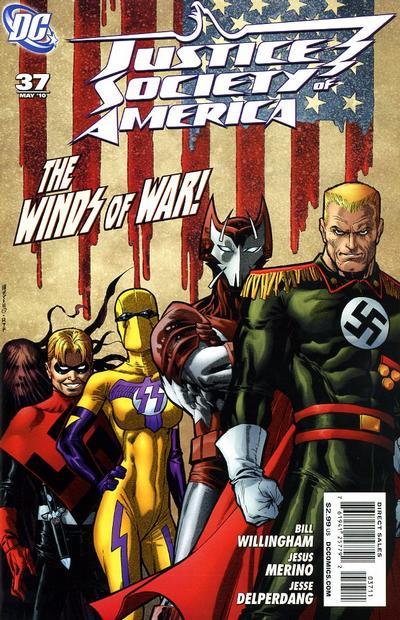 Justice Society of America #37: Twenty years in the future, Mr. Terrific relates the battle of the JSA against the Fourth Reich and how just when victory seemed to be in their grasp, they lost it all. What is unrevealed is exactly how that led to the fall of ALL superheroes, especially as the majority of the villains don't come across as that big of threats. We see Lightning and Mr. America enter the battle but it's Lightning is the one who we see take down an impressive foe with ease. The story then transitions to what the older, depowered and captured heroes are up to and hints at their big plan to set the world aright.
The story comes across as a good old-fashioned piece of fun and fluff. I couldn't help but think of the classic "Days of Future-Past" that told a similar story of older heroes facing extermination try to undo the events in their past/our present that set the world on that particularly dark course. So far, this story doesn't threaten to usurp that one in classic status as that story so easily gave so many iconic yet tragic and bittersweet moments and scenes such as the final charge against the Sentinels. But, the story succeeds in entertaining and providing some good superhero throw-downs with twists along the way even while the reader knows the pre-ordained conclusions. Of course part of that is probably due to the fact it's a title that doesn't require reading a host of other books to understand what's going on, there's not rampant death just to increase body counts or make the books seem more serious and edgy ala Robinson's Cry for Justice and Justice League.
Mr. America's place on this team continues to be a bit of an enigma as he doesn't add one iota of presence. Of the young guns, he should be the one that comes across more strongly and with a certain amount of experience and world-view. He has had formal training and presumably faced some very bad guys as part of the FBI, he already was a professional crime-fighter. He dresses the part of Captain America, but he remains a complete cypher and rank rookie. A bit of that is because it has the same shortcomings listed in the Black Terror book ie there's no real sense of who these characters are outside of the team. A little of that is forgiven in a team book as the focus of characters has to rotate through the larger cast. When you have a book like the traditional JLA, the job is made easier as many characters have their own books and there can be more focus on the secondary characters in terms of subplots and characterizations. Heck, it's part of the reasoning behind having B and C listers joining the teams to begin with. It allows for character growth and subplots without worrying about the events in the solo books.
Kid Karneval is taken out with one punch after a lot of build-up. The rest of the Reich is identified as if they had been seen before this storyline but most of them are just place-holders, we aren't told anything about them (especially as half are based on characters from MLJ and thus have no prior context or continuity to the DCU). In fact, the Fourth Reich is the weakest part of the story. As a group, they aren't threatening, their powers and abilities are not defined. Nor do we see an actual face to this new Reich, who is behind it all. On one side, the story is Mr. Terrific's story, we see it through his eyes. He personalizes the superhero side. We don't really have his opposite number though. We don't know who the villain is that set all of this up, that put together this team (or, how other than being a psychopath, the Kid fits in with the group ideologically). It needs a Red Skull/Zemo/Baron Strucker to stand on the opposite end and serve as the focal point, to be the villain whose plans and desires are the motivating forces for the story, to embody the opposite side. Especially since this is NOT really a story about the evils of Nazism. The villains are Nazis, but that's short-hand here for them wanting to conquer the world, it's not about heroes fighting Nazis per-se. It could be any world conquering type with some super-powered joes at his disposal. Thus the importance of providing the story with a character that embodies what the conflict is about, especially this far in to the story.
Project Superpowers Chapter Two #8: To bring down the mad god Zeus, the heroes that have been at odd purposes combine forces, those that serve the President and through him the Supremacy and those that have set themselves up as bringing down that group and restoring America to the people through creating seeming anarchy. The plan doesn't seem to go very well as characters with their false allegiances are found out or on the cusp of being found out.
There's some great scenes artwise. Salazar's art is steadily improving in quality and clarity in storytelling. I don't know if Ross and Krueger are deliberately aiming for meta-textual commentary, but the revelation by the Green Lama that the heroes of the urn have achieved a near mythic status and possibly may not be able to die could easily be taken as a commentary on the status of the heroes of the 1940s. Due to their public domain status several of them have popped up at various companies and in different incarnations, especially in the last couple of years. Of course other meta-textual concerns pop up across the book such as the pairing of the heroes of Big Shot comics together. It's not a bad idea per se, but no story-logic is given. They have a task to accomplish, some vision to construct a mysterious object that will help defeat Zeus. Which makes a little sense with Marvelo who is a magic hero and Skyman who is a technological/inventive genius. But, the inclusion of the Face doesn't really follow. Likewise we have Lady Satan, the Woman in Red and Masquerade nee Miss Masque are grouped solely because they are women and the use of the color red.1 Or the joining of all the Ace heroes into one group. It's a little cutesy nod to the characters' histories but without providing real story context.
________________________________________
1 Of course, there is a history of the use of the color of red and women in literature and culture. First, it signaled women of a loose sexual nature. By the thirties, there was a pulp called the Scarlet Adventuress signaling by that time the pairing didn't necessarily mean of a sexual nature, but women who didn't conform to the traditionally gender defined standards, mores and roles.

|
